Today I finished my paper and read some the interesting ethnography on Cambodian American communities. I had visited Cambodia and I had heard about the community nearby in Lowell, MA, yet I know nothing of these fellow "Asian Americans." I have a new understanding of the importance of writing on second-generation and third-generation immigrant experiences. Perhaps due to the fact that many people view my identity through a cookie-cutter lens, I used to view generational differences in much starker terms.
Ramy's show Ramy is also part of this process: although generations view their lives, pleasures and difficulties through different lenses, one can still synthesize the two "worlds" with an open heart and imagination. Like Ramy, I have also found it challenging in social situations and rarely said outright that I did not drink, even though I had already stopped.
I also really appreciated the differently abled role of Steve and how he interacted with knowing passive aggressiveness, which reminded me of how some of my Asian American guy friends talk with me as well. Some people seem to have had problems with how much the females in the show are interacting with their sexual identities; for me, it is relatable to see people to explore their desires, even if most people viewed them as "undersexed." (Steve included.)
It also takes a lot of courage to commit to creative work, such as ethnography or a show like Ramy. Walid said before, in an endearing way: I like saying that you are Chinese, because anyone can become "American," but not everyone can be "Chinese."
Between writing my paper, I also heard some of the good news from Liverpool. I did not expect that my team would win, let alone by such a huge margin. I joked later that Mohamed Salah did not even have to appear on the field for Liverpool to win.
The clouds gathered as I waited for the bus; I gave up and walked instead. The rain started just before my Zumba class.
Our instructor Karen told us about her upcoming marriage and possible change in schedules. I felt surprised and happy for her. Today's class was longer and we were all sweaty by the end. She told us that to feel certain songs, which is totally different with how I approached most media as a historian. Towards the end, I really felt one of the beats and pulled it off.
Walid and I met at 9pm, Downtown Crossing, while I was reading about Donald Glover's baby momma and how it created some controversy. Walid and I embraced very longingly. When I complained that I was thirsty, he showed the banana he brought me and told me about his Somali iftar at his new neighborhood mosque.
He was served by other men and had eaten everything with his hands like a good sport. Prior to dinner, he compared the prices of food at the neighborhood supermarkets and found them to be not much cheaper than prices in New York. I also complained that at least NY places give one a sense that they are family businesses, whereas the chain stores of Boston do not bring down the prices as much as one would expect.
While we were waiting for the T, a queerly dressed man, cowboy hat in tow, started passing comments to everyone he saw. He said to us, "You two should get married!" We replied as he walked by, "we're already married!" which made him feel slightly sheepish. Walid was very happy that even strangers could see how much in love we were.
Walid also called many of his relatives today. He passed on the greetings of his cousin, who studied as a pharmacist and said "say hello to your beautiful wife." <3 We returned home and watched the lo-fi version of Patriot Act on the mattress "scam" and discussed which mattress we should buy next.
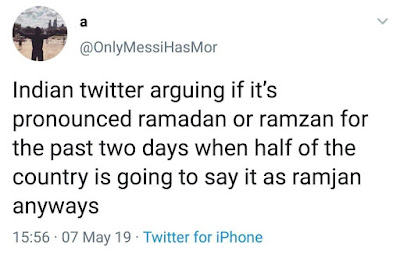
Finally, a funny desi joke my friend Aaron sent to me!
Ramy's show Ramy is also part of this process: although generations view their lives, pleasures and difficulties through different lenses, one can still synthesize the two "worlds" with an open heart and imagination. Like Ramy, I have also found it challenging in social situations and rarely said outright that I did not drink, even though I had already stopped.
 |
| Still from Ramy, with his parents |
It also takes a lot of courage to commit to creative work, such as ethnography or a show like Ramy. Walid said before, in an endearing way: I like saying that you are Chinese, because anyone can become "American," but not everyone can be "Chinese."
Between writing my paper, I also heard some of the good news from Liverpool. I did not expect that my team would win, let alone by such a huge margin. I joked later that Mohamed Salah did not even have to appear on the field for Liverpool to win.
 |
| Walid told me that Salah wore a T-shirt that said "Never Give Up." I had already given up! |
The clouds gathered as I waited for the bus; I gave up and walked instead. The rain started just before my Zumba class.
Our instructor Karen told us about her upcoming marriage and possible change in schedules. I felt surprised and happy for her. Today's class was longer and we were all sweaty by the end. She told us that to feel certain songs, which is totally different with how I approached most media as a historian. Towards the end, I really felt one of the beats and pulled it off.
Walid and I met at 9pm, Downtown Crossing, while I was reading about Donald Glover's baby momma and how it created some controversy. Walid and I embraced very longingly. When I complained that I was thirsty, he showed the banana he brought me and told me about his Somali iftar at his new neighborhood mosque.
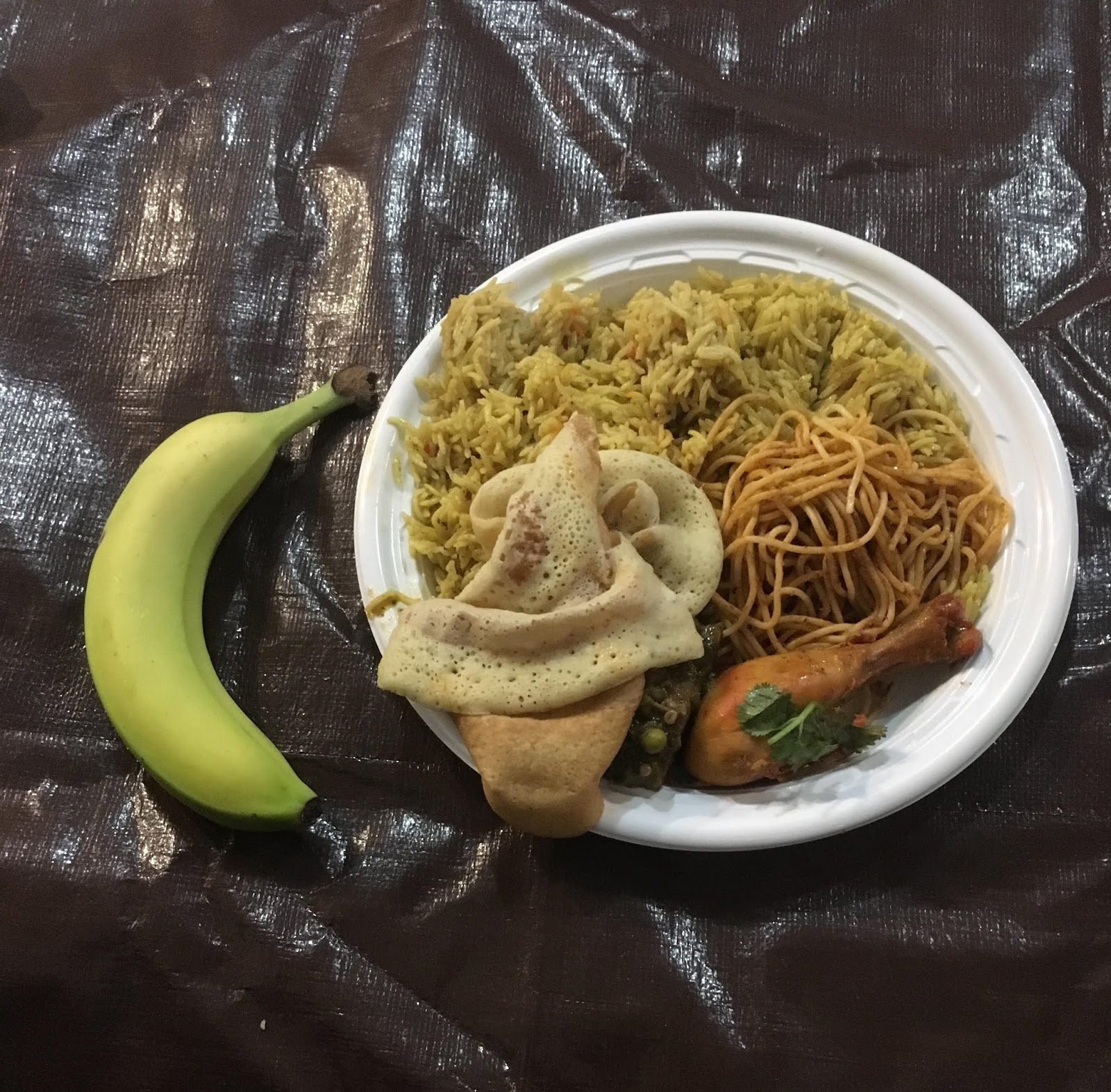 |
| Walid's dinner |
While we were waiting for the T, a queerly dressed man, cowboy hat in tow, started passing comments to everyone he saw. He said to us, "You two should get married!" We replied as he walked by, "we're already married!" which made him feel slightly sheepish. Walid was very happy that even strangers could see how much in love we were.
Walid also called many of his relatives today. He passed on the greetings of his cousin, who studied as a pharmacist and said "say hello to your beautiful wife." <3 We returned home and watched the lo-fi version of Patriot Act on the mattress "scam" and discussed which mattress we should buy next.
Finally, a funny desi joke my friend Aaron sent to me!

