إظهار الرسائل ذات التسميات ethiopia. إظهار كافة الرسائل
إظهار الرسائل ذات التسميات ethiopia. إظهار كافة الرسائل
الخميس، 28 أبريل 2022
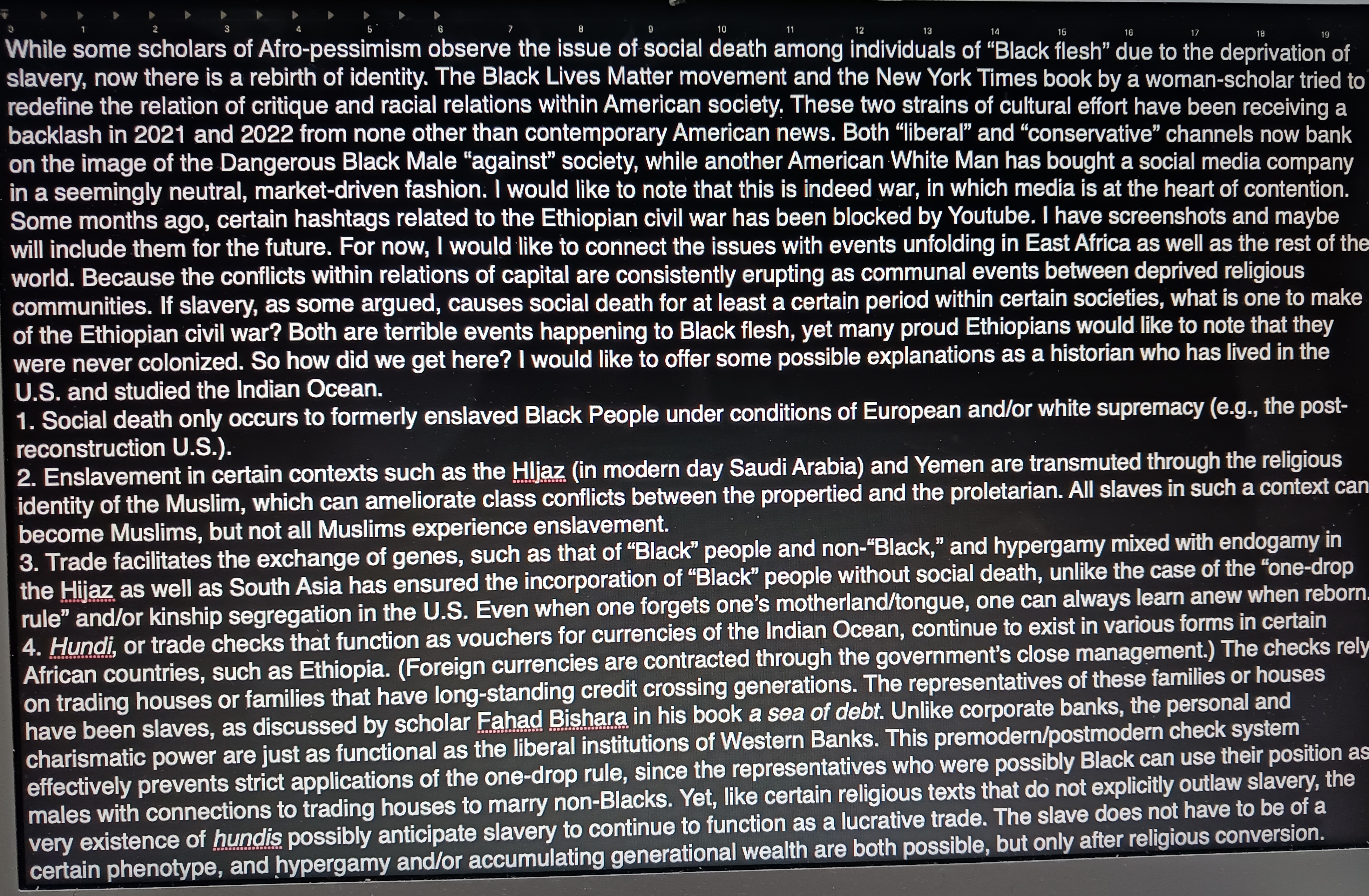
Rebirth of Black Life, Ethiopia and the Indian Ocean

الخميس، 31 ديسمبر 2020
Diaspora and Development
While reading a book about water management in Yemen, I was surprised to learn that 6 centuries ago, people from Yemen were migrating from the Hejaz to what is present-day Ethiopia due to ecological distress. I also read about the Rashaida tribe (aka “Bani Rashid”) which followed a similar migratory pattern a hundred and fifty years ago in a large-sized coffee table book at the St. George Art Gallery. They currently live on the coastal areas of East Africa.
This question about the survival of the Yemeni people has haunted me since I have been following the heart-wrenching developments of the civil war. Many organizations focus on the lack of humanitarian intervention into this region from developed nations. Yet much less is discussed about the relationship between Yemen and Africa at large. The latter is considered relatively undeveloped, but provides assistance nonetheless through economic networks.
“Diaspora” has a complicated relationship with the nation-state. As Yemen strives to define its identity as a nation-state, with the Southern Transitional Council vying for prominence and calling for political autonomy, the survival of the diaspora is also a worthy subject of discussion a humanitarian and academic perspective.
Yemeni restaurants dot the urban spaces of Djibouti and Addis Ababa. The restaurants are generally popular among the upper-middle class of these respective cities. The restaurant-goers consume Yemeni culture in its aesthetics and food alongside a sense of Islamicate culture, such as designs of Yemeni architecture.
 |
A rather elaborate version of Yemeni fish. Source: internet |
The menu includes lamb as well as Yemeni fish, which is usually baked and served on a flat and dry surface. The restaurant "Bait al Mandi," located in the embassy-dotted Heron area of Djibouti, even had a French menu. This menu signified the class of the targeted clientele. As I ate in the "Al Pasha" restaurant, which is located in the former colonial space of Djibouti, a high ranking Djibouti military officer also was eating lunch to my left, as well as 4 abaya-wearing girls to my right. The girls self-consciously switched to communicate in French when they joined my table. The buffet at the up-scale Kempinski Hotel, near the shoreline, costs 45 dollars a person. This buffet also included the item of Yemeni fish. Through culinary heritage, Yemeni people find a way to maintain their economic independence through the upper echelons and aspiring classes of (Islamicate) Africa, without any handouts from (non-Muslim) developed nations.
This trend of perceptions of a certain diaspora, which differs from the way English media portrays them, also follows a China-related observation. Western development agencies pioneered the foreign presence in East Africa. Their buildings are usually gated and guarded with barb wire. Their cars are usually very clean and up-to-date in comparison with the dusty and slightly run-down city buses common people use for transportation. The general vibe of these agencies toward the area seems optimistic but also condescending, since their presence has been felt for decades. In contrast, China’s presence feels much more pragmatic: profit is the name of the game and hardcore construction capital accumulates, instead of the other abstract notion of “development.” While China also engages with similar efforts of development, such as poverty alleviation and disease preventions, other sectors do not shy away from the business element of China’s involvement in Africa. In Ethiopia, furthermore, many of the tiles on the street are distinctly from mainland China. To trace it even further back, Addis Ababa has socialist architecture harking back to a different type of internationalism than the current one led by development agencies. Yet development agencies and mainland China-led initiatives both share a secular bent and an emphasis on financial accountability. The ethical aspect of accountability and sociability can easily be lost in translation during the search for construction and development.
Both the China population and Yemeni diaspora do not fit in the dominant literature on foreigners in East Africa, and thus have drawn my attention. This article has discussed their presence in terms of urban consumption as well as racial identity. After the abolition of slavery in most parts of the world, the evolving identities of “Africa” can be indicated not only through skin or tribe, but also capital. Though capital accumulation is intertwined with racial identity around the globe, the native-foreign relationship cannot be distinctly drawn alongside the binary of exploitation. While welcoming populations seeking refuge such as the Yemeni people, nationalism is alive and well alongside capitalism in East Africa. As the PM of Ethiopia calls for importing more “zero-zero” standard of new cars instead of used cars from abroad, the role of the Chinese and other non-Ethiopian diaspora will need to find a new way of continuing their commercial relationship with Ethiopia.
السبت، 31 أكتوبر 2020
Some East African History from My New Friend
It has been 10 days since I arrived in Djibouti. It is 30+ degrees celsius here and I do not leave the indoors much in the daytime, which gives me time to ruminate and read. The currency here is the Djiboutian Franc and there are usually power-outs every week.
Much has happened though I will focus on one individual. I have met a Somali-Canadian gentleman here whose name is Sahal Ali. He invests in agricultural products in the countryside. While staying at the same hostel, we are lucky enough to hear the azaan every day from the neighboring mosque. The man who conducts the azaan is very good. Coincidentally, I am also reading a book about Africa and the Indian Ocean World, which traces the spread of trade in these two regions as well as the proselytization of Islam. My new friend Sahal Ali also helps with my understanding of the religious-cultural terrain. Upon learning about my research interests, he has shared photos of his travels to a museum in Massawa, Eritrea. The city of Massawa, like Djibouti, is a a historically important port that hosted traders of varied ethnicities, many of whom were Muslim. The Ottomans also had official ties with the Emirs, one of whose name is Emir Abdullah (not to be confused with the Hashemite Abdullah of the Arab revolt). Sahal Ali knows one of the traders of cultural artifacts in this town and has said that the trader owns a copy of a 9th-century Quran. I wonder if it is for sale or just for show and tell.

1935 photo of Massawa Bazaar. Source: journalist Martin Plaut
Sahal also has a very interesting background. He traveled to Canada to pursue his studies in 1991 when he was 16 years old. He learned French and settled in Ottawa for work--he translated and processed immigration applications. Perhaps that explains his friendly attitude and organized demeanor. I said I have always wanted to visit Toronto because of its diverse inhabitants. He has some relatives in California as well.
He became bored of the job after 18 years and also faced many Islamophobic harassment due to his name, which was "Ali." He also found that the Canadian government tried to pass citizenship laws that infringed upon the rights of his second-generation children: a certain law (I am not sure if it passed or not) stipulated that if second generation Canadians commit a crime in Canada, they faced deportation.
He decided to move back to where he was born. Many of his colleagues and friends found his decision to be ridiculous, but so far things have gone well until the shutdowns related to the coronavirus pandemic occurred. Sometimes he visits Canada as well and drives for a smart-phone app car service. When white men board his car, he asks them where they are from. First they are usually puzzled, but after his insistence and explanation ("I am always asked where I am from"), they tell him that their grandfathers or fathers came from another country. He felt satisfied in knowing that white Canadians also come from elsewhere, though the laws and social culture may inadvertently benefit them more.
His father used to live in the Somali area of Ethiopia as well, which gave him a unique perspective about the country. He criticized the old regime for colonizing Somali land and pushing for Ethiopian supremacy, but finds that now the politics is more balanced, since a Somali can become a president of Ethiopia (which I assume was not the case before). He is amazed that Ethiopia did not manage to occupy a place with a port after many years of dominance in the region. I said I did not know much about these events before, and I only read about the Ottoman participation at the Berlin conference (1884–1885), which was an international conference regulating the Scramble for Africa and her resources. Sahal said that Ethiopia delegates also participated at this conference, though I have yet to find a written source to confirm this statement.


الاشتراك في:
الرسائل (Atom)