‏إظهار الرسائل ذات التسميات Egypt. إظهار كافة الرسائل

السبت، 7 أغسطس 2021

Egypt's minorities and the history of the Fatimid State

review of 


The opening of the book perhaps sets it up for a historical misunderstanding. Muslims are by default "arab conquerors," despite the histories written about the civilizing missions of Ismaili dais, who later founded the Fatimid dynasty. Simply put, Muslims were once civil minorities as well, who did not come to Africa merely as conquerors. The Fatimid state has a curious similarity with the current Egyptian state in terms of how it relates to minorities--make the elites among Copts and Jews part of their social legitimacy. (Jews-- not so much in today's Egypt.) If we keep this continuity theme in mind, then the idea of "religious minority" in Egypt is different than the "Jewish" in Europe problem, posed by Dr. Saba Mahmood in her book at the very beginning, within the context of Marx's "Jewish Question." Jewish people in Europe were never elevated to the status of Fatimid-era Copts. There is even a book which discusses the violent nature of European states in the 16th century and the connection with the roots to the Holocaust by another author, but I have not read that book. Mahmood highlights the challenges faced by judiciaries in both Europe and Egypt in the 20th century, yet does not delve into the social contracts of the Fatimid state. Minorities can indeed hold power amongst themselves, ruling over the sha'ab (non-elite classes of people).
Secondly, the changes and ruptures she notes about the Coptic community is interesting, which I am not too familiar. Yet the minority status-as-marginalization is not really a historically rooted one, even if Copts were persecuted by the Byzantines. The Fatimids, again, were also not welcomed in Egypt in the beginning. They faced challenges by the populace, both Muslim and otherwise. The Fatimids gained authority without socio-cultural hegemony in some periods. Among the regular non-ruling class Muslims, many did not accept the infallibility / authority of appointed Ismaili imams and some also saw the business-missionizing aspect of Ismaili'ism as dubious. The question of rule was shaky even for Fatimid Muslims when they gained the seats of power, who ostensibly shared the faith of non-Ismaili Muslims in Egypt. Mobs harassed representatives of the state, showing how the process of conversion was uneven and shaky.

The author rightly points to differing policies toward minorities between Ottomans and Mamluks; however, that later stage of Sunnification in Egypt (e.g., the co-optation of Al-Azhar which was founded by Ismaili'is) is not sufficiently explained in her opening chapter. Those who are inclined to view Egypt's history dynastically may be more accepting of her periodization.  

The Baha'i faith, which she explored later in the book, also poses a similar question. Since the founder regarded their revelation as temporally continuous with The People of the Book (Jews -> Christians -> The House of Muhammad -> Shi'a Muslim imams -> Bab), rather than an a priori difference from the beginning of Time. This tension is left unexplained, perhaps for the purpose of her argument.

I am using the term Ismaili from a modern perspective as well, which needs some qualifications. for those who are not familiar with the history. Dr. Khalil Andani has a wonderful Zoom lecture on this subject for those who are interested:


الاثنين، 12 يوليو 2021

راديو اليمن: جلب التراث الموسيقي الثري لجنوب شبه الجزيرة العربية إلى مصر

 راديو اليمن: جلب التراث الموسيقي الثري لجنوب شبه الجزيرة العربية إلى مصر

تعد الموسيقى والأزياء اليمنية التقليدية ، التي تعلوها العود اليمني المعروف باسم الطربي ، من بين أبرز ما تم تشكيله حديثًا في الفرقة

عطي متولي ، السبت 5 أكتوبر 2019


راديو اليمن


على مدى السنوات القليلة الماضية ، تصدرت اليمن عناوين الصحف بسبب الاضطرابات السياسية والأزمات الإنسانية. لجأ قسم كبير من السكان إلى البلدان المجاورة ، واستقر بعضهم عبر شبه الجزيرة العربية ، بينما اتجه البعض الآخر إلى أركان العالم الأربعة. وبالمثل ، أصبحت مصر موطنًا للعديد من الأفراد والعائلات اليمنية الفارين من الحرب والمجاعة.


في سيل الأخبار عن وضع اليمنيين في بلدهم ، غالبًا ما نتغاضى عن الثقافة الغنية التي يحتفظون بها ، قرونًا من التراث المغلف بالهندسة المعمارية والفنون والموسيقى. في حين أن العديد من الكنوز الثقافية لا يمكن نقلها ، فإن الموسيقى هي التي لديها القدرة على التحرك عبر الحدود السياسية والجغرافية ... في الواقع منذ أبريل الماضي ، تم نقلها إلى عتبة دارنا ، مع فرقة راديو اليمن.


في غضون بضعة أشهر قصيرة ، قدمت راديو اليمن عروضها للجمهور في العديد من الأماكن الفنية والأماكن الحميمة في جميع أنحاء القاهرة ، ساحرة بالموسيقى اليمنية الجمهور المتزايد بشكل متزايد ، سواء من الشتات اليمني أو من السكان المحليين الذين رحبوا بهذا المسعى المثير للاهتمام.


"راديو اليمن هو فرقة غير تقليدية للغاية تعزف موسيقى تقليدية للغاية مع لمسة. مهمتنا هي إعادة إنشاء هذه الأغاني القديمة من كل من شمال اليمن وجنوبه ومشاركتها مع جماهير جديدة في جميع أنحاء العالم ، ونقل الموسيقى اليمنية إلى مراحل أكبر وأكبر "، بحيث يقدم الموسيقيون أنفسهم على صفحة الفرقة على Facebook. 


لكن الأمر الأكثر إثارة للاهتمام هو أن راديو اليمن لا يلمس حواسنا السمعية بموسيقى فريدة فحسب ، بل يوفر أيضًا متعة بصرية ، حيث يرتدي الموسيقيون خلال الحفلات الموسيقية الأزياء اليمنية التقليدية.


جديد ، جديد ومليء بالعاطفة ، بعيدًا عن الوطن ، ومع ذلك احتضنه جمهوره المحلي بحرارة ، تمكن راديو اليمن من اتخاذ خطوات كبيرة في وقت قصير جدًا. لم يمض وقت طويل على لقاء الفنانة المصرية زينب أبو طالب بالموسيقي اليمني المقيم في القاهرة محمد الحجري في ما اعتقدوا أنه سيكون مجرد تبادل ودي للأفكار الإبداعية.


 تتذكر أبو طالب كيف أن اهتمامها بالموسيقى اليمنية وجهها إلى الحجري ، عازف عود يمني: "التقينا قبل عامين ونصف فقط". هي في الأصل خريجة كلية الطب في القاهرة وطالبة سابقة في بيت العود ، أبو طالب هي أيضًا مغنية بارزة مع عروض محلية وإقليمية للموسيقى العربية التقليدية ، الموشحات والمواويل ، وعدد من الجوائز باسمها ، بما في ذلك واحدة لأداء منفرد لأغنية زي العسل لصباح في مهرجان فنون الجامعات (2003) وأخرى في 2009 لأداء منفرد لأغنية "العشق" لأم كلثوم.


راديو اليمن

زينب أبو طالب ومحمد الحجري من راديو اليمن (الصورة: بإذن من راديو اليمن)


في اكتشافاتها الإبداعية ، تواصل تحدي نفسها بمجموعة متنوعة من النكهات الجديدة ، منتقلة من التراث المصري إلى التراث الهندي ، وحتى الكوري. عندما وصلت أبو طالب إلى موسيقى الخليج العربي ، أدركت أنه يجب عليها أولاً معالجة الثقافة الموسيقية اليمنية لأن الأخيرة أثرت بشدة على المنطقة بأكملها. مع نمو شغفها ، بدأت في الاقتراب من أفراد المجتمع اليمني ، وكوّن العديد من الأصدقاء في الطريق.

"وجهتني صديقة إلى الحجري" ، كما تكشف ، مضيفةً كيف أن لقاءاتهما الأولى تألقت بالإبداع ولغة فنية مشتركة ، وكم تعلمت من تلك الاجتماعات وكم استمتعوا باللعب معًا. في ذلك الوقت ، قام الثنائي ، غير مدركين لما كان يحدث ، بزرع البذرة الأولى لإذاعة اليمن.

Al-Hejry performing in Cairo


يشرح الحجري قائلاً: "لقد غادرت اليمن منذ أربع سنوات ونصف ووصلت إلى مصر منذ ثلاث سنوات ونصف" ، ولفت انتباهي إلى دقة الثنائي بقيمه نصف السنوية. ويضيف أنه في العام بين مغادرة اليمن والاستقرار في مصر ، جرب حظه في إندونيسيا وماليزيا ولبنان وعُمان ، لكنه شعر براحة أكبر لدى وصوله إلى مصر: "رغم أنني بعيد عن منزلي وعائلتي ، أشعر وكأنك في المنزل هنا. الناس في غاية السهولة والترحيب ".


بدأ الحجري مسيرته الموسيقية في اليمن كعازف عود وملحن. تشمل محفظته العديد من العروض عبر مجموعة متنوعة من المنظمات والسفارات والفنادق في صنعاء ، وظهوره خلال TEDx. تم استخدام إحدى مؤلفاته كموسيقى خلفية لفيلم من إنتاج الصليب الأحمر اليمني. وبما أنه ، كما يكشف الحجري ، لا توجد معاهد عليا لتعليم الموسيقى في اليمن ، فقد اكتسب مهاراته ومعرفته من زملائه الموسيقيين والموارد عبر الإنترنت.


ومع ذلك ، لم يتماشى اهتمام هجري الموسيقي مع آراء عائلته حول ما يجب أن يفعله "الرجل المناسب" للعيش.

ويوضح الحجري أن اختياراته كلفته الاغتراب عن الأسرة وأصوله. وجد مجتمعه الخاص من العقول المبدعة. كما أنه كان وحيدًا عندما غادر اليمن وجاء في النهاية إلى مصر.


"كنت مصمما على دراسة الموسيقى في القاهرة لذلك التحقت بالمعهد العالي للموسيقى العربية. لقد ركزت على الدراسة ولم أؤدي حتى اجتاز طريقي عروض زينب "، يوضح مشيرًا إلى عروضهم الأولى في مقهى صغير ، حيث بدأت حفلاتهم الموسيقية نصف الأسبوعية تثير اهتمام العملاء. "هذا عندما فكرنا في إنشاء مشروع من شأنه تعزيز التراث الموسيقي اليمني ، إلى جمهور أكبر."


يضيف أبو طالب أنه سرعان ما انضم إليهم أصدقاء يعزفون الموسيقى: عازف الطبلة (الدربوكة) المقيم في القاهرة مارشال بوديكر من الولايات المتحدة الأمريكية وعازفة متعددة الآلات تؤدي على الطبلة في الفرقة ، ماريا ك.


"لم نقصد إنشاء فرقة متعددة الجنسيات ، لقد حدث ذلك للتو. ربما كان الأمر أسهل في ذلك الوقت: أربعة منا يعزفون الموسيقى اليمنية ، وندمجها مع الموسيقى والإيقاعات المصرية ، ونستمتع بأزياءنا اليمنية ... "ما يعتقده أبو طالب بأنه مزيج عفوي قد أكد في الواقع على تفرد راديو اليمن.

ومن المهم أيضًا الإشارة إلى أن الحجري يعزف على العود المصري والعود اليمني التقليدي المعروف باسم الطربي. على عكس العود المصري ، الذي يتخذ شكل الكمثرى ، فإن الطربي له قوام أرق من الخشب ومغطى جزئياً بالجلد.

 يعد صوت التربي عنصرًا مميزًا في موسيقى صنعاء (أحد التقاليد الموسيقية اليمنية الرئيسية) ، وهو فريد جدًا بالنسبة للعروض الفردية ، ويخلق ظلالًا جميلة مع آلات أخرى مثل الجيتار.

مع صفاته الفريدة من نوعها على طول الطريق ، يتم إدارة راديو اليمن من قبل كل من أبو طالب والحجري اللذين يتشاركان المسؤوليات الفنية والتنظيمية للفرقة. كما يشرح الحجري ، فهو وراء اختيار العديد من عناصر الذخيرة التي تضيف إليها بوطالب صوتها الفني المهم ، وتتصدرها بوعي أفضل بالأماكن التي يمكن أن تؤدي فيها إذاعة اليمن.

يطلعني الحجري باختصار على ذخيرة الفرقة ، بدءًا من الإشارة إلى أربعة ألوان رئيسية للموسيقى اليمنية ، والتي تؤديها إذاعة اليمن: "أولها غناء وموسيقى سنان (المرتبطة بالعاصمة اليمنية) ، وهي أقدم تقليد غنائي في اليمن. البلد وشبه الموشح. والموسيقى الحضرمية الأخرى: بها الكثير من الأنماط الإيقاعية المتأثرة بتلك الموجودة في إفريقيا والهند ، وهي قريبة من موسيقى الخليج العربي. موسيقى لحجي مبهجة للغاية في إيقاعاتها وألحانها بينما الموسيقى العدنية ربما تكون الأقرب إلى قلوب المصريين لأنها استوعبت الكثير من التراث الموسيقي المصري وكذلك الهندي: ثقافة منفتحة للغاية ".

Faisel Alawy


من بين أهم ما يميز ذخيرة راديو اليمن مقطوعات تمثل كل لون من ألوان الموسيقى اليمنية.

 تغني الفرقة يا ذا تبون الحسيني لفيصل علوي (موسيقى لحجي) ،
 والحب والبون (حب وقهوة) لعلي العنسي 
 وباشل حبك معي لأبو بكر سالم (حضرمي) ،
 ومحل ما يا إجباك لمحمد سعد عبد الله (عدني).
 بالإضافة إلى الذخيرة اليمنية ، تضيف الفرقة أيضًا بعض التراث المصري وستكشف قريبًا عن التكوين الأصلي في حفل موسيقي في ساقية الصاوي في 20 أكتوبر.

 
محمد سعد عبد الله (عدني).


"نأمل أن ننمو بينما نحاول جذب جمهور أكبر والمزيد من الوسائط إلى حفلاتنا الموسيقية. نحن نروج للتراث الموسيقي لليمن ، ونظهر أن هذا البلد الجميل لا يتعلق فقط بالحرب والأزمات الإنسانية. لدينا رسالة قيم تمتد لقرون لكي ننشرها ؛ قال الحجري وهو يسجل الاهتمام المتزايد بالفرقة ، "إنه شغفنا ولكنه أيضًا مسؤولية كبيرة".

وبدعم من الحجري ومشروع إذاعة اليمن ، يبدو أن بوطالب قد وجدت دعوتها. بتواضع لاستقبال الجمهور ، تأمل أن تفعل المزيد. "آمل حقًا أن يصل راديو اليمن إلى ما وراء مصر. علينا تعزيز الثقافة اليمنية لثروتها وجمالها. إنها ثقافة قريبة جدًا من قلوب العديد من الدول ، وتتردد صداها جيدًا بالتأكيد في مصر ، "كما تقول ، مضيفة أن" العديد من الأشخاص والهيئات ساعدت إذاعة اليمن على النمو ، بما في ذلك ملوك السعيده للملابس التقليدية التي تقدم أزياء للفرقة. وأحمد محمد سكران ، المدير العام لاستوديو فايب لتطوير الفنون حيث نجري معظم التدريبات. "

مع كل الشغف والعمل الجاد ، من الممكن جدًا لإذاعة اليمن أن تحقق أحلامها قريبًا.


السبت، 31 أكتوبر 2020

Some East African History from My New Friend

It has been 10 days since I arrived in Djibouti. It is 30+ degrees celsius here and I do not leave the indoors much in the daytime, which gives me time to ruminate and read. The currency here is the Djiboutian Franc and there are usually power-outs every week.

Much has happened though I will focus on one individual. I have met a Somali-Canadian gentleman here whose name is Sahal Ali. He invests in agricultural products in the countryside. While staying at the same hostel, we are lucky enough to hear the azaan every day from the neighboring mosque. The man who conducts the azaan is very good. Coincidentally, I am also reading a book about Africa and the Indian Ocean World, which traces the spread of trade in these two regions as well as the proselytization of Islam. My new friend Sahal Ali also helps with my understanding of the religious-cultural terrain. Upon learning about my research interests, he has shared photos of his travels to a museum in Massawa, Eritrea. The city of Massawa, like Djibouti, is a a historically important port that hosted traders of varied ethnicities, many of whom were Muslim. The Ottomans also had official ties with the Emirs, one of whose name is Emir Abdullah (not to be confused with the Hashemite Abdullah of the Arab revolt). Sahal Ali knows one of the traders of cultural artifacts in this town and has said that the trader owns a copy of a 9th-century Quran. I wonder if it is for sale or just for show and tell. 

1935 photo of Massawa Bazaar. Source: journalist Martin Plaut


Sahal also has a very interesting background. He traveled to Canada to pursue his studies  in 1991 when he was 16 years old. He learned French and settled in Ottawa for work--he translated and processed immigration applications. Perhaps that explains his friendly attitude and organized demeanor. I said I have always wanted to visit Toronto because of its diverse inhabitants. He has some relatives in California as well.

He became bored of the job after 18 years and also faced many Islamophobic harassment due to his name, which was "Ali." He also found that the Canadian government tried to pass citizenship laws that infringed upon the rights of his second-generation children: a certain law (I am not sure if it passed or not) stipulated that if second generation Canadians commit a crime in Canada, they faced deportation.

He decided to move back to where he was born. Many of his colleagues and friends found his decision to be ridiculous, but so far things have gone well until the shutdowns related to the coronavirus pandemic occurred. Sometimes he visits Canada as well and drives for a smart-phone app car service. When white men board his car, he asks them where they are from. First they are usually puzzled, but after his insistence and explanation ("I am always asked where I am from"), they tell him that their grandfathers or fathers came from another country. He felt satisfied in knowing that white Canadians also come from elsewhere, though the laws and social culture may inadvertently benefit them more. 

His father used to live in the Somali area of Ethiopia as well, which gave him a unique perspective about the country. He criticized the old regime for colonizing Somali land and pushing for Ethiopian supremacy, but finds that now the politics is more balanced, since a Somali can become a president of Ethiopia (which I assume was not the case before). He is amazed that Ethiopia did not manage to occupy a place with a port after many years of  dominance in the region. I said I did not know much about these events before, and I only read about the Ottoman participation at the Berlin conference (1884–1885), which was an international conference regulating the Scramble for Africa and her resources. Sahal said that Ethiopia delegates also participated at this conference, though I have yet to find a written source to confirm this statement.


These days the Ethiopian government is finishing a dam on the Nile river, which has been under construction for 7 years, and the Egyptian government has expressed their discontent. Sahal said that it is too late for their intervention; and anyways they constructed the Aswan dam a long time back. Though the rhetoric is heated and sharp, Sahal does not think any serious conflict will happen. He also finds that American politics to be "bizarre," though the cyclical nature of ideologies will inevitably backfire against the extreme posturing of the leader today. I admired his eloquence and calm attitude in discussing these matters. He said that Africans do not get aggressive easily when expressing their opinions. Perhaps it is because of the qat-chewing that keeps everyone in their cool. In any event, it is a nice intellectual detour for me from the otherwise brain-wracking scene of American politics.


الأربعاء، 17 يوليو 2019

Art Project on White(-passing) Privilege


As I am interacting with more and more immigrants in the East Coast, some common themes emerge: 1) peer group competition; 2) relative access to white privilege. It is partly due to the fact that we do not have access to many resources in general. Thus, we often appeal to our ethnic communities and are aware of how each person survives in white-supremacist America. But people who can sometimes pass as white also access that form of white privilege or white-passing privilege. This is an art project that has been born out of these themes.

From Wikipedia 
White privilege (or white skin privilege) is the societal privilege that in some countries benefits white people over non-white people, particularly if they are otherwise under the same social, political, or economic circumstances. 
One person who exercised white privilege while also claiming ethnic membership, for example, is Mahmoud "Al-Astoria". The last name is not his real last name since I have decided to take into account that he was once a friend of my partner Walid. Walid does not want to disclose his last name.
He uses his ethnic resources as well as his ability to pass as white to leverage his road to success in America. Such contradictions have led to many people's cynicism in regards to the label "people of color." I still find this label useful for progressive political mobilization, and hopefully, this project can keep some of the people in this community accountable.


Adrian Qian. "Certificate #1." Digital Media. 2019.

Thus, I have written this certificate to convey my dismay at such survival practices, since I am a person of color who will not pass as white in all visual interactions. (My voice, on the other hand, with its East Coast accent, can pass as white.) I also acknowledge the fluidity of race, and thus I do not invoke any authority on this subject other than my personal name in the certificate.

This is also subject to context because not everyone wants to have the white-passing privilege. In the Arab American context is it especially important to talk about this aspect because 1) some white(-passing) Muslims have dominated discussions on Islam in America and 2) there are some Arab immigrants who use the N-word in conversations. My professor, who is Lebanese American, has also used the N-word in class. One of my classmates voiced her concern with her peers, but I do not think any other steps were taken.

This documentary "Not Quite White" by Jamil Khoury is also useful for understanding the long historical process of Arab American identity formation.


Some personal factors are also involved in making this certificate, and some of you may detect my spite. Simply, Mahmoud decided to invite us over for lunch. We traveled 5 hours from Boston and was 20 minutes late. He ended up ditching us altogether and was spotted eating lunch instead at Walid's old workplace in Astoria, NY.

الجمعة، 7 يونيو 2019

Ramadan 2019: Day 25 - Eid al-Fitr

I will skip writing about some days, partly because I am lazy, and partly because I want to discuss the feelings of the end right now. I usually did not have a lot of opportunities for making meaning with others in previous endings of school or relationships. Eid is very special in that sense because it is a public celebration of the end of an intimate matter related to the body and soul. Astrology appeals to me for the same reason, because some humans become aware of the lunar calendar and celestial order through astrology as well. The lunar calendar of Chinese Han culture did not make a very deep impression on me prior to the discovery of Islamic months and astrology.

On Day 24, Khalid, Walid's brother, called us and Walid told him about my day of fasting. Khalid has two sons, who are very cute in their different ways. He recently went through a divorce, and I was curious to see that he was still wearing his wedding ring. He reminded me of my parents' experiences, even though I know very little of either case. He asked if I was happy being with Walid, and I said sometimes. He said it's ok, we are also only sometimes happy with Walid. I enjoyed his self-deprecating humor and openness to my emotions. He told us that he was learning English because he wants to communicate with me when I visit their house.


Day 25 Thursday

Stills from the film Shadow Play (2018) directed by Lou Ye
In the afternoon, I watched a Chinese thriller film, The Shadow Play. The Chinese name of the film is also adapted from a famous Mandarin song, "there is a cloud made up of rain, floating in the wind." The Taiwanese woman A-yun, whose name means cloud, made a fortune in mainland China during the prime years of her youth. Her untimely death despite her wish to return to Taiwan also reminded me of the lack of ritual that can mediate my coming and going from mainland China to the U.S. In contrast, I really appreciate the different Islamic ways of mediating different forms of existence and relationships to place, such as the verse read before traveling.


Afterward, I went to the big mosque because Walid told me that there would be fish in the evening. I sat at my usual corner and continued to read Empire of Guns. It was my first time visiting there without wearing a hijab. Walid later introduced me to his co-worker's fiancee, who is a practicing convert. She told me that the mosque during Night of the Decree (laylat-ul-qadr) was fully packed. We both were curious about each other and talked for over an hour. She started her studies in Boston last year and lived along the green MBTA line. I also met one of her friends, a student from Turkey. But in the end, the curiosity seemed to be largely intellectual and felt like fieldwork. She did not seem to have had many Asian American friends and was surprised that I could be both Asian American and Han Chinese. It is also partly due to the fact that fewer women of color engage in the public sphere. She seemed to be self-conscious about her origins and her single-parent mother, as was I. I congratulated her on Eid in advance because I knew I would not see her before then. The fish was a little bland but I was grateful for the free food.


Day 26 Friday - Eid al-Fitr (Tuesday for some, Wednesday for others)

On Saturday, Walid and I bought some more food and a blender from C0stco. He thought he might give the soon-to-be-wed couple a blender as a gift as well.

I received my first issue of the International Journal of Middle Eastern Studies in the mail today. I joined their membership recently because I will present at the upcoming conference in New Orleans. I was very happy to read Dr. Max Weiss's article, which called for critical Ba'ath studies, rather than reproducing the "war-mongering" rhetoric of the post-2003 era.

On Sunday, I watched an interesting video about feminine energy. Walid and I walked to the park nearby to bathe in the sunlight and I tried to discuss some of my spiritual goals in life. He and I talked, looked at animals and also heard some children play nearby. He also climbed a tree, which I thought was quite cool and funny.

During the following days, Walid and I continued to have conflicts over our interpersonal relationships. We ate his last iftar together and he sang an Arabic song jokingly, that said, "I wish Ramadan was longer." I mourned June 4th, which was the 30th anniversary of the Tiananmen Massacre. Walid celebrated Eid with the mosque community while working on that day. He started work at 5am for necessary preparations. He met Omar, from Taha collective, and wrote a Faceb00k post about it. The other people from Taha collective started celebrating Eid mostly on the later day, Wednesday.

I was glad and relieved that it was over. I felt overwhelmed with the connotations of the holiday and Walid's work schedule. I wished Ahmad and some other close friends "Eid Mubarak", but not as much as I had expected when this month first. I was happy to see snaps of people in Gulf countries all dressed up, hanging out, giving children money and getting new haircuts. I, meanwhile, gave and received zero gifts.

On the bright side, at least I did not have to call any relative I did not want to call:

from a meme group on Faceb00k

Reading the following tweets saved me from more bitterness--


I wondered to Walid, why I only hear from people who are distributing food to the poor, but not poor people receiving food offerings during Ramadan (except me)? The good news is that I finally successfully submitted all documents for food stamps received news from the Massachusetts DTA on this issue. I was grateful that this unusual schedules ended and Walid's non-Ramadan schedule is more similar to my summer schedule. Walid ate plenty of dates at his workplace and perhaps will return to his non-date diet, which usually lacks fruit. I also finished my box of dry dates that I bought a long time back during the last days of Ramadan, 2019.

Doraemon themed Eid al-Fitr Celebration graphic. Interesting to see the Japanese anime characters in Islamic clothes....


الجمعة، 31 مايو 2019

Ramadan 2019: Day 22-24

Day 22 Monday

In the morning, Ian made some annoying comments about my snaps of the ICE protest and mentioned for Brexit. I was perplexed by how he made the connections between "problems" at "home" and problems in the U.S.
At 2pm, Walid accompanied me on the bus headed school. Few people appeared on the street during this holiday. Walid departed for work while I went to the department and printed some forms. I met Michael, who was still working on his never-ending paper, and we discussed issues like his favored online community--Reddit. He asked if I was free to take over his plant. I obliged and followed him while he discussed his non-South Asian advisor with me. We saw his roommate Mackenzie packing to go on her vacation just as we approached his house.

I heated my food and ate some at his place. I also borrowed some books from him. The downside was that he continued to make weary comments about his relativistic attitude toward historical research and fussing over his future. Some interesting conclusions we reached: 1. Russian socialist architecture (and the Chinese derivative) are ableist and often carry eugenic assumptions about the productive proletariat.  2. High school history education in both China and the U.S. are much more patriotic than their college versions.

Later, I left for home on a cab with the plant while I gave some reproductive advice over the phone to a person in need. I remembered the restfulness worthy of any holiday and enjoyed watching the sunset from my room. Walid arrived at my place after work at 11pm. We listened to some tracks by Belafeesh, and Walid knew some of the music quite well. We also listened to Surat Sakinah and I thought about the question about why the nonbelievers do not have access to Allah's tranquility.  I drank pomegranate juice and mentally prepared for---

Day 23 Tuesday - My day of fasting

Walid and I woke up for suhoor at 3am. Walid prepared for us sweet fateer, jam, and told me a trick: ignore the feeling of being full... I later found out that we could have stopped eating at a later time, which was what I did last year, but Walid preferred to stop before fajr.

We watched the film Eternal sunshine of the spotless mind. I found it quite depressing and joked that the film could have only been shot before the social media era since nothing is truly erasable from the internet.

During the afternoon, we went to buy some marinated chili (harissa) from the Arab shop for only $2.7. We also bought fish and other vegetables from the Super88 market. Walid instructed the man in charge of cutting fish and the other fishermen watched attentively. He expected me to translate and eventually tried.
After arriving back to my place, Walid and I filled out some of the forms despite our fatigue and my dizziness. I felt frustrated, as usual, over the information requested. Walid also read from his book.


When the clock approached 6:30pm, Walid started preparing for the Egyptian dish--sengari fish--for dinner. He learned about the recipe from watching a DIY video on Y0utube. I also busied alongside him as the sous chef. The end result was more watery than he expected, but I liked it since it was closer to the fish I was used to eating. We broke our fast after bismillah at 8:17pm. I ate while my brain was on autopilot. When we finished eating, I sent some of the pics to my grandfather and mom. Tea, among other food items, tasted much better after I broke my fast.


Day 24 Wednesday 

I woke up around 9am and read a very annoying rejection email from an organization. Walid comforted me and said that at least I can spend more time with him.

In the afternoon, I tried going to Zumba but physical conditions prevented me. Walid and I toured around Newbury street and we ventured into an art gallery for the first time. We saw an old French sketch of Egypt for $300. Walid pointed to exactly where he lived on the sketch. I debated whether to drink coffee (in the end I did not). We also browsed at some books in Trident Bookstore. Walid accompanied me back to my place, made the special Syrian apricot drink Qamar-a-din, prepared the thermo-pillow for me, and then left for work. I also missed the last Purifying the Nafs event organized by the Taha Collective, which I planned to attend before.

Captured still from the music video Asrab Shai
In the evening, I visited the big mosque. I saw the green lights shining from the minarets for the first time. Three elderly people walked in front of me. I followed them slowly. Later, I entered the bustling canteen. Walid introduced me to his Egyptian colleague and gave me a plate of mixed pasta and rice. She said hello very warmly. She resembled the ideal Egyptian middle-aged woman, with a very functional headdress, I see on tv sometimes.

I sat in a corner facing the window while Walid busied around with his Kuwaiti colleague. He complained later that he was never scheduled for the same time slot as his Turkistani colleague. He suspected that this was because the management recognized that both of them had good work ethics. Walid later told me that he also made Somali tea with sugar. He was annoyed that I missed it, among other snacks, but I did not mind since I thought that priority for food should be given to those who are fasting.

I also saw the Turkistani man and his wife, among other people coming-and-going around the parking lot or in the canteen. The call to prayer happened and Walid cleared the canteen with his colleague. Some girls sat in the canteen during prayer time as well, which I found comforting. In different contexts, public space meant different things to different people: in Boston, where space is charged for increasingly high rent, I was very grateful to have a warm place to stay, away from the place where I pay for rent. I almost teared up when I first sat down and felt the warmth of people relaxing and chatting.

After the prayer, Walid returned and he continued to serve people, including some black kids. I sipped the coffee prepared by Walid. I finished the book Being Muslim and wrote down some of my thoughts. I overheard one of the guest imams lecturing about the importance of knowing that one's actions are always being watched. I found the overall message of his sermon to be quite confusing since one could easily use that in a pro-surveillance context. I also reflected on my own position of watching others (including Walid) and being watched in the canteen. I saw a man holding a cushion in his hand, and I realized that Walid did not joke when he said people camped at the mosque during the Night of the Decree (laylat-ul-qadr).

I waited to give Walid his advil until he told me that he did not need it. Later, the imam delivered 12 raqa'as. I did not know that this was only one segment and thought that he would go on forever.
I used the restroom upstairs; while I was waiting, I saw a Moroccan man cleaning the floors.

At the T station, I went on the wrong train and waited an addition 14 minutes for the next. Two Turkish-speaking girls, one wearing a hijab, arrived on the new train and they were overjoyed with the festivities of Ramadan. I felt lucky to participate in the events more than last year, despite my initial apprehensions.

السبت، 16 ديسمبر 2017

Learning Arabic Here and There


It has been five months since I started learning Arabic! Although the actual time I have put in studying is around three months. I took a break in between the Beirut Urban Arabic class that happened in July, and the college Formal Arabic 1 class, which lasted from September till this week. I treated it like a daily vocation in July. The task kept me floating and motivated to leave the house. Beirutis were eager to communicate with me since 1) I was such a novelty to most, so they wanted to ask why I am here; and 2) we often had business to communicate, e.g., the bus driver would have to communicate me if I wanted to go somewhere. Even though people say Beirut is not the best place to learn Arabic, it was still an inviting environment. I also had the wonderful classmate, Morgana, who would practice with me in the bus or in the hostel room. Even though one time I was suffering from altitude sickness, learning with a friend was doable.


Ahmad and Morgana in our Urban Arabic class


My teacher in Beirut, Ahmad Orfaly, was also very patient and kind in the Urban Arabic class. He was also humble and said he would not be able to teach the formal Arabic course. The textbook was very well-designed and did not have many family-oriented questions.

In contrast, the Alif Baa and Al Kitaab textbooks we used in the American college classroom have quite a lot of dialogues involving family, which I dislike. I would freeze up every time I was expected to talk about my family. I think my teacher knew, and الحمدلله, she didn't ask about my family during the oral exam.

In class, we are also careful to avoid any racy or controversial topics. In contrast, in Beirut, we were aware of the country's painful past, such as when we learned the word rafiq, (رفيق) one asked if it is the same as the name of the former PM, Rafic Hariri. (It is.) Then we got into a short discussion on his assassination. Students would travel outside of Beirut almost every weekend, so sometimes we would also discuss the ongoing news, such as the Lebanese military action in Beqaa Valley. I could also combine the information I learned from the street environments for my homework, such as "al-Hamra." In contrast, we are much more removed from such contexts in the American classroom, so a lot of brain power is put into use to make something up or look up how to write "Boston" #بوسطن. I exclaimed once to my Saudi friend Abdullah how amazing it is that American places can also be written in Arabic. It is just that I am so English/Chinese/Indo-centric that I never expected Arabic-speaking people would write Boston in their own alphabet. My friend Ahmad told me when I was in Beirut that Arabic has been less susceptible to new English loan words since there are many roots that can make new Arabic words. So even new things like airplane has its non-English phonetic word.


I learned the word "street" this semester, even though I already "saw" it in Beirut.

I also felt awkward bringing up current events, since I did not know if my teacher would like to discuss it or not and whether or not the other students would be interested. I know that it shouldn't be the responsibility of those suffering to discuss matters such as the Muslim Ban, and yet it is the Elephant in the Room. She did once light-heartedly bring up Donald Trump and used photos from his family in a powerpoint for us to practice Arabic; but the politeness reigned. Once she used the Arabic BBC website for examples; hopefully next semester it would become more integrated. We also had video materials recorded by the textbook producers. Our language department also organized a couple of Arabic events, and I attended one film screening.

Exposure to the Egyptian dialect was a useful component from Alif Baa and Al Kitaab. I was much more acquainted with the Levantine dialect before. Other than the most common greeting words, the knowledge for accents were not required; it was just used as an aid for context. The Arabic teacher, Ustaadha Batool, is also very sweet and kind. She sometimes shares her life from Egypt with us in the class. She has a PhD in theatre and also incorporates theatre skits in her teaching. Writing those skits also improved my general sense of the Formal spoken pattern.

The class in Beirut and the class in the U.S. were equally challenging; perhaps because the U.S. course is modeled off of the Middlebury program, which is the country's best. Ustaadha also used to teach there, as well as the editors of the textbooks. She had a good eye for spotting any missing diacritics, which I did not have to know in Beirut. I was mostly cruising along the first few weeks of this semester, since I knew the alphabet and basic grammar. Later on the course was still intense and introduced a lot of new material. I got an A from the Beirut class and will probably pass this class as well; but if I took it for ABCD grades, I would probably not get an A this time around.
Ustaadha told us that the college Spanish 1 course doesn't even teach as much as what we did, and the Spanish-learning students already know most of the alphabet!

This semester, I relied my friend, Ahmad for practicing oral dialogues or grammatical questions. I am becoming more familiar with the available English-Arabic online resources, such as dictionaries and Youtube songs / Quran recitations. Google translate now also has a new function function--when typing in latin, Arabic can show up in the text box directly. I also watch Snapchatters from the Gulf talk about their lives in Khaleeji accents, and it has been a great source of motivation. Their consistency seems to remind me that even if I flunk the course altogether they will still be there speaking Arabic.


A snapshot I took from a snapchat post by Arizonan / Qatari snapchatter Aziz


Sometimes stress makes one feel like everyone else will also stop because your "world" has "ended." I felt more angst and stress due to other factors while taking the college course. I had 5 days of Thanksgiving break in which I did not study Arabic at all, as well as the two days this week, after turning in all the papers. As I become more and more acquainted with my brain's relationship with language, the time spent Not-Studying is often as useful as Studying. There is a good Anonymous piece from The Guardian on how language learning helps combat depression.
...the hardest part of the process is being kind to myself. The voice of depression always chides me for not doing more. It is true that learning a language can often feel like an immense task, but breaking it down into steps – one more podcast, one more Duolingo lesson, one more chapter in my textbook – can remind me I am progressing. I can check the number of words studied, the videos watched. This helps me talk back to the voice of depression that says I can’t do it.


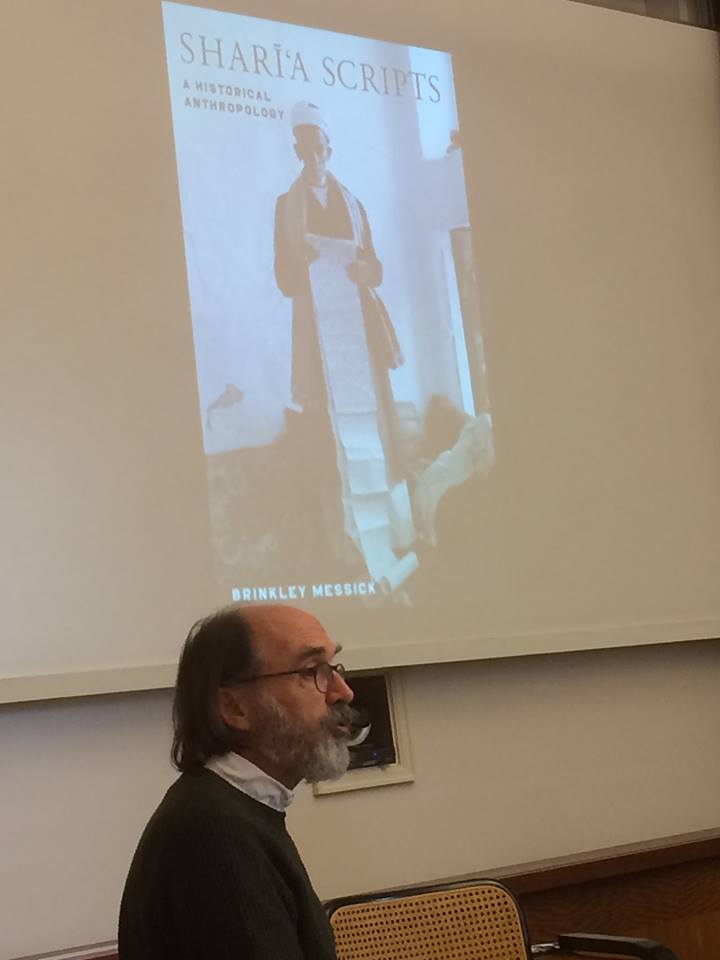
 Prof. Brinkley Messick talking about his new book Shari'a Scripts
I also study Arabic not only for knowledge purposes but also to switch gears from reading scholarly papers and thinking immensely large sociopolitical questions. I also have to remind myself that I am learning for myself, rather than to prove to someone else that I am a hardcore language-learner or Arabophile. I will still take it next semester with Ustaadha Batool, if other conditions allow.

Lastly, I wanted to share that I had the chance to listen to a lot of great scholars of Islam last weekend at the Shi'i studies conference at the Institute of Advanced Studies in Princeton, NJ. It was very exciting to see Arabic skills used for reading primary historical sources.


I might write more about my experience after my exam on Monday. "Allah maaek" to myself lol!

الاثنين، 7 نوفمبر 2016

Islamic Ethics and Friendship

Both scholars Talal Asad and Saba Mahmood have studied the Islamic Revival in Egypt and noted the pedagogical value of ritual.
Asad writes:
What Shaykh Usama was trying to describe was thus more interesting than the disapproval of my friends in Cairo. What he sought to convey was the idea of intention itself being constituted in the repeated acts of body-and-mind within a social context. In fact, like the mastery of all grammar, the ability to perform devotions well (to devote oneself) required not only repetition but also flexibility in different circumstances. It was not simply a matter of acting as in the past but of acquiring a capability for which the past was a beginning and by which the need to submit consciously to a rule would eventually disappear. When one mastered the capability, its exercise did not require a continuous monitoring of oneself (“Am I following the rule correctly?”).
According to Shaykh Usama there was always a social dimension to the disciplines of devotion, as in the traditional duty of every Muslim “to urge what is good and oppose what is reprehensible” (amr bi-l-ma‘rūf wa nahy ‘an al-munkar),[18] including advice (nasīha) and warning (tahdhīr). What I found intriguing about his discourse was the attempt to tie amr bi-l-ma‘rūf to the virtue of “friendship” (suhba, ikhwa), to present it as a matter of responsibility and concern for a friend rather than simply of policing.[19] The language and attitude in which one carried out that duty was integral to what amr bi-l-ma‘rūf was, because, “Every Muslim is a brother to every other Muslim.” What is known historically in Christian history as “pastoral care” is here diffused among all Muslims in relation to one another.
In Mahmood's book Politics of Piety, she makes a distinction between amr bi-l-ma‘rūf  and the practice of da'wa. The former emphasizes moral exhortation while the latter can also include violent interference. (p59-60; Mahmood also cites the commonly invoked hadith in explaining amr bi-l-ma‘rūf : "Whosoever among you sees a munkar must correct it by hand. And if not able to, then by tongue. And if unable to do even that, then by heart. And this is the weakest [manifestation] of faith.") Still, there are similarities in her text with Asad's. She a also notes how female practitioners discuss the relation between intent and practice. Having an ethical comport is sufficient in some cases, but by and large following the rules also have a value in itself that would enhance or strengthen the ethical comport. For example, one female preacher suggested that the rules for women to lower their gaze during private tutor sessions led by a male is not optional even when both parties harbor pure intents. Another example is about the earliest option prayer: when one practitioner expressed difficulty in waking up and washing for this prayer, the preacher suggests that she isn't thinking about God during the day, and perhaps there are other problems that prevent her from harboring purer intents. Women "pursued the process of honing and nurturing the desire to pray through the performance of seemingly unrelated deeds during the day (whether cooking, cleaning, or running an errand), until that desire became a part of their condition of being." (p124)

These practices also extend the meaning of self, which is a project Mahmood suggested to do from the book's first chapter (p13)--

Earlier critics have drawn attention to the masculinist assumptions underpinning the ideal of autonomy, later scholars faulted this idea for its emphasis on the atomistic, individualized, and bounded characteristics of the self at the expense of its rational qualities formed through social interactions within forms of human community. Consequently, there have been various attempts to redefine autonomy so as to capture the emotional, embodied, and socially embedded character of people, particularly of women. A more radical strain of poststructuralist theory has situated its critique of autonomy within a larger challenge posed to the illusory character of the rationalist, self-authorizing, transcendental subject presupposed by Enlightenment thought in general... 
Asad also emphasizes the role of others in creating the sense of self in invoking discussion on the collective effort of hisba (accountability):
Hussein Agrama contrasts hisba as a form of care of the self and also as a legal device: “While hisba, in its classical Shari‘a elaborations, was part of a form of reasoning and practice connected to the cultivation of selves, in the courts it became focused on the maintenance and defense of interests aimed at protecting the public order.”[24] His account demonstrates that when the shari‘a tradition of amr bi-l-ma‘rūf is incorporated into the judicial system of the state, it becomes part of the state’s coercive power and legalized suspicion in the interest of public order, and this makes friendship not merely impossible but also a distortion of the modern (impersonal) concept of justice.
These observations are also related to my reflections on friendship and how to relate to others. I really benefit from reading and thinking about these differences. I have not yet read the continental philosophers' works on friendship, but perhaps there could be some overlaps with what I have presented in this post

الأحد، 14 ديسمبر 2014

The Old Revolution

If the Egyptian Revolution happened in 2008 I would have been much more familiar with the political actors. I had been very concerned with democratic freedoms around the world, especially China's, and even staged or joined politically charged performance art in Beijing. But times have changed and my personal opinions regarding the discourse of democracy and human rights have also been complicated since. Ethically, a crucial point occurred when an opportunistic entrepreneur and alumni gave a speech at my college. To put it bluntly, he got rich during the privatization of the former Soviet Union's state sector the 1990s. During the speech, he was very unabashed about the fact that he took advantage of an unraveling country's state sector. He married a Czech wife and lives in Czech now as a millionaire. When I asked something along the lines of whether he sees the same happening to China, he was unconcerned with the moral dimension but rather focused on the "How to Get Rich" factor. He recommended people who have the ambition to go to Burma for the next liberalization windfall and invest there. I still remember this event, but this is my first time recounting it and I still feel indignation that there will always be these type of people who take advantage of political changes in other countries and encourage others to do the same. I see opportunistic actors gaining material benefits in China if liberalization occurs, and I hope that when people discuss "democracy" arriving they would also recognize this moral (if not legal) hazard. In and out of China, I am more concerned with AIDS rights, feminism and specific labor movements.

As a historian in training, I also know that certain cases have specific contexts and democratic experience of one country is not necessarily transferable to another country. However, these issues appear in discussions when I am in studying in Germany, since I met people who are from different parts of the world (and many who are anti-American). I have recently befriended an Egyptian, called A., who is my age. He comes from a Muslim family but he himself is non-practicing (no fasting during Ramadan, drinks and eats pork.). He is not very anti-American but he is sufficiently skeptical of neoliberal discourses. I have shared my favorite book that critiques the idea of "economics" as this objective subject that can necessarily promote development through top-down meansThe Rule of Experts, by Timothy Mitchell with A. last month. 

More on this incredible book later, which was not the core of our discussion today over coffee. (A really tall and clumsy German sat next to us in the Balzac cafe, spilled his tea and then his stuff. When he settled down with his handwritten notes papers, he was probably also listening) I learned that A. was part of the revolutionary wing in Egypt and on and off with the Socialist wing from Jan. 25th 2011 and stopped a few months after his female cousin Mgot arrested around the time after the military took power through a coup the second time, around July 2013. M., according to A., along with a group that consisted of half girls and half boys, were left in a desert for some time. None were fed for some days. The girls were released because it was very controversial. The boys were sentenced to 15 years in jail. M. is still active in pro-democratic organizations but A. thinks that it is too dangerous and that there is no hope. He does not want to return to Egypt, for both political and social reasons (he finds them too materialistic. I recommended him to check out the scene in China. Arabs in this city still regard A. as an Egyptian, regardless of how disaffected he is.).

A. still wants to take part in leftist groups in Germany and he thought about groups that help refugees. We have only arrived for 2 months so we have yet to find our "组织." I have tried talking with some Socialists here, references I got from the U.S.,  but my German is not at their level yet to be of any help. A. also attended Socialist Alternative meeting in New York, near Zuccotti Park, and was invited to talk about the Egyptian Revolution in 2012. He thinks that this invitation would not happen again these days. The enthusiastic side of American politics is that people are genuinely outraged by racist police brutality against African American males, but Egypt under the undemocratic leadership of al-Sisi does not seem to have a lot of hope in A.'s opinion.

Here's a song by Leonard Cohen about personal loss and political defeats, also the title of this post.


I fought in the old revolution
on the side of the ghost and the King.
Of course I was very young
and I thought that we were winning...

Yes, you who are broken by power, 
you who are absent all day, 
you who are kings for the sake of your children's story, 
the hand of your beggar is burdened down with money, 
the hand of your lover is clay.