‏إظهار الرسائل ذات التسميات language. إظهار كافة الرسائل

السبت، 16 ديسمبر 2017

Learning Arabic Here and There


It has been five months since I started learning Arabic! Although the actual time I have put in studying is around three months. I took a break in between the Beirut Urban Arabic class that happened in July, and the college Formal Arabic 1 class, which lasted from September till this week. I treated it like a daily vocation in July. The task kept me floating and motivated to leave the house. Beirutis were eager to communicate with me since 1) I was such a novelty to most, so they wanted to ask why I am here; and 2) we often had business to communicate, e.g., the bus driver would have to communicate me if I wanted to go somewhere. Even though people say Beirut is not the best place to learn Arabic, it was still an inviting environment. I also had the wonderful classmate, Morgana, who would practice with me in the bus or in the hostel room. Even though one time I was suffering from altitude sickness, learning with a friend was doable.


Ahmad and Morgana in our Urban Arabic class


My teacher in Beirut, Ahmad Orfaly, was also very patient and kind in the Urban Arabic class. He was also humble and said he would not be able to teach the formal Arabic course. The textbook was very well-designed and did not have many family-oriented questions.

In contrast, the Alif Baa and Al Kitaab textbooks we used in the American college classroom have quite a lot of dialogues involving family, which I dislike. I would freeze up every time I was expected to talk about my family. I think my teacher knew, and الحمدلله, she didn't ask about my family during the oral exam.

In class, we are also careful to avoid any racy or controversial topics. In contrast, in Beirut, we were aware of the country's painful past, such as when we learned the word rafiq, (رفيق) one asked if it is the same as the name of the former PM, Rafic Hariri. (It is.) Then we got into a short discussion on his assassination. Students would travel outside of Beirut almost every weekend, so sometimes we would also discuss the ongoing news, such as the Lebanese military action in Beqaa Valley. I could also combine the information I learned from the street environments for my homework, such as "al-Hamra." In contrast, we are much more removed from such contexts in the American classroom, so a lot of brain power is put into use to make something up or look up how to write "Boston" #بوسطن. I exclaimed once to my Saudi friend Abdullah how amazing it is that American places can also be written in Arabic. It is just that I am so English/Chinese/Indo-centric that I never expected Arabic-speaking people would write Boston in their own alphabet. My friend Ahmad told me when I was in Beirut that Arabic has been less susceptible to new English loan words since there are many roots that can make new Arabic words. So even new things like airplane has its non-English phonetic word.


I learned the word "street" this semester, even though I already "saw" it in Beirut.

I also felt awkward bringing up current events, since I did not know if my teacher would like to discuss it or not and whether or not the other students would be interested. I know that it shouldn't be the responsibility of those suffering to discuss matters such as the Muslim Ban, and yet it is the Elephant in the Room. She did once light-heartedly bring up Donald Trump and used photos from his family in a powerpoint for us to practice Arabic; but the politeness reigned. Once she used the Arabic BBC website for examples; hopefully next semester it would become more integrated. We also had video materials recorded by the textbook producers. Our language department also organized a couple of Arabic events, and I attended one film screening.

Exposure to the Egyptian dialect was a useful component from Alif Baa and Al Kitaab. I was much more acquainted with the Levantine dialect before. Other than the most common greeting words, the knowledge for accents were not required; it was just used as an aid for context. The Arabic teacher, Ustaadha Batool, is also very sweet and kind. She sometimes shares her life from Egypt with us in the class. She has a PhD in theatre and also incorporates theatre skits in her teaching. Writing those skits also improved my general sense of the Formal spoken pattern.

The class in Beirut and the class in the U.S. were equally challenging; perhaps because the U.S. course is modeled off of the Middlebury program, which is the country's best. Ustaadha also used to teach there, as well as the editors of the textbooks. She had a good eye for spotting any missing diacritics, which I did not have to know in Beirut. I was mostly cruising along the first few weeks of this semester, since I knew the alphabet and basic grammar. Later on the course was still intense and introduced a lot of new material. I got an A from the Beirut class and will probably pass this class as well; but if I took it for ABCD grades, I would probably not get an A this time around.
Ustaadha told us that the college Spanish 1 course doesn't even teach as much as what we did, and the Spanish-learning students already know most of the alphabet!

This semester, I relied my friend, Ahmad for practicing oral dialogues or grammatical questions. I am becoming more familiar with the available English-Arabic online resources, such as dictionaries and Youtube songs / Quran recitations. Google translate now also has a new function function--when typing in latin, Arabic can show up in the text box directly. I also watch Snapchatters from the Gulf talk about their lives in Khaleeji accents, and it has been a great source of motivation. Their consistency seems to remind me that even if I flunk the course altogether they will still be there speaking Arabic.


A snapshot I took from a snapchat post by Arizonan / Qatari snapchatter Aziz


Sometimes stress makes one feel like everyone else will also stop because your "world" has "ended." I felt more angst and stress due to other factors while taking the college course. I had 5 days of Thanksgiving break in which I did not study Arabic at all, as well as the two days this week, after turning in all the papers. As I become more and more acquainted with my brain's relationship with language, the time spent Not-Studying is often as useful as Studying. There is a good Anonymous piece from The Guardian on how language learning helps combat depression.
...the hardest part of the process is being kind to myself. The voice of depression always chides me for not doing more. It is true that learning a language can often feel like an immense task, but breaking it down into steps – one more podcast, one more Duolingo lesson, one more chapter in my textbook – can remind me I am progressing. I can check the number of words studied, the videos watched. This helps me talk back to the voice of depression that says I can’t do it.
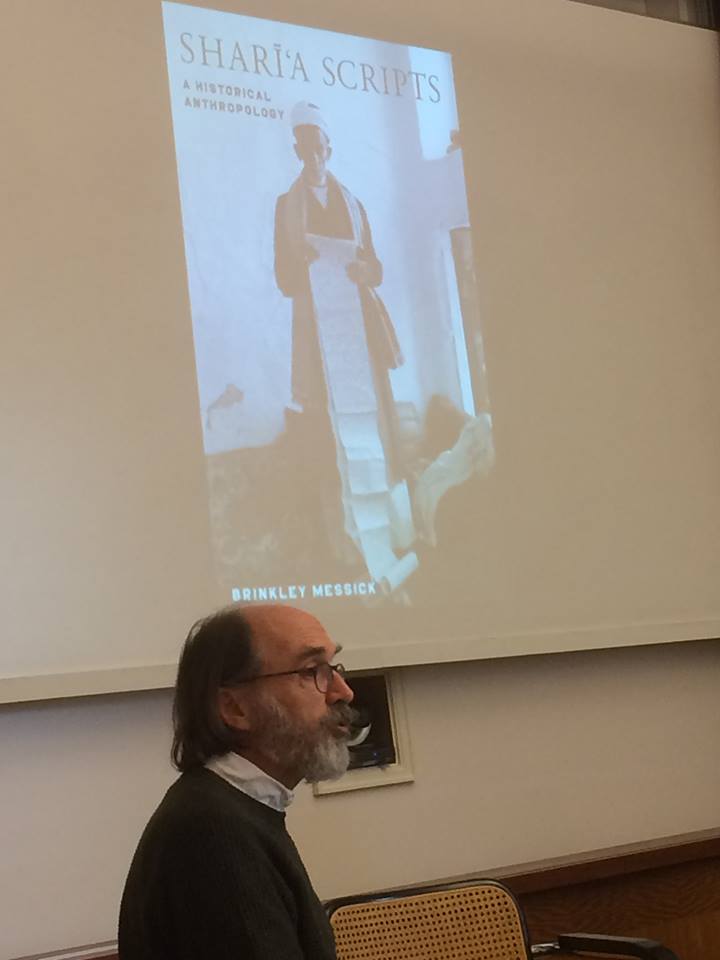

 Prof. Brinkley Messick talking about his new book Shari'a Scripts
I also study Arabic not only for knowledge purposes but also to switch gears from reading scholarly papers and thinking immensely large sociopolitical questions. I also have to remind myself that I am learning for myself, rather than to prove to someone else that I am a hardcore language-learner or Arabophile. I will still take it next semester with Ustaadha Batool, if other conditions allow.

Lastly, I wanted to share that I had the chance to listen to a lot of great scholars of Islam last weekend at the Shi'i studies conference at the Institute of Advanced Studies in Princeton, NJ. It was very exciting to see Arabic skills used for reading primary historical sources.


I might write more about my experience after my exam on Monday. "Allah maaek" to myself lol!

الثلاثاء، 8 أغسطس 2017

Encountering Followers of Jesus in Beirut

One day, my roommate Dan and I were touring around American University of Beirut as well as the sea front. When we ventured on the way back to our airbnb house, we passed by a bookstore that had an English sign board. I wanted to visit it earlier but always passed it during night time after it closed. This time it was open, so we entered. The decor was very nice and cozy, with a full cafe. Trendy English Christian music played in the background. All the books were related to Christianity. The store also sold decorations as well as stationary imported from China. A math student named Hasan welcomed us and offered us juice with biscuits from a famous western brand. We were a bit hesitant until he said it was his offer. We have clearly underestimated Lebanese hospitality!


Later we met Hiam, who was the person in charge of the place. She had a bespectacled, learned look and a motherly demeanor. Her English accent was quite versatile. When she knew that we were tourists, she warmly recommended some spots for us to tour. Then we moved to a sitting spot to sit down and chat. We learned through her that it was more of a fellowship for followers of Jesus Christ rather than a for-profit bookstore. They had Bible study meetings thrice a week. They also offered us cake from the famous chain Roadster Diner, which was also sent to them for free by some mysterious person. That person sent the desserts in a very passive aggressive way, as a form of apology for some small misunderstanding. Hiam said, "If you are sending the desserts because you think you made us mad, we are really not mad!" But the person still sent the desserts anyways.

Hiam first asked about our story. She asked how we came to decide to come here, since zlebanon was quite "dangerous." I told her I was interested in understanding the society after hearing about the cartoon incident.  She was especially intrigued by Dan, who was half-Syrian and half-British and could speak phrases in Arabic. He was also studying French and Deutsch, so they conversed in French as well. She praised that some people just have a knack for languages, such as her nephew who learned Mandarin, Turkish and Russian in addition to the regular three. She requested to see a picture of Dan's Syrian mother. But he said his mother didn't have a picture. Hiam exclaimed that his mother is quite extreme on the religious front. Hiam mixed some Arabic phrases in her speech and had a very chic dressing style. She is teaches Arabic as a private teacher for foreigners who live in Beirut.  I learned that she has no kids. I said that it is quite fortunate since she would have fewer problems. She said that problems do not come from children or marriage. Happy people find happiness with or without marriage. But she also frowned down upon divorce when she heard that Dan's parents divorced; she did not cite theological reasons. Rather, she finds that two people who have lived together for a long time would find it very difficult to separate and the general outcome is not a good. Her way of talking about the faith reminded me a lot of the people I had met in the US. 


Other tha Hasan, there were many others also helping around the store. One woman, who I will call Jane, shared with us her conversion story. It seemed that she was already from a Christian family from her name, but Jesus Christ did not have the same role in her life until she was healed from a jaw-lock in the recent years. All her close relatives had died from various reasons and she was the only one. Hiam said that she walked through many dark phases in her life. Hiam said that the beggars who usually said "Bless your parents" or "uncle" in idiomatic Arabic did not have anyone to bless when they encountered Jane. One beggar even offered to give her money instead when they heard about her story. Jane was painting a very nice painting with a cross on it. She later played the piano very well and also played crazy, improvised tunes for the fun of it. Her entire demeanor was very jolly, so it was even more intense when she did not smile and looked intently at Dan throughout the story of meeting Jesus Christ, as if that could push him towards conversion in some way. Jane and Hiam had a very casual and close relationship. Hiam used the phrase "Ma too zghale" to ask Jane for a favor and explained to me that it means "Don't be made small".


Hiam also shared the story of a Lebanese man with a Shi'a name in the store, whom I will call D. D was homeless when an Ethiopian maid found him. He was considering suicide. But the maid told him about Jesus's love and introduced him to Hiam's brother-in-law. Her brother-in-law met up with him every day to study and talk about things unrelated to "the street." Hiam said that his mother tried to kill him, which was the main reason for his mental instability and homelessness. She emphasized how unusual it was in Lebanese society to be homeless, since family ties are really strong. (I was a bit skeptical about this claim but had no way to figure out the truth of it.) Both Dan and I listened but later we both found it odd that she was sharing this story with us without D's consent or involvement. He wore casual western clothes, looked around 26 years old and shyly hung around without doing much work related to the store. According to the story, Hiam considered to take him in, since there was room in her place. But she was a single person living with her mother at the time, and she said that the neighbors would talk if they took in a single male. She said that as a follower of Jesus Christ, she could not let people of Beirut think about her religion in the wrong way: "I can't talk about Jesus and do something against our Culture. people don't think nicely." Since he has found a place, he has been coming to the book shop for the past 6 months.

They closed the shop around 8:30. After unexpectedly spending around two hours there, Dan and I left with the others. Hiam said that we should come by again to volunteer or study, and we said sure. I later visited again to introduce my friend Morgana to the project. They didn't seem like they needed extra hands, so I didn't go as a volunteer. Dan brought his brother the next time he went and they also just talked about Jesus. Still, it was quite eye opening to see how some Christians with the evangelical streak are similar in this vastly different part the world. 

الخميس، 8 يونيو 2017

Social Relations and Sexual Assault

Yesterday a scholar came from the University of Massachusetts-Amherst to speak on her research work on sex workers of Bombay. Her main concern is that most legal and policy discourses do not take into account the differences in terms they use and the terms the sex workers use. For example, a daily wage laborer who may have been engaging in sex work as well would use the term majburi to describe her undesirable circumstances. A Dalit man Muku also used the same word majburi for moving after a drought in his Maharastrian village. This term is best translated as having to do something under constraint, but even that for the scholar is unsatisfactory and disempowering. Policymakers would usually use the words like "forced" for majburi, e.g., someone was forced to engage in sex work. She finds that this translation reduces the legitimacy of their means of liveligood, which includes sex work. She also finds issue with the liberal paradigm of sex as individual expression and, rather than something socially mediated. She also proposed that there is a strong overlap of sexual labor and daily wage labor for these lower-classed, lower-caste people. She brings up the issue of caste, such as hijras are not only a community seen in a sexually charged manner, but also through caste lenses; but I found the caste issue to have been more of an auxiliary to the talk as a whole. I would have been more keen on understanding how caste is reflected in such an urban sexual economy. The talk garnered a lot of attention and much discussion. Most questions were thinking about how one could link the ethnography with the center questions. I also asked a question about how to think about these undisciplined sexualities in general, since intercaste marriages in India are also punished for breaching the dominant regulation of a casteist sexual economy. I did not get a satisfactory answer.

This post will be discussing another incident related to the idea of ambiguity and sexual relations bounded by social processes. I was exchanging in Delhi at Jawaharlal Nehru University in 2015. I befriended A.S. at the Brahmaputra Hostel, where I went to eat most of the time. Like most people staying at this Hostel, he was a PhD student. Towards the end of the semester, I had the opportunity to travel with him to Gwalior. We stayed overnight in separate accommodations. It was a nice trip overall, with some hiccups in between. We had to wait for several hours due to some planning errors outside of the Gwalior Fort. During this time he mentioned to me about a Lucknow girl who he claimed to be madly in love with. He said that she did not love him as much. We even had beers in a restaurant, which is rather unusual given the relatively conservative environment of the city. At the train station, I bought the memoir Lucknow Boy written by Vinod Mehta, while A.S. continued to reminisce about “his” Lucknow girl. We also played the game of Antakshari (a South Asian spoken parlor game played with song verses) while waiting in the train station. We arrived in Delhi around 5AM, and it was relatively cold. He suggested for me to stay at his hostel for some time, but I refused. We remained on good terms afterwards. I also hosted my birthday party in December in his room, in which he was invited. After the party, he expressed interest in one of my friends who attended as well, to which I downplayed since I thought they would probably not be suitable as a couple. 

A month later I finished my semester. He helped me handle some of my luggage on the last day before I returned to Germany in 2016. He received the opportunity to exchange on scholarship in an Eastern European country, and left for said country in March, but we did not meet. 

Last year, September 27th, I was in the U.S. and recounted the memories of traveling in Gwalior to another friend of mine on Wechat. Then coincidentally, some news about A.S. popped up on my facebook timeline. It was a link reporting sexual assault charges against him. The victim said that he promised he would marry her, which he did not. I automatically assumed that this was the Lucknow girl he used to speak so often about (I was wrong. I searched for this news again today, which has been either cleaned from Google or swamped by other more controversial cases of sexual assault that have since been unfolding. But I did manage to find a link to a news report and in that report, it is said that this girl studied at Delhi University. Only then did I realize I had wrongly assumed the identity of the victim for the nine months.). An Eastern European friend of A.S. had shared the link and defended A.S. against the news. The friend personally vouched that A.S. is a good person and would never do such a thing. This was during the time when JNU had experienced much attack from a biased news media, so I was very skeptical of this report and defensive as well. I discussed this issue with my mom in the same manner and stressed that perhaps it was because of his changed circumstances that severely affected his relation with the Lucknow girl, and this claim was being subsequently being made against him.

My mom thought that such incidents often happen under an environment where people become upward mobile in a short period of time. According to her analysis, the woman would want to share some glory with the successful man who had the ability to go abroad. When she does not get what she wants, she resorts to claims of sexual assault or rape. My mother thought that when it comes down to cases of sexual assault, it is a game of he-said, she-said: the outcome largely depends on the clout of each party involved. If the man has more social and legal resources, then the girl would usually “lose,” regardless of what actually happened. 

The matter stayed in my mind for some time and I gradually forgot about it. When I visited JNU again this year in March, I was again confronted with more details about this case. I met up with Sardarji, who is an affable and popular guard at the university and a true friend of mine. He had met A.S. on two separate occasions with me as well. A.S. and I were once invited to eat handmade makki ki roti (unleavened Punjabi bread made from corn flour) at Sardarji’s home across the road from the University. We had a really good time eating and talking about how the University is often a social force of its own that defends its turf against the other corrupt and elite groups of Delhi, including those that have ties with the state. The other time was when Sardarji attended the birthday party hosted in A.S.’s room.


When Sardarji and I met, I felt like there was much to discuss since we do not have very good ways of communication when we are in different countries. We spoke in Hindi. I prefer to talk in Hindu with someone in person rather than on the phone, because there would be more visual cues for me to understand. Sardarji thought that the case of A.S. was one of the important things to be discussed with me, since we were friends. He asked me if I knew about the case. I said yes, I had read about it, and I was very shocked about the situation. He said he was shocked as well, since A.S. seemed to have been such an innocent boy (sada). We both agreed that A.S. seemed innocent. Sardarji gave me more details which he witnessed on the night of the police raid after the FIR was filed: the policemen stormed Brahmaputra hostel and one even slapped A.S. The moral accusations hurled at A.S. that night by various agents of the law seemed to be more emotionally charged than the actual “crime”: he was married at home and was having relations with more than one girl who were not his wife. Sardarji also seemed to be more appalled by the promiscuity rather than the rape. It is very ironic that the last time all three of us bonded, Sardarji, A.S. and I were discussing about the acts that rebelled against the state (in Hindi): JNU students had been defending one JNU female student who had been harassed by a Delhi elite who was the son of some politician. The police came to arrest students and it was a total chaotic clash. This time, for Sardarji, the police now represented moral authority that rightly punished the philanderer. I listened with awe to both cases, since 1) I did not witness or could not have read about it anywhere and 2) my language capabilities restricted me from posing questions that would generate more nuanced details. Sardarji and I talked perhaps for 40 minutes and this case was the most prominent theme.  We said goodbye and I left the campus.
Through facebook, A.S. also learned that I was in Delhi and reached out on facebook to meet up.  I did not know how to make about the whole situation and I did not reply.

Today, I was reading Nivedita Menon’s book Recovering Subversion and the chapter on rape was particularly thought-provoking. “Law’s claim to truth is based on a binary logic which sets up oppositions like truth/untruth, guilt/innocence, consent/non-consent. This binary logic, [Carol Smart] argues, is completely inappropriate to what she calls the ‘ambiguity of rape.’ In criminal law the object is to establish guilt or innocence, and in rape cases, the establishing of either, turns on another pair of opposites: that of consent/non-consent.
The dualism of consent/non-consent is “completely irrelevant to women’s experience of sex. Neither begins to approach the complexity of a woman’s position when she is being sexually propositioned or abused… (T)he ‘telling’ of a story of rape or abuse inevitably reveals ambiguities. Hence a woman may agree to a certain amount of intimacy but not to sexual intercourse. In the legal model however, consent to the former is consent to full intercourse… (I)n legal terms submission fits on the consent side of the dichotomy. The only alternative when non-consent is not established is to presume consent.” (p123)
This story came up again in my mind and I decided to write down what I have learned so far. How to think about an anthropology of sexual assault or sex work that does not fall into the binaries of consent/non-consent or agency and oppression?


الاثنين، 6 أكتوبر 2014

Visiting the Tibetan Mindrolling Monastery of Dehradun

During my stay in Uttarakhand, the northwestern province of India last month, I visited Mindrolling Monastery in Dehradun with V. I went there not only because the place is top-rated on tourist sites for Dehradun, but also because I have been interested in the Tibetan struggle for independence and I have visited Tibet before this trip. 

First I visited the dharma hall, which was hosting a dharma class upstairs. Some monks looked down curiously. I could not step in the dharma hall 法堂 but I admired the wall paintings and drew some sketches of the deities portrayed. 


Then we proceeded to the Great Stupa, the major point of interest. Construction just completed this year in May.


We had to take off our shoes before we entered the temple grounds as well as this pagoda, which is customary for most religious sites in India. I thought was a sign of Indian customs combined with a Tibetan religious setting (Religious sites in Tibet did not require tourists to take off our shoes.). 

Aside from the Dalai Lama's blessing of the stupa, which was commemorated in 2002 on a plaque, I also found a plaque that wrote in Tibetan and English that "the foundation stone for this stupa of Buddha's descent from Devaloka which liberates upon seeing has been laid by the honorable [Indian] defense minister George Fernandes on the 29th of April 2000." So it clearly has some geopolitical significance as well. I looked up the word devaloka: "In Indian religions, a devaloka or deva loka is a plane of existence where gods and devas exist." Another point of synthesis between Tibetan and Hindu culture.

Inside this pagoda structure were two floors. There were two exquisite installations of Tibetan cosmic mandalas, which were surprisingly better than the ones I saw in Lhasa, one Buddha statue, as well as wall drawings of stories, flower vases, and Tibetan medicine diagrams. No photography was allowed. I paid my respects to Shakyamuni and left.


The English text below says, "This representation of the Potala Palace in Lhasa, Tibet has been built in the year 2002 in order to commemorate the 360th anniversary of the establishment of the Gaden Phodrang spiritual and temporal government of Tibet."


Some mini-stupas with a giant Tibetan prayer wheel inside. While I was pushing one, an Indian girl asked me in Hindi what that was. I could only shake my head since I only knew the Chinese name at the time...


Monkeys seen on-site


Very inspiring words from the 14th Dalai Lama

Flag with sutras written on them

Amusing sign (along with no loud voices etc.)

I was slightly amused to discover that the monks and people who worked there speak fluent Hindi. V spoke to a postcard shopkeeper in Hindi about Xi Jinping's recent visit to India, while I had to speak him in English. I realize that as I write this, my impression of "the exiled life" is limited to elites, who have the luxury to retain a clear identity distinct from their host culture. Whereas the Tibetans who have lived in Dehradun assimilate very well, at least on the level of language.

Here is some background from the Mindrolling Monastery website regarding the particular sect of Tibetan Buddhism based in Tibet: 
The Nyingmapa or Nyingma School has six main monasteries of learning and practice. Of the six, Mindrolling was one of the largest and most important practice and study centers in Central Tibet. Established in 1676 in the Drachi Valley by the great Dharma king Chögyal Terdag Lingpa, Mindrolling attracted monks from the length and breadth of Tibet.
Mindrolling was, and is today, considered by all the great masters of Tibetan Buddhism, and especially by all the teachers of the Nyingma lineage, as an inspiring example of the practice of the pure and profound Dharma of Vajrayana Buddhism. An unbroken lineage of great masters continues up to this day. With the Chinese invasion of Tibet in 1959, many Tibetan masters were urged to flee in an attempt to protect their lives and thus the precious teachings.
Brief history of the monastery in India:
Mindrolling began to re-establish its monastic seat in exile in Dehra Dun, India in 1965, through the untiring efforts of His Eminence Khochhen Rinpoche and small group of monks. Embarrassed by the wilderness and rough conditions on the land they had selected, they first worked to build monk's quarters and the main shrine room before inviting His Holiness the XIth Mindrolling Trichen to assume leadership. His Holiness then moved from Kalimpong to Dehra Dun in 1976.
Finally, on the subject of exile and nostalgia, it reminded me of a Tibetan song the U. Wisconsin Madison summer language class presented, that left a deep impression on me. Basically it's written from a kid's voice, asking her father, mother and relatives to teach her Tibetan and maybe show her Tibet one day. As I left monastery grounds, I saw a Tibetan girl hop on a motorcycle with her family. Without much time or resources to research, one can only wonder how many Tibetans still can speak Tibetan while in exile in India. 

الاثنين، 17 مارس 2014

Studying Hinduism in China

During my post-college gap year, learning about India has been a solitary exercise. Fortunately, there are also rare glimpses of the Chinese academics that focus on India through websites as well as classes. I have had the rare opportunity to sit on a religious studies class taught by one of them at Peking University and the experience was much better than any MOOC I have watched. So far, I listened to two lectures that were humorous but controversial, lively but also problematic at times. In a sense, he approached the culture with deference, neither approving or disapproving by offering normative suggestions. 
During the first lecture, the professor stressed the ingrained notion and deep-set culture of caste and dismissed the idea that it was an institution that could be soon abolished. He mentioned that a young primary school student had to write a research report, and she chose India's caste system as her topic. After researching Baidu (China's worse version of Google), the student concluded that the oppressors invented the caste system to rule over the oppressed and that the unjust system would soon die out. The professor commended this 10-year old student for concluding with this coherent explanation. Though he did not bother to correct her, he suggested to his college students that the truth was far more complicated. He took much effort in class to demonstrate the system's resilience and cogency through history.
The professor argued that the Mahatma Gandhi family's diminished influence in politics is related to his Vaishya caste, while the Nehru dynasty continued to thrive because they were Brahmins. I was utterly shocked by that theory, which was, for better or worse, something I would never hear in an American classroom. I mentioned this theory regarding the perception of politicians to my Indian friend, Vikash, who confirmed it. Vikash suggested that many people might hold grudges against Gandhi but they would never mouth it in public. I liked the metaphor he used: There are the people who slaved and died for building the Taj Mahal, the few people who remember them, and the vast majority of people who only marvel at the beauty and love story surrounding the Taj. Similarly, there are the few Gandhi’s detractors, and there are Gandhi’s flag-bearers and passive supporters. (This recent Caravan article by Arundhati Roy, however, is a great exception that shows Gandhi's lack of commitment to anti-racism in South Africa.)


Segment 1 of 1800s scroll painting of a parade in colonial India, seen at the Beijing Palace (Gugong) Museum. Victoria & Albert Museum Collection on exhibit


Segment 2 of 1800s scroll painting of a parade in colonial India, seen at the Beijing Palace (Gugong) Museum. Victoria & Albert Museum Collection on exhibit.

Back to the caste system. The professor suggested that even today, some Dalits ("贱民" or "不可接触者" in Chinese, direct translation from "Untouchables") would apologize for polluting someone else's car after being hit by it. A Dalit official received his newspaper tossed across the room by his higher-caste subordinate. In contrast, the professor suggested, no one could have dared to do that to the first Ming emperor Zhu Yuanzhang, even though he was also just a beggar from the start.
The caste system presented as an immutable and continuous system is problematic. "Dalits have always been Dalits (贱民永远是贱民)," the professor proclaimed. He also mentioned that through his experience, Brahmins usually cannot eat with lower castes. He also cautioned that the Chinese custom of delivering shared food with one's chopsticks (夹菜) to a Brahmin or Ksatriya's bowl is unacceptable. Yet Indian sociologist André Béteille's research, aptly titled "India's Destiny is not Caste in Stone" has shown that inter-dining between castes has increased over the years. First, he explains the rules of purity and pollution in this case:
Only castes of equivalent rank could inter-dine with each other. In general people accepted cooked food and water from the hands of their superiors, but not their inferiors. The ritual rules governing food transactions were rigid and elaborate until a hundred years ago. 
Nobody can deny that there has been a steady erosion of those rules. Modern conditions of life and work have rendered many of them obsolete. The excesses of the rules of purity and pollution have now come to be treated with ridicule and mockery among educated people in metropolitan cities like Kolkata and Delhi.
I wondered what problems the Chinese professor's presentation of caste suggested. I once engaged in an intense debate regarding whether one should judge India's caste system upon arriving in the country the first two weeks. The American professor criticized inequality in the abstract vehemently and bemoaned the current situation in India with great passion. I tried to suggest that inequality in the abstract was not unique to India, and was rebuked. This Chinese professor, however, approached the caste system with more ease and acceptance. After the professor's first lecture, I was impressed and thought that Chinese people would have a much better understanding of caste because of common experiences of the elite ruling over the non-elites during pre-modernity. 
This week I listened to another lecture and my previous impressions were confirmed again: the professor continued to discuss how the conniving Brahmins and Ksatriyas successfully aligned the Vaishya and the Shudras with their interests during the turbulent Brahminical period (600 BCE - 600 CE) when Jains and Buddhists challenged the caste system. The professor admired how the Brahmins and Ksatriyas understood the universal human desire to step on other people's heads even while they are being stepped on. The Vaishya and Shudra caste happily accepted an inferior status just so they could have membership in the cultural ecosystem and be on top of Untouchables. This sweeping explanation left me deeply unsettled. He also suggested that Gandhi tried to combat the caste stigmas by introducing the Harijan (Children of God) term, but failed because he could not reinvent the caste myth of Purusha--"the Brahmin from his mouth, the Kshatriya his arms, the Vaishya his thighs, and the Shudra his feet."--"Which part of the giant did the Dalits come from?" The professor asked. At least his dead skin of his sole(脚后跟的死皮)?--again, the politically incorrect joke. Still, the professor has a great knack for comparing religions, and there are a lot of other themes in these lectures that I shall revisit in the future.

Some other related thoughts on Chinese scholars of India. Fudan University lecturer and Sanskrit academic Dr. Liu Zhen (刘震) advocates for an Indology institute in China. He promised to establish this institute before he returned to China to his Munich University adviser, Sanskrit and Tibetan scholar Dr. J. U. Hartmann. While Liu's ambitions are commendable, I am both amused and annoyed that the translation of “印度学”(English: Indology German: Indologie): in Chinese it can also mean "Indian studies." Liu continues the tradition of the focus on philology, calling it "a pure discipline is a form of religion, it is not a means to earning a living, it needs sacrifice."
I could not help but think, that sounds very self-elevating, but what about modern India and the sociocultural aspects of India? Usually when Indian culture is mentioned in Chinese academia, one usually thinks about the famous and canonical Pali and Sanskrit scholar Ji Xianlin who also studied in Germany. While the motives behind Area Studies approach has been questioned, the approach for studying only the classical and religious aspect of a country is also incomplete. I hope to see more students and professors of Indian history in China that not only look at the classical culture but also the colonial history.
Referring to one kind of Indian thought by studying only the classical texts can create a considerable amount of tension. As A.K. Ramanujan has proposed in his philosophical inquiry Is There an Indian Way of Thinking, 
There are Great and Little Traditions, ancient and modern, rural and urban, classical and folk. Each language, caste, and region has its special world view. So, under the apparent diversity, there is really a unity of viewpoint, a single supersystem. Vedists see a vedic model in all Indian thought. 
But we are not all Vedists that have learned years of Sanskrit. I do not mean to diminish the importance of Sanskrit, having studied it for one year, but I would hope for interdisciplinary approaches when for future Indian studies in China.