‏إظهار الرسائل ذات التسميات lebanon. إظهار كافة الرسائل

الاثنين، 30 أبريل 2018

Arabic Music Performance in Boston


Boston College organized a free Arabic music concert on rainy Sunday night, April 15th, at Gasson Hall. Prof. Ann Lucas said the introductory remarks first in English and then in Arabic. She welcomed us with “أهلا و سهلا” and also wished that the program will continue in the future (في مستقبل) Many of the audiences also were Lebanese. I stood throughout the show because all the chairs were taken. It was my first time at such a formal Arabic music performance. Before my exposure to music of the same region was mostly dabke and zajal music.


The main show of the evening featured  Lebanese oud performer Charbel Rouhana. Before he went on stage, the ensemble and chorus performed Levantine folk songs featuring themes of love and scenes of nature in the first half. Children of the Center for Arabic Culture the opened the show with My Darlings Around me (حبايبنا حولي), conducted by Syrian lawyer and conductor Alma Riceh. This choir is the only children’s Arabic choir in Massachusetts. The remaining choruses were directed by Nizar Fares, a Beiruiti who holds a PhD in musicology. During certain intervals, the Qanun player also had his solo parts and the audience responded with loud applause.

from Wikipedia


Dr. Fares, who also plays the Oud and is a musician in his own right, praised Charbel Rouhana to have accomplished what he thought as excellence that required an average person at least four times the amount of effort. Rouhana took stage and played several more numbers of Levantine songs as well as Oud-centric musical arrangements for us. The later learned that the oud is an instrument 3500 years old and has heavily influenced the Spanish guitar. 

Gasson Hall April 15th; Picture found from website


I also attended an Oud performance in Beirut, where I sat very formally at first; but I soon realized that Oud could also be entertained for a dance party. The crowd in the bar rose to their feet and also made requests upon the performer. I later found out that Rouhana also performs Oud in jazz style.

In this case, at Boston College, it was modeled off of a European influenced understanding of a performance. I had read about Umm Kulthum’s rise in fame as well as her collaboration with old forms of performances. While she retained the formal Arabic language in her pronunciations, she also contended with the new arrival of film and dressed in European dresses. 

Umm Kulthum and her ensemble

The Lebanese dialect lyrics of this musical performance was transliterated and translated for us to follow. I could understand “moon” and “lover.” During the call and response sections, I also participated in the choruses. I noticed that the gender of the addressee is important in Arabic; God would be presented as a gender-specific figure in literature and poetry. In contrast, Indian Sufi music addresses God in gender-neutral terms.

After the last amusing song Qahwa (coffee), a nun from Lebanon presented an award to Boston College’s music department, commended this performance and also praised the ability for music to communicate through all cultures. She also looked forward to future performance exchanges in Boston. Rouhana also signed his book on Maqam for people who were interested in purchasing it. I would like to learn more about Arabic music theory in the future.

السبت، 16 ديسمبر 2017

Learning Arabic Here and There


It has been five months since I started learning Arabic! Although the actual time I have put in studying is around three months. I took a break in between the Beirut Urban Arabic class that happened in July, and the college Formal Arabic 1 class, which lasted from September till this week. I treated it like a daily vocation in July. The task kept me floating and motivated to leave the house. Beirutis were eager to communicate with me since 1) I was such a novelty to most, so they wanted to ask why I am here; and 2) we often had business to communicate, e.g., the bus driver would have to communicate me if I wanted to go somewhere. Even though people say Beirut is not the best place to learn Arabic, it was still an inviting environment. I also had the wonderful classmate, Morgana, who would practice with me in the bus or in the hostel room. Even though one time I was suffering from altitude sickness, learning with a friend was doable.


Ahmad and Morgana in our Urban Arabic class


My teacher in Beirut, Ahmad Orfaly, was also very patient and kind in the Urban Arabic class. He was also humble and said he would not be able to teach the formal Arabic course. The textbook was very well-designed and did not have many family-oriented questions.

In contrast, the Alif Baa and Al Kitaab textbooks we used in the American college classroom have quite a lot of dialogues involving family, which I dislike. I would freeze up every time I was expected to talk about my family. I think my teacher knew, and الحمدلله, she didn't ask about my family during the oral exam.

In class, we are also careful to avoid any racy or controversial topics. In contrast, in Beirut, we were aware of the country's painful past, such as when we learned the word rafiq, (رفيق) one asked if it is the same as the name of the former PM, Rafic Hariri. (It is.) Then we got into a short discussion on his assassination. Students would travel outside of Beirut almost every weekend, so sometimes we would also discuss the ongoing news, such as the Lebanese military action in Beqaa Valley. I could also combine the information I learned from the street environments for my homework, such as "al-Hamra." In contrast, we are much more removed from such contexts in the American classroom, so a lot of brain power is put into use to make something up or look up how to write "Boston" #بوسطن. I exclaimed once to my Saudi friend Abdullah how amazing it is that American places can also be written in Arabic. It is just that I am so English/Chinese/Indo-centric that I never expected Arabic-speaking people would write Boston in their own alphabet. My friend Ahmad told me when I was in Beirut that Arabic has been less susceptible to new English loan words since there are many roots that can make new Arabic words. So even new things like airplane has its non-English phonetic word.


I learned the word "street" this semester, even though I already "saw" it in Beirut.

I also felt awkward bringing up current events, since I did not know if my teacher would like to discuss it or not and whether or not the other students would be interested. I know that it shouldn't be the responsibility of those suffering to discuss matters such as the Muslim Ban, and yet it is the Elephant in the Room. She did once light-heartedly bring up Donald Trump and used photos from his family in a powerpoint for us to practice Arabic; but the politeness reigned. Once she used the Arabic BBC website for examples; hopefully next semester it would become more integrated. We also had video materials recorded by the textbook producers. Our language department also organized a couple of Arabic events, and I attended one film screening.

Exposure to the Egyptian dialect was a useful component from Alif Baa and Al Kitaab. I was much more acquainted with the Levantine dialect before. Other than the most common greeting words, the knowledge for accents were not required; it was just used as an aid for context. The Arabic teacher, Ustaadha Batool, is also very sweet and kind. She sometimes shares her life from Egypt with us in the class. She has a PhD in theatre and also incorporates theatre skits in her teaching. Writing those skits also improved my general sense of the Formal spoken pattern.

The class in Beirut and the class in the U.S. were equally challenging; perhaps because the U.S. course is modeled off of the Middlebury program, which is the country's best. Ustaadha also used to teach there, as well as the editors of the textbooks. She had a good eye for spotting any missing diacritics, which I did not have to know in Beirut. I was mostly cruising along the first few weeks of this semester, since I knew the alphabet and basic grammar. Later on the course was still intense and introduced a lot of new material. I got an A from the Beirut class and will probably pass this class as well; but if I took it for ABCD grades, I would probably not get an A this time around.
Ustaadha told us that the college Spanish 1 course doesn't even teach as much as what we did, and the Spanish-learning students already know most of the alphabet!

This semester, I relied my friend, Ahmad for practicing oral dialogues or grammatical questions. I am becoming more familiar with the available English-Arabic online resources, such as dictionaries and Youtube songs / Quran recitations. Google translate now also has a new function function--when typing in latin, Arabic can show up in the text box directly. I also watch Snapchatters from the Gulf talk about their lives in Khaleeji accents, and it has been a great source of motivation. Their consistency seems to remind me that even if I flunk the course altogether they will still be there speaking Arabic.


A snapshot I took from a snapchat post by Arizonan / Qatari snapchatter Aziz


Sometimes stress makes one feel like everyone else will also stop because your "world" has "ended." I felt more angst and stress due to other factors while taking the college course. I had 5 days of Thanksgiving break in which I did not study Arabic at all, as well as the two days this week, after turning in all the papers. As I become more and more acquainted with my brain's relationship with language, the time spent Not-Studying is often as useful as Studying. There is a good Anonymous piece from The Guardian on how language learning helps combat depression.
...the hardest part of the process is being kind to myself. The voice of depression always chides me for not doing more. It is true that learning a language can often feel like an immense task, but breaking it down into steps – one more podcast, one more Duolingo lesson, one more chapter in my textbook – can remind me I am progressing. I can check the number of words studied, the videos watched. This helps me talk back to the voice of depression that says I can’t do it.


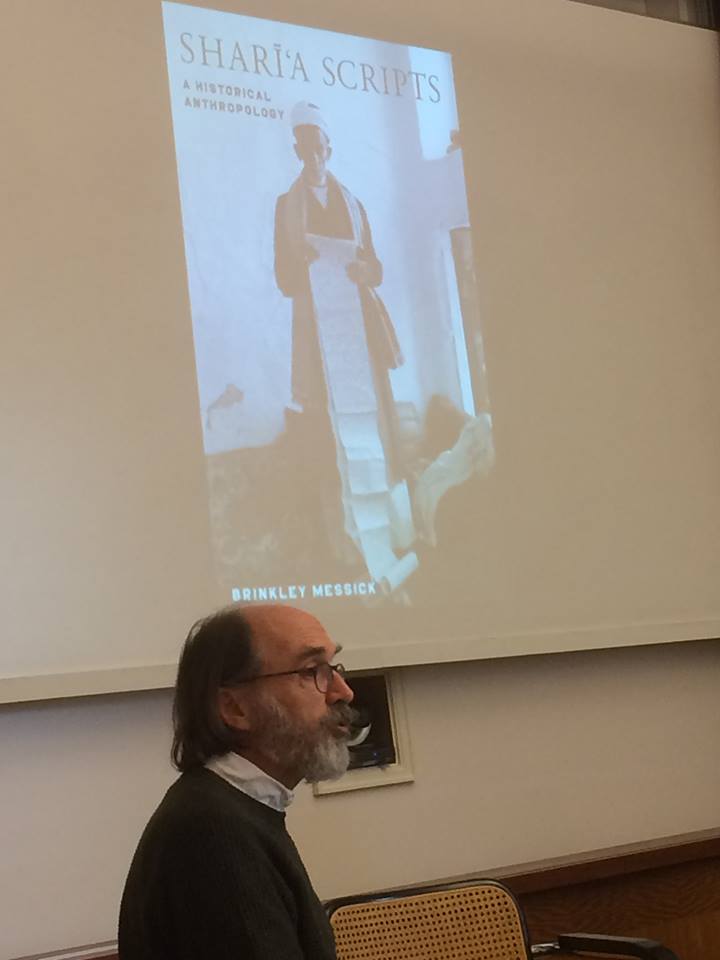
 Prof. Brinkley Messick talking about his new book Shari'a Scripts
I also study Arabic not only for knowledge purposes but also to switch gears from reading scholarly papers and thinking immensely large sociopolitical questions. I also have to remind myself that I am learning for myself, rather than to prove to someone else that I am a hardcore language-learner or Arabophile. I will still take it next semester with Ustaadha Batool, if other conditions allow.

Lastly, I wanted to share that I had the chance to listen to a lot of great scholars of Islam last weekend at the Shi'i studies conference at the Institute of Advanced Studies in Princeton, NJ. It was very exciting to see Arabic skills used for reading primary historical sources.


I might write more about my experience after my exam on Monday. "Allah maaek" to myself lol!

الاثنين، 9 أكتوبر 2017

Day Trippin' Tripoli, the one in Sham


Tripoli, aka Tarābulus / Tarabulus al-Sham, was not on top of my list of tourist destinations. Like many millenials who travel to Lebanon, I had watched the Vice documentary about the armed urban conflict and decided best to stay away from Tripoli. My Airbnb flatmates Ian and Dan held a similar impression of the city when they arrived in Lebanon for their holiday. Dan was especially worried that something wrong might happen. Ian was eager to see the city because it is closer in architectural style to his hometown, Damascus, than Beirut. But our host Ibrahim said that it is a cool city and showed us a short documentary on the reconstruction efforts since the conflict. I was also hoping we could visit the bookstore that burned. 


We set off on July 15 and made jokes about getting shot by crossfire. The same jovial middle-aged Lebanese driver who took us to Jounieh also found us again and offered to take us to Tripoli as well. At first he did not even recognize us, even though I think we stand out as a odd group of tourists. Ian, who continued to act as our trusty translator, said we didn't have the money and opted to take a bus for 5000LL per person.


At the bus stop in Beirut

On the way north, we passed by the same places we visited before; Jounieh and Harissa, which I might write about in a future post. The main highway artery is right next to the sea. We shared the bus with soldiers and a classmate from Arabic. There was supposedly 1 hour wifi for free but we didn't log in successfully. I snapped more shots of the road while Ian and Dan slept. 


When we arrived at the last stop, we were a bit at loss because there was no Google Maps. But I had the tour book with me from Ibrahim, which showed that the famed Citadel was at the bank of the river, so we ambled towards the river. On the way, we passed by bazaars and busy streets.


 Now I look back at the photos, I am surprised that the architecture maintained some uniform style, even though a lot of them are dilapidated. Clearly someone put in some effort in urban planning. 
But I have yet to read into the history. I took a lot of photos of the landscape and buildings that had religious significance or signs because I noticed the use of calligraphy was different from the signs in Beirut. 


(Colonial) Clock tower


We stopped by a very beautiful shop with tourist ornaments on the 1st floor and generic cosmetics on the 2nd floor. The architecture was beautiful.


As we left from the bazaar area, political posters began to appear. We also looked at the Syrian street from afar.


On the way to citadel, we passed a shop that sold religious CDs and cassettes. Ian interpreted the shopkeeper's brief explanation and I remembered my anthropology Professor's work on Islamic soundscapes.


Instructional DVDs on proper conduct in Islam with English translations


Skull caps imported from Turkey


We hiked along the river a while and found a very unconventional route that took us to the foot of the citadel but not the main entrance.


#OfficiallyLost #Tripoli


We even passed by a private home right next to it. The home seemed very peaceful with lots of (stray) cats.


We passed through an ancient alleyway. It seemed as old as the citadel itself. 


After stepping over a gully that had a dead rat in them, we made it to a grave which led to a side entrance of the citadel.


Pictures of the tombstones and flowers. Very picturesque graveyard and probably the only predominantly Islamic grave I have been inside.


At this point I still have not seen anything that "makes" this place a tourist spot.  


At the darwaza of the citadel


Stray cat at the citadel


What impressed me most was the birds eye view of the city as well as the presence of the Lebanese army. We found an army post with tents in a very secluded corner of the citadel. Even after centuries, a fort will more or less function as a fort. I have not seen any similar form of army presence at the Great Wall in Beijing or the Red Fort in Delhi, which is telling about the precarity of Lebanon. A guard emerged from his tent, saw us and shooed us away from the premises. 


There were also dungeons and I was kind of spooked, afraid that there might still be dead organic matter lying around. It reminded me of some former royal places in India.


We had lunch at a normal looking joint because there was chicken roasting by the corner. Most of the people who worked and patronized there are from Syria and they also talk with Ian about his British-Syrian origins. The cashier guy was so generous and warm, when he heard how far we traveled from, he gave us falafels for free. I was a bit unwell (shang huo) and didn't want falafels; Ian was a bit annoyed with me that I didn't eat meat and thus created more issues for him in terms of solving the food logistics. But I decided to eat them anyways. 


Beautiful archways in the old part of Tripoli


At some point while we we were wandering in the bazaar, we were apprehended by some youngsters. They were hired by the soap-selling shops and wanted us to buy some soap. We entered in a courtyard with a very classic fountain, one that reminds Ian of his home in Damascus. I also saw the soap-making bucket and was impressed by the antique-style set up. One girl who worked at the same shop said she learned English from watching English television. I was shocked and finally accepted the fact that I would have to learn languages through other means. I bought two bars of soap for 12,000LL. The male shop keeper also said that he had customers from China who bought soap by the ton.


I asked the soap-seller where I could find the bookstore. He was fluent in English, had heard about the bookstore, but was not sure about where it was and thought it might be closed. I realized I might leave without visiting it. 


I also realized that most books available are very generic.


I wanted to visit a mosque but all of them were closed. So we just snapped shots outside of them. Mamluk architecture is so different from other architectural styles I have seen in the same area.


Lovely street calligraphy


We passed by this cute kid and stylish car. They look like they were headed to some event. Ian was still full of energy while Dan and I were beat.
We asked several people for the directions to the bus station and many of them told us that the buses were already finished. Still, we persevered just in case there were buses left.


A tank parked on the street. We passed by an army point in the city. One officer said hello to me. Other boys on the street also notice I am Chinese and say "ni hao". Ian gets a great kick out of it; one of them chuckles in a very silly way after he said ni hao and Ian was so amused by the corniness of it all and repeats the anecdote time after time.


I also bought some string beans for 1000LL. That was definitely cheaper than what I would get in Beirut. At last we found the bus station but the last bus to Beirut indeed had left the dock. We luckily found a minivan and packed into it. The Americans we saw from the castle also joined us in the bus. We learned that most of them study about the Middle East at Harvard. But the one we talked with the most was exchanging at AUB from Georgetown University. His name was Hank.

On the way back, Hank and Ian discussed their impressions of the city.

Ian: Beirut is capitalist and divided. It's very different than Tripoli's vibe.

Hank: The latter is connected more to Damascus. It was never considered part of Mount Liban until the 1920s partition of the Ottoman Empire and official establishment of the French Mandate.

Beirut rose into prominence during the 1800s. More people came and missionaries took advantage. Western trade oriented. It was very rich until civil war.

Then the conversation shifted to the Shia neighborhood in Beirut: Hank explained that in the 1890s, Dahiya became part of Beirut. The inhabitants were mostly village people and more conservative than the heart of Beirut. Hank lived there in 2015 for several months. He also gave us a brief overview of his understanding of Syrian history: the French favored Alawis and minorities because they were part of the war zones. The Alawis suffered a lot from the late 1800s famine as well. Alawis were heavily divided in their attitudes toward the French. They were not a coherent group until the Assad family came into power. The first Assad removed religious authority and dismantled "Alawi" as a religion. The French gave them social mobility. It would have been difficult for them to achieve mobility otherwise; although there were also Alawi tax collectors (which is a relatively high social position) in 1860s.

Later I lost track of the conversation and focused on the beautiful scenery.


 Then we arrived in the Armenian town of Beirut; Ian, Dan and I took a bus back to the promenade close to where we lived while the others took a taxi. We arrived at the promenade just in time for the sunset. 


End note: I wrote this a bit later than I expected, and may have left out some details. Overall I should accept that blogs will not reflect experiences as they were, but rather filtered through memory and time. I really appreciated Ian's role of interpreting and guiding us, even though Dan and I also got fed up with him sometimes. The trip would not have happened if I did not have their company. My blog's readership exceeded 5000 hits last month! Thanks to all of you for reading!