‏إظهار الرسائل ذات التسميات Arab. إظهار كافة الرسائل

الجمعة، 4 يونيو 2021

التطريز في اليمن

يجمع التطريز بين الأسلوب التقليدي والأساطير المحلية والتأثيرات الجغرافية. في بعض الأحيان يكون لها وظيفة الوقاية أو الحماية من العين الشريرة.


الأنماط والغرز والتقنيات المستخدمة هي خصائص منطقة أو مدينة أو قرية ، حضرية أو ريفية.


لقد أتاح للنساء الفرصة للتعريف بمهاراتهن ووضعهن الاجتماعي والمالي وهويتهن.


يسمح بالتعبير عن المشاعر والعواطف والخيال في مجتمع صارم.


غالبًا ما يوجد جيب مخفي على اللوحة الأمامية للفستان ، حيث يوجد جيب صغير


جبل حراز

استخدم اليمنيون تقنية خاصة لسحق القماش بمجاديف خشبية ثقيلة لإضفاء لمعان عالٍ عليه. المثلثات الحمراء المستخدمة في هذا الفستان ترمز إلى الخصوبة (المثلث) والحماية من النزيف (اللون الأحمر). تم استيراد القماش الأحمر المخطط الذي يحد الشق الأمامي للثوب من الهند. يتميز البنطال بتطريز خيط فضي منسوج ومن نفس منطقة الفستان. كانت الأريكة الفضية لهذا الفستان الذي يبلغ من العمر 100 عام مهترئة بشدة ، ولكن تم إصلاحها بعناية قبل هذا المعرض من قبل Grazia Zalfa ، وهي خياطة موهوبة في جمعية الديكور في واشنطن الكبرى.


عباية نيلي
http://costumehistoryisfun.blogspot.com/


"الألواح الجانبية الداخلية تجعل الخصر يبدو صغيرًا دون أن يبدو مشدودًا. ذكي جدا."

- Moroccanmaryam@yahoo.com


1955 فيلم وثائقي بريطاني عن النساء اليهوديات المهاجرات حديثًا كخياطات. كما شوهد رجل يعمل بالخياطة.


https://www.britishpathe.com/video/yemenite-embroidery-also-in-cp-029


 تعكس طريقة لبسنا مكانتنا في العالم وكيف نريد أن يدركنا الآخرون. لم تكن الملابس وتزيينها في أي مكان أكثر أهمية للهوية من النساء اليهوديات في اليمن. لقد تركوا وراءهم رموزًا ثمينة للهوية الإقليمية والعائلية والشخصية.

لقد رأوا تطريزهم وأزيائهم التقليدية تتكيف وتعديلها بلا رحمة من قبل بلد عازم على خلق هوية وطنية واحدة لليهود العائدين من الشتات بعد الحرب العالمية الثانية. في هذه العملية ، فقدت النساء اليهوديات اليمنيات جزءًا كبيرًا من هوياتهن. تعال وانضم إلينا في هذه الصورة المليئة بالمناقشة.


امرأة في فلسطين المحتلة ، من خولان اليمن
1960


السبت، 7 يوليو 2018

Review of "The Ba'thification of Iraq"

As a writer, the author of  The Ba'thification of Iraq (2015) can be commended for his command of Arabic political terminologies. He also has a penchant for Stalin and Nazi rants. He offers the Baath-Nazi-Commie analogies liberally in almost every chapter, which reveal his obvious ideological leanings as an advocate of the 2003 U.S. intervention. The U.S.-led post-invasion debathification process used the experience of de-nazification from the 1940s rather dogmatically, as documented by Dr. Aysegul Keskin Zeren in her 2017 work "From De-Nazification of Germany to De-Baathification of Iraq."


Published November 15th 2015 by University of Texas Press

If the author went beyond facile analogies of Stalin and Saddam, he could possibly see clearly that many strategies and slogans of the Baath Party was copied and / or adopted from the Iraqi Communist Party. The 20th century analytical theme--the party system functioned as a crucial apparatus for state formation--is lacking. The author is primarily focused on establishing the Baath Party as an exception rather than the rule.

As a historian, the author of this book stresses certain contexts out of proportion and overlooks other contexts, such as British imperialism. He portrays Ottoman political culture as faction-ridden and corrupt and uses this distortion to explain the lack of coalition building in Iraq and the demise of Abd al-Karim Qasim in the 1958 coup. Iraq seems to appear out of Oriental chaos, only to be saved. 


This author has used his privilege as an American (official) to access the Baath Party documents which have been housed in Hoover Institution Archives, courtesy of an agreement with the Iraqi Memory Foundation; the negative implications of this arrangement for the historiography of Iraq and ordinary citizens have been explained by historian Saad Eskander (http://libraryjuicepress.com/blog/?p=439).
Finally, this review could not have been possible if I did not have years of engaged readings on the functioning of the Chinese Communist Party. More cross-region comparisons should be employed for de-Orientalizing histories of the 20th century.

السبت، 16 ديسمبر 2017

Learning Arabic Here and There


It has been five months since I started learning Arabic! Although the actual time I have put in studying is around three months. I took a break in between the Beirut Urban Arabic class that happened in July, and the college Formal Arabic 1 class, which lasted from September till this week. I treated it like a daily vocation in July. The task kept me floating and motivated to leave the house. Beirutis were eager to communicate with me since 1) I was such a novelty to most, so they wanted to ask why I am here; and 2) we often had business to communicate, e.g., the bus driver would have to communicate me if I wanted to go somewhere. Even though people say Beirut is not the best place to learn Arabic, it was still an inviting environment. I also had the wonderful classmate, Morgana, who would practice with me in the bus or in the hostel room. Even though one time I was suffering from altitude sickness, learning with a friend was doable.


Ahmad and Morgana in our Urban Arabic class


My teacher in Beirut, Ahmad Orfaly, was also very patient and kind in the Urban Arabic class. He was also humble and said he would not be able to teach the formal Arabic course. The textbook was very well-designed and did not have many family-oriented questions.

In contrast, the Alif Baa and Al Kitaab textbooks we used in the American college classroom have quite a lot of dialogues involving family, which I dislike. I would freeze up every time I was expected to talk about my family. I think my teacher knew, and الحمدلله, she didn't ask about my family during the oral exam.

In class, we are also careful to avoid any racy or controversial topics. In contrast, in Beirut, we were aware of the country's painful past, such as when we learned the word rafiq, (رفيق) one asked if it is the same as the name of the former PM, Rafic Hariri. (It is.) Then we got into a short discussion on his assassination. Students would travel outside of Beirut almost every weekend, so sometimes we would also discuss the ongoing news, such as the Lebanese military action in Beqaa Valley. I could also combine the information I learned from the street environments for my homework, such as "al-Hamra." In contrast, we are much more removed from such contexts in the American classroom, so a lot of brain power is put into use to make something up or look up how to write "Boston" #بوسطن. I exclaimed once to my Saudi friend Abdullah how amazing it is that American places can also be written in Arabic. It is just that I am so English/Chinese/Indo-centric that I never expected Arabic-speaking people would write Boston in their own alphabet. My friend Ahmad told me when I was in Beirut that Arabic has been less susceptible to new English loan words since there are many roots that can make new Arabic words. So even new things like airplane has its non-English phonetic word.


I learned the word "street" this semester, even though I already "saw" it in Beirut.

I also felt awkward bringing up current events, since I did not know if my teacher would like to discuss it or not and whether or not the other students would be interested. I know that it shouldn't be the responsibility of those suffering to discuss matters such as the Muslim Ban, and yet it is the Elephant in the Room. She did once light-heartedly bring up Donald Trump and used photos from his family in a powerpoint for us to practice Arabic; but the politeness reigned. Once she used the Arabic BBC website for examples; hopefully next semester it would become more integrated. We also had video materials recorded by the textbook producers. Our language department also organized a couple of Arabic events, and I attended one film screening.

Exposure to the Egyptian dialect was a useful component from Alif Baa and Al Kitaab. I was much more acquainted with the Levantine dialect before. Other than the most common greeting words, the knowledge for accents were not required; it was just used as an aid for context. The Arabic teacher, Ustaadha Batool, is also very sweet and kind. She sometimes shares her life from Egypt with us in the class. She has a PhD in theatre and also incorporates theatre skits in her teaching. Writing those skits also improved my general sense of the Formal spoken pattern.

The class in Beirut and the class in the U.S. were equally challenging; perhaps because the U.S. course is modeled off of the Middlebury program, which is the country's best. Ustaadha also used to teach there, as well as the editors of the textbooks. She had a good eye for spotting any missing diacritics, which I did not have to know in Beirut. I was mostly cruising along the first few weeks of this semester, since I knew the alphabet and basic grammar. Later on the course was still intense and introduced a lot of new material. I got an A from the Beirut class and will probably pass this class as well; but if I took it for ABCD grades, I would probably not get an A this time around.
Ustaadha told us that the college Spanish 1 course doesn't even teach as much as what we did, and the Spanish-learning students already know most of the alphabet!

This semester, I relied my friend, Ahmad for practicing oral dialogues or grammatical questions. I am becoming more familiar with the available English-Arabic online resources, such as dictionaries and Youtube songs / Quran recitations. Google translate now also has a new function function--when typing in latin, Arabic can show up in the text box directly. I also watch Snapchatters from the Gulf talk about their lives in Khaleeji accents, and it has been a great source of motivation. Their consistency seems to remind me that even if I flunk the course altogether they will still be there speaking Arabic.


A snapshot I took from a snapchat post by Arizonan / Qatari snapchatter Aziz


Sometimes stress makes one feel like everyone else will also stop because your "world" has "ended." I felt more angst and stress due to other factors while taking the college course. I had 5 days of Thanksgiving break in which I did not study Arabic at all, as well as the two days this week, after turning in all the papers. As I become more and more acquainted with my brain's relationship with language, the time spent Not-Studying is often as useful as Studying. There is a good Anonymous piece from The Guardian on how language learning helps combat depression.
...the hardest part of the process is being kind to myself. The voice of depression always chides me for not doing more. It is true that learning a language can often feel like an immense task, but breaking it down into steps – one more podcast, one more Duolingo lesson, one more chapter in my textbook – can remind me I am progressing. I can check the number of words studied, the videos watched. This helps me talk back to the voice of depression that says I can’t do it.


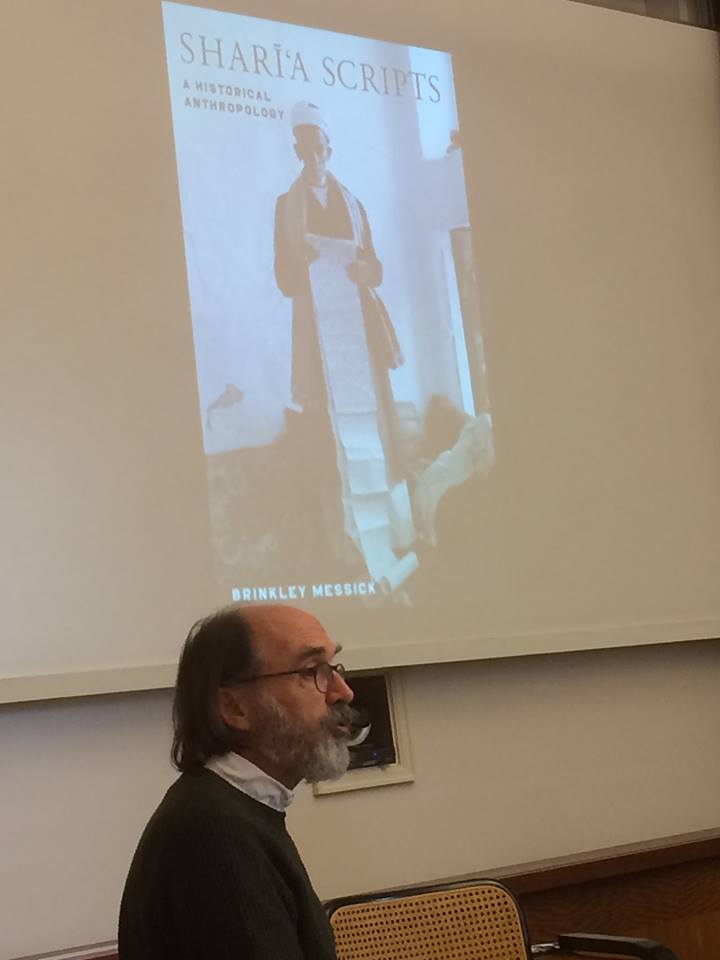
 Prof. Brinkley Messick talking about his new book Shari'a Scripts
I also study Arabic not only for knowledge purposes but also to switch gears from reading scholarly papers and thinking immensely large sociopolitical questions. I also have to remind myself that I am learning for myself, rather than to prove to someone else that I am a hardcore language-learner or Arabophile. I will still take it next semester with Ustaadha Batool, if other conditions allow.

Lastly, I wanted to share that I had the chance to listen to a lot of great scholars of Islam last weekend at the Shi'i studies conference at the Institute of Advanced Studies in Princeton, NJ. It was very exciting to see Arabic skills used for reading primary historical sources.


I might write more about my experience after my exam on Monday. "Allah maaek" to myself lol!

الاثنين، 6 نوفمبر 2017

Some Moments from the film "Forget Baghdad"

The documentary film Forget Baghdad, made in 2002, is actually a remembrance of Baghdad. Four Iraqi Jewish writers living in Israel recount their childhood watching Egyptian and Indian cinema. They also recalled their Communist youth before they emigrated to Israel. Only one of the interviewees remained a communist after he left Iraq. Communism seemed to have been a very historically specific quest that resonated with them at the time, rather than a dogma. One interviewee recalls how he would participate in Marxist reading groups. He gave a very literal take on idealism and materialism, while the discussant leader wanted something more theoretical. Then a worker who had a nickname of “Big Thumb” provided an answer about how idealism and materialism were related in a dialectic sense. The interviewee felt disappointed in himself. I was surprised that such deep discussions took place in those times of Baghdad.

Trailer


All of them recall the protests in 1946 and how many strangers in the city were in solidarity with communists. I had read about Communist movements in Iraq before but I never read first-hand accounts. The site of protest—the British embassy— was close to the red light district, and one interviewee hid with the help of the prostitutes. Another interviewee, Sami Michael, is an award-winning novelist. During the protests, he found himself under the body of his friend which was being kicked by a police. He was so mad, he attacked the police while shouting, "He is an intellectual and he is about to die!" The police would have shot him if it wasn't for a woman in an abaya who stood between them. He ran to the river and was given a boat to escape. He escaped all the way to Mashhad and was hidden in a mosque, even though under normal circumstances he would not have been allowed. I did not know about the restrictions on Jewish people entering Mashhad before watching this documentary.
All the interviewees expressed the sentiment that most of the Iraqi Jews were not Zionists and did not want to leave Iraq as late as 1950. But there were bombs (allegedly planned by Zionists) in Jewish areas that scared many of them away.


Director Samir and his cousin Jamal Al Tahir in front of the Kremlin in Moscow. Originally from Dschoint Ventschr Filmproduktion.

In addition to the accounts given the by the interviewees, the filmmaker Samir provides a lot of context and paints a very complex picture. He shows how there were more politically-sharp newspapers accessible in Israel compared to the situation in Iraq. Many of the interviewees contributed to newspapers and reflected on their relationship with Arabic and Hebrew. The filmmaker  comments on how much of the Arab hostility towards Israel forgets that there are also Arabic-speaking people in Israel. The filmmaker also interviews the film studies scholar, Ella Shohat, who is also a Baghdadi Jew. She discussed how certain Israeli films tend to harmonize the issues of the nation by presenting Ashkenazi and Mizrahi Jews as culturally different but ultimately suitable for marriage and reconciliation. She is a Mizrahi Jew who felt a deep sense of alienation from Israeli society. She recalled how Iraqi Jews were forcibly sprayed with DDT when they landed in Israel. European-style bread would be subsidized by the state, while pita bread was not. Many Iraqi Jews labored on farms in order to win their position in society.
Shohat recounted her first time meeting an Iraqi Arab for the first time when she was in New York. Yet he was also foreign to the concept of Iraqi Jews and had not heard of the Farhood (pogroms). She exclaimed that people’s memories often forgets history. Now, fortunately, there is a Babylonian Jewry Heritage Museum dedicated to the history of people like Shohat.
The writer Sami also admits that sometimes he feels that “In the Arab world we are Jews, in Israel we’re Arabs.” He later laughs and says he is a baklava, a mix of both cultures. He complained that Israel is an ideologist country, superficial and small. Yet he said that he became more accustomed to settling in Israel once his daughter was born: for her, Israel will be her home; and for this reason, he decided to place his roots here for good.

In terms of the language, I could understand the word “fish” when Sami reminisced about the Iraqi specialty. I also understood the words spy (jasoos) and nationalism (al-qaumiyya). Overall it was a deep and engaging documentary film that clearly required a lot of effort.

الثلاثاء، 8 أغسطس 2017

Encountering Followers of Jesus in Beirut

One day, my roommate Dan and I were touring around American University of Beirut as well as the sea front. When we ventured on the way back to our airbnb house, we passed by a bookstore that had an English sign board. I wanted to visit it earlier but always passed it during night time after it closed. This time it was open, so we entered. The decor was very nice and cozy, with a full cafe. Trendy English Christian music played in the background. All the books were related to Christianity. The store also sold decorations as well as stationary imported from China. A math student named Hasan welcomed us and offered us juice with biscuits from a famous western brand. We were a bit hesitant until he said it was his offer. We have clearly underestimated Lebanese hospitality!


Later we met Hiam, who was the person in charge of the place. She had a bespectacled, learned look and a motherly demeanor. Her English accent was quite versatile. When she knew that we were tourists, she warmly recommended some spots for us to tour. Then we moved to a sitting spot to sit down and chat. We learned through her that it was more of a fellowship for followers of Jesus Christ rather than a for-profit bookstore. They had Bible study meetings thrice a week. They also offered us cake from the famous chain Roadster Diner, which was also sent to them for free by some mysterious person. That person sent the desserts in a very passive aggressive way, as a form of apology for some small misunderstanding. Hiam said, "If you are sending the desserts because you think you made us mad, we are really not mad!" But the person still sent the desserts anyways.

Hiam first asked about our story. She asked how we came to decide to come here, since zlebanon was quite "dangerous." I told her I was interested in understanding the society after hearing about the cartoon incident.  She was especially intrigued by Dan, who was half-Syrian and half-British and could speak phrases in Arabic. He was also studying French and Deutsch, so they conversed in French as well. She praised that some people just have a knack for languages, such as her nephew who learned Mandarin, Turkish and Russian in addition to the regular three. She requested to see a picture of Dan's Syrian mother. But he said his mother didn't have a picture. Hiam exclaimed that his mother is quite extreme on the religious front. Hiam mixed some Arabic phrases in her speech and had a very chic dressing style. She is teaches Arabic as a private teacher for foreigners who live in Beirut.  I learned that she has no kids. I said that it is quite fortunate since she would have fewer problems. She said that problems do not come from children or marriage. Happy people find happiness with or without marriage. But she also frowned down upon divorce when she heard that Dan's parents divorced; she did not cite theological reasons. Rather, she finds that two people who have lived together for a long time would find it very difficult to separate and the general outcome is not a good. Her way of talking about the faith reminded me a lot of the people I had met in the US. 


Other tha Hasan, there were many others also helping around the store. One woman, who I will call Jane, shared with us her conversion story. It seemed that she was already from a Christian family from her name, but Jesus Christ did not have the same role in her life until she was healed from a jaw-lock in the recent years. All her close relatives had died from various reasons and she was the only one. Hiam said that she walked through many dark phases in her life. Hiam said that the beggars who usually said "Bless your parents" or "uncle" in idiomatic Arabic did not have anyone to bless when they encountered Jane. One beggar even offered to give her money instead when they heard about her story. Jane was painting a very nice painting with a cross on it. She later played the piano very well and also played crazy, improvised tunes for the fun of it. Her entire demeanor was very jolly, so it was even more intense when she did not smile and looked intently at Dan throughout the story of meeting Jesus Christ, as if that could push him towards conversion in some way. Jane and Hiam had a very casual and close relationship. Hiam used the phrase "Ma too zghale" to ask Jane for a favor and explained to me that it means "Don't be made small".

Hiam also shared the story of a Lebanese man with a Shi'a name in the store, whom I will call D. D was homeless when an Ethiopian maid found him. He was considering suicide. But the maid told him about Jesus's love and introduced him to Hiam's brother-in-law. Her brother-in-law met up with him every day to study and talk about things unrelated to "the street." Hiam said that his mother tried to kill him, which was the main reason for his mental instability and homelessness. She emphasized how unusual it was in Lebanese society to be homeless, since family ties are really strong. (I was a bit skeptical about this claim but had no way to figure out the truth of it.) Both Dan and I listened but later we both found it odd that she was sharing this story with us without D's consent or involvement. He wore casual western clothes, looked around 26 years old and shyly hung around without doing much work related to the store. According to the story, Hiam considered to take him in, since there was room in her place. But she was a single person living with her mother at the time, and she said that the neighbors would talk if they took in a single male. She said that as a follower of Jesus Christ, she could not let people of Beirut think about her religion in the wrong way: "I can't talk about Jesus and do something against our Culture. people don't think nicely." Since he has found a place, he has been coming to the book shop for the past 6 months.

They closed the shop around 8:30. After unexpectedly spending around two hours there, Dan and I left with the others. Hiam said that we should come by again to volunteer or study, and we said sure. I later visited again to introduce my friend Morgana to the project. They didn't seem like they needed extra hands, so I didn't go as a volunteer. Dan brought his brother the next time he went and they also just talked about Jesus. Still, it was quite eye opening to see how some Christians with the evangelical streak are similar in this vastly different part the world. 

الأحد، 6 أغسطس 2017

Identities in Beirut: Who is an Arab?

Overlooking the street in Hamra from the balcony of where I lived
During my one-month stay in Beirut, I mostly walked and took the bus to the Arabic language institute Saifi in the area called Gemmayze. I lived in Hamra, which is towards the west side of the city. Although they are only three miles apart, they are vastly different. Gemmayze is an art district frequented by hipsters and fashionably-dressed tourists at day and party-goers at night. While Hamra is also known for its party-goers and tourists, the European / white Americans are less conspicuous. More locals patronize Hamra, which has also been known for its historical cafe culture. More pan-handlers are also visible in Hamra. It is also much more hustling and bustling throughout the day and night. In between these two areas, I would cross by heavily guarded Christian churches, poorer Shi'i neighborhoods, as well as the heavily gentrified / reconstructed Downtown area. 
Houses of a poor Shi'i neighborhood


Through traveling from the West to the East side of Beirut almost every day, I picked up many markers of gender, class, and sects in the urban spaces. While the class differences and high level of commercialized property in Beirut were more obvious to me, symbols of sects and discourses surrounding identity also came to me through my walks or chance-encounters. This is one of the experiences I have encountered; it is significant not only because the conversation was related to identity, but also because it was one of the few times the interlocutor was extremely vocal in regards to politics. I will write at least two more, featuring a Christian book shop in Hamra and a friend who lives in Dahiya.

________________________________________


On my last day in Beirut, I ordered an Uber car for my trip to the airport. Dani accepted my request and drove up in a rather large car. He could not help me move the luggage from upstairs, since he could not leave the car unattended, but he helped me load it in the car. I was very flustered because I packed most of the things last-minute and was drenched in sweat. I was also worried about the cab fare's payment option, since I was not very familiar with the Uber app. (The last time I used it was in eight months ago.) The east-bound traffic was also terrible. Dani noticed my stress and he was very eager to divert my attention to other things. He offered me water and mints and told me that even if the payment doesn't go through, things will be alright. I noticed that there was a wooden cross hanging at the rear view mirror as soon as I entered the car, and picked up that he was probably a Christian.


He could speak some sentences in English, such as praising the flavor of the mints or informing me the adequate time one should arrive at the airport for an international flight (3 hours, according to him, although later I found out that nobody really does that). I also used some Arabic that I learned over the summer course.  I learned that he is 42 years old and lives about 20 minutes away from Beirut (Either in the town of "Baouchriyeh" or "Bacha"). For more complicated conversations, we relied on the Google translate audio function on his phone, which was surprisingly accurate. Somehow he knew that I was in a very reflective period of my life. He told me in a heart-felt and philosophical manner that happiness is most important thing. "Money is not important. If you have a loving family and a house of your own, you will be happy," showed Google translate. He was curious about my deal in Beirut as well. At one point he asked me if I work for the US government (in a totally calm and natural way). I knew that many Americans in the region probably work for the government, so I said no without thinking too much about it. Then he asked, Why are you studying Arabic? I tried to express my interest in politics and history. He was even ready to settle for the seemingly unsatisfactory answer.  Then I landed on "hab"(which i wanted to use for a special interest in  cultures) but then he understood it as love in general. I also accepted at that point of the difficult conversation that the reason can be explained as for love. I said I have an Iraqi friend. 

"Have you been to Iraq?"

"Not yet. Will go some day."

I said that Beirut does not seem to be a very happy place. He did not disagree outright, but explained it through economic terms. He said that Lebanon has a lot of money. Some people have jobs and money, some people don't have money. Some people work a lot, and have three jobs. 

He complimented US society because it is the dream for a lot of people and is the land of opportunity. I did not know how to explain to him the various issues of race and economic inequality, so I just nodded along. 

Then he started to talk about how the politicians in Lebanon are corrupt. He said that Lebanon is using a multi-denominational system. There is no accountability because of this arrangement. I said that there will be a new constitution next year, so hopefully things will change then. He said that if they apply constitution, Lebanon would be the most beautiful country in the world. (In my opinion, it is already very beautiful, but I thought it is always nice to aspire to more as a public citizen, so I didn't say anything.) He also pointed out later that there is trash littered on the road to the airport and it hurts him to see it as such.

Then the conversation took a surprising turn. He started blaming Arabs. He said that 90 percent of Arabs are bad. I asked, are you not an Arab? He said, I am Phoenician (Fini). I did not need Google translate for this identity marker.  I already knew about the politicization of the ethnic marker Phoenician and it was also featured during a Father-Son dialogue in the film West Beirut. (It was also strangely similar--they started discussing problems of Lebanon and how the Arab world has made it worse, to which the son decidedly distances himself by declaring that he is Phoenician.) The last time I asked this question related to the Arab ethnicity was during the start of my Lebanon trip. A friend of my host, who I will call W, was giving me a concise version of his view of Arab historiography. His politics of Arab nationalism, which included a union of Jordan, Palestine, Syria and Lebanon, stemmed from his view of history. At one point I asked, if everyone is "Arab", then why different languages exist? And are you an Arab? W said that different groups of people decided to adopt the language, and that those who did adopt the language "became" Arab, like he did. The ironic thing was that he was a light-skinned ginger who has emigrated to Italy and often passes as an Italian.

Back to the cab ride. Dani proceeded to say something that astonished me so much I could only laugh: "The Arab was created to sleep." Google translate wrote. I was kind of confused until he clarified with gestures that he meant--Arabs were created to eat and sleep. He explained that Arabs take things for granted: "Thank you China, thank you Japan. Without the west we would only be on horses. No cars, no nothing (Ma fi shi)." I did not say much to that, because it was the first time someone was so honest to me about this issue. Later he helped me exchange my remaining Lebanese pounds to dollars, we arrived at the airport and I shook his hands goodbye. Behind this sentiment is a lot of colonial baggage (akin to intellectual and dissident Liu Xiaobo's statement that China should be colonized for societal progress) and also reveals the trend in which many Lebanese Christians have emigrated abroad. I am still confused how someone like Dani could be so attuned to societal problems and care for its betterment yet still come to simplistic conclusions. It is far too simple to say that Dani is "racist" or pro-Western: at least he has chosen to stay in Lebanon. He could see that religion is not only a practice but also an institution, since he knows that the multidenominational institutions in Lebanon systematically separate the people into groups so that the elites can divide the spoils. These were the same sentiments expressed during the 2015 "You Stink!" protests against the corruption of the Lebanese government. (Read more about the antagonistic relationship between sectarianism and government reform from the chapter "The Architecture of Sectarianization in Lebanon" by Bassel Salloukh in SectarianizationStill, I am hopeful that behind contradictory notions, there is also hope.