‏إظهار الرسائل ذات التسميات Arabic. إظهار كافة الرسائل

الجمعة، 7 يونيو 2019

Ramadan 2019: Day 25 - Eid al-Fitr

I will skip writing about some days, partly because I am lazy, and partly because I want to discuss the feelings of the end right now. I usually did not have a lot of opportunities for making meaning with others in previous endings of school or relationships. Eid is very special in that sense because it is a public celebration of the end of an intimate matter related to the body and soul. Astrology appeals to me for the same reason, because some humans become aware of the lunar calendar and celestial order through astrology as well. The lunar calendar of Chinese Han culture did not make a very deep impression on me prior to the discovery of Islamic months and astrology.

On Day 24, Khalid, Walid's brother, called us and Walid told him about my day of fasting. Khalid has two sons, who are very cute in their different ways. He recently went through a divorce, and I was curious to see that he was still wearing his wedding ring. He reminded me of my parents' experiences, even though I know very little of either case. He asked if I was happy being with Walid, and I said sometimes. He said it's ok, we are also only sometimes happy with Walid. I enjoyed his self-deprecating humor and openness to my emotions. He told us that he was learning English because he wants to communicate with me when I visit their house.


Day 25 Thursday

Stills from the film Shadow Play (2018) directed by Lou Ye
In the afternoon, I watched a Chinese thriller film, The Shadow Play. The Chinese name of the film is also adapted from a famous Mandarin song, "there is a cloud made up of rain, floating in the wind." The Taiwanese woman A-yun, whose name means cloud, made a fortune in mainland China during the prime years of her youth. Her untimely death despite her wish to return to Taiwan also reminded me of the lack of ritual that can mediate my coming and going from mainland China to the U.S. In contrast, I really appreciate the different Islamic ways of mediating different forms of existence and relationships to place, such as the verse read before traveling.


Afterward, I went to the big mosque because Walid told me that there would be fish in the evening. I sat at my usual corner and continued to read Empire of Guns. It was my first time visiting there without wearing a hijab. Walid later introduced me to his co-worker's fiancee, who is a practicing convert. She told me that the mosque during Night of the Decree (laylat-ul-qadr) was fully packed. We both were curious about each other and talked for over an hour. She started her studies in Boston last year and lived along the green MBTA line. I also met one of her friends, a student from Turkey. But in the end, the curiosity seemed to be largely intellectual and felt like fieldwork. She did not seem to have had many Asian American friends and was surprised that I could be both Asian American and Han Chinese. It is also partly due to the fact that fewer women of color engage in the public sphere. She seemed to be self-conscious about her origins and her single-parent mother, as was I. I congratulated her on Eid in advance because I knew I would not see her before then. The fish was a little bland but I was grateful for the free food.


Day 26 Friday - Eid al-Fitr (Tuesday for some, Wednesday for others)

On Saturday, Walid and I bought some more food and a blender from C0stco. He thought he might give the soon-to-be-wed couple a blender as a gift as well.

I received my first issue of the International Journal of Middle Eastern Studies in the mail today. I joined their membership recently because I will present at the upcoming conference in New Orleans. I was very happy to read Dr. Max Weiss's article, which called for critical Ba'ath studies, rather than reproducing the "war-mongering" rhetoric of the post-2003 era.

On Sunday, I watched an interesting video about feminine energy. Walid and I walked to the park nearby to bathe in the sunlight and I tried to discuss some of my spiritual goals in life. He and I talked, looked at animals and also heard some children play nearby. He also climbed a tree, which I thought was quite cool and funny.

During the following days, Walid and I continued to have conflicts over our interpersonal relationships. We ate his last iftar together and he sang an Arabic song jokingly, that said, "I wish Ramadan was longer." I mourned June 4th, which was the 30th anniversary of the Tiananmen Massacre. Walid celebrated Eid with the mosque community while working on that day. He started work at 5am for necessary preparations. He met Omar, from Taha collective, and wrote a Faceb00k post about it. The other people from Taha collective started celebrating Eid mostly on the later day, Wednesday.

I was glad and relieved that it was over. I felt overwhelmed with the connotations of the holiday and Walid's work schedule. I wished Ahmad and some other close friends "Eid Mubarak", but not as much as I had expected when this month first. I was happy to see snaps of people in Gulf countries all dressed up, hanging out, giving children money and getting new haircuts. I, meanwhile, gave and received zero gifts.

On the bright side, at least I did not have to call any relative I did not want to call:

from a meme group on Faceb00k

Reading the following tweets saved me from more bitterness--


I wondered to Walid, why I only hear from people who are distributing food to the poor, but not poor people receiving food offerings during Ramadan (except me)? The good news is that I finally successfully submitted all documents for food stamps received news from the Massachusetts DTA on this issue. I was grateful that this unusual schedules ended and Walid's non-Ramadan schedule is more similar to my summer schedule. Walid ate plenty of dates at his workplace and perhaps will return to his non-date diet, which usually lacks fruit. I also finished my box of dry dates that I bought a long time back during the last days of Ramadan, 2019.

Doraemon themed Eid al-Fitr Celebration graphic. Interesting to see the Japanese anime characters in Islamic clothes....


الاثنين، 20 مايو 2019

Ramadan 2019: Day 12-13

Day 12 - Friday


Walid and I met up at 7pm and went to an iftar hosted by members of the Taha Collective. The event happened at an apartment close to MIT. The woman at the front desk asked us cautiously, "are you here for the event?" I said with a tad bit unsure, "the iftar." Walid was more used to communicating such details and soon assured the woman that we were indeed here for the fast-breaking dinner.

We arrived via the stairs since the elevator required card access. Many attendees were also from MIT, mostly desis and some white Americans. The graduate of Rutgers, Omar, talked with us about his Ramadan; he cannot fast due to his health conditions. I had only seen some people at previous Taha events, which had lecturing and/or duas commemorating virtues of the Imams. This event was more relaxed and focused on socializing, which I did not like in such cliquey environs. Someone discussed with enthusiasm about their shared city of Hyderabad and their routine. Another gossiped about the rent of the apartment, which I was also curious.

I remembered the time when I thought I would have no trouble making desi friends when I arrived in Boston, which soon proved to be wrong--not everyone can engage with me fully while also dealing with the strained life of American identity politics. We sat at a fireplace and some college students watched distantly. I had a brief conversation with a woman in the biryani line. She was a researcher at MIT. She also found the pretenses quite strained and gave up. I thanked Irtaza, who was paddling out the chicken biryani. I also said hi to Laila, who looked tired, possibly just finished with her coursework.

He prayed with other Muslims and later wrote a nice message about this interfaith experience on his faceb00k. This created a lot of conversation among his male friends. We both noticed that when readers do not like our message, they tend to note typos in our text rather than say outright their issue.
انبارح كان فيه إفطار منظمه شباب من جامعة هارفرد. فطرنا على تمرات وميه، أُذِن للصلاة وكان الأذان مضاف عليه " حي على خير العمل". وقفنا كلنا للصلاة، كنت فاكر ان الوحيد -المتفتح ومتقبل الاخر- اللي هيصلي زي السنه وسط شيعة، بس لقيت معظم اللي حوليا زيي.افتكرت الجدال العقيم اللي كنت جزء منه عن ان الشيعة مننا ولا من الناس التانيين. بس يبدو إن مستوى التعليم والبيئة المحيطة لها تأثير كبير، لدرجة مكنتش متخيل أن حد من اللي معايا دول كان جزء من جدال بالنوع دا. بالمناسبة طلعوا بيصلوا زيييينا بالضبط تقريباً والأهم من كدا الأكل كان حلو.

There was some confusion over the direction of prayer. We joked that the leader of the prayer is quite headstrong in his mistakes like me. We took a group picture but I have yet to receive it...

I brought pecan pralines from c0stco. I did not think that everyone could finish it at first. Soon after iftar, someone started hogging the whole box and finished all the whole pecans.

Walid noticed another Egyptian man present, who served the dessert. Walid did not feel like striking up a conversation that would soon become too intimate.
We left and walked along the red line over the river. It was my first time walking over the bridge despite crossing it thousands of times on the Red Line. We took selfies and parted ways. I had trouble sleeping because I was nervous from the social gathering as well as for the next day's schedule.

Walid also shared the good news that he secured a job at the big mosque. I am happy for his new opportunity but I am also concerned with the forms of political engagement that this would entail.


Day 13 - Saturday
Art by @ejnoodles
I left the house at 6am in the morning, one of my first times leaving so early, and went to the Isha yoga class taught by Sam and Tulsi at the Democracy Center, Cambridge. There were only two students, one was a person called Jose from Mexico. At 12pm, I went home, felt very tired and slept after lunch.

Walid and I met at 5pm, after my nap. We danced a bit outside the house. I made some Chinese noodles for our dinners.


ZZZzzzzz

We finished the Avengers: Endgame at night. I enjoyed it more than Walid, who thought it would have been a waste of money to watch it in theaters.

(*SPOILER ALERT*)

I noted how the patrilineal message linked with the Avengers' legacy: If the white Captain America stayed anonymous after his decision of not returning to the 21st century as the 40-year-old self, there would have been no proper passing-down ceremony. Still, he came back and gave his shield to an African American superhero. Black Widow sacrificed herself in a very sati fashion, took one for the team in all eternal glory. Tony Stark doesn't have to leave his daughter any symbolic legacy, and we as viewers are happy that she is financially secure. The threat of any female characters using the stones for her own legacy was out of the question (note how asexuality played a role in Tilda Swinton's guardian-of-the-stone character).

We also discussed how literary traditions affect the kinds of films each country makes. Walid thinks that Americans love superhero movies because of the lack of myths their country has in comparison to Egypt. Peter Hessler makes a similar point in his recent New Yorker article: My House in Cairo https://www.newyorker.com/culture/personal-history/my-house-in-cairo

Walid also discussed his techniques of improving family relations with me. I wanted to sleep and we soon slept, even though Walid wanted to talk more. 

الجمعة، 17 مايو 2019

Ramadan 2019: Day 10-11

Day 10 Wednesday

Walid and I reflected before on the first instances when people called us "uncle" and "aunty." I was called aunty when attending college. Walid's nephew, Asar, called him "ammu Walid," which made Walid conscious about his age.

I went to the hairdresser in the afternoon. She was quite dressed up, in all black clothing and sharp cream-colored gel-nails, which helped me feel that I was also going for a "makeover." She was also quite focused on making this trip an "experience," asking a lot of well-meaning questions, and showing the end product through a dramatic build-up. She offered a lot about herself as well: unmarried (despite wearing a ring), easygoing, likes to travel to Europe and the Caribbean, of Italian descent...

I felt uncomfortable when she kept praising my straight hair in front of two other ladies of African descent and mused about the origins of this interracial hair salon. She also noticed my frequent yawning and asked if I partied last night. I felt slightly obliged to educate her on the idea of Ramadan. Instead, I gave up and offered a sheepish smile.

I waited for a bus transfer for forty minutes without cellphone service while Walid waited for me at Malden Center. The rushing cars, suburban decay, and the manicured, external facade left me feeling apocalyptic. The habitus of the well-tended gardens and individual houses can render immigrant existence as largely ahistorical and destined for such depressing, parochial pastures.

I reunited with Walid and complained about the foreignness of the aging suburban community and my out-of-place-ness. Walid was quite understanding although he was tired of waiting at the station. We recharged at the Indian take-out restaurant while I ate spicy palak paneer with a mango lassi. The restaurant played a punjabi playlist, including Punjabi Mast, which swept some of the blues away. Other days the TV played teledramas or Hindu and Sikh bhajans. I wondered if internet connectivity was more essential to diasporic people than non-diasporic people in the U.S. I realized that the cook/cashier man lost a lot of his hair over the short time I had met him. Walid thought it could be from stress.

A picture of maqlooba from Fauzia's Kitchen fun
We bought groceries and Walid helped carry it all the way back. He was excited over the $2 / pound mackerel that would be perfect for his baking plans. He broke his fast with the remaining lassi, while uttering the words prior to iftar. He made a vegetarian version of maqlooba and we both enjoyed it.


I felt ill in the evening and Walid read surat al-jumaa for me. I found the message about Jewish people eye-opening and somewhat disturbing as well. One version of the explanation is that the passage meant that if certain people think they are favored by God, they can "prove it" by desiring death since that is a sign that they are sure that they will enter heaven (jannah). But this life is attractive in its own ways, and among all the people I have met, only a few who I have seen in Asia have truly achieved that level of consciousness.


Day 11 Thursday 

The sun finally appeared after days of rain and clouds. I chatted with Amina in the morning, which helped me wake up my brain. I learned more about updates in her life while offering some of my wisdom on how love affects one's spirit, without using those words as such. Later, she messaged me and said that she finally realized that over-rationalizing prevents other sweet aspects of life.

I read Dr. Kecia Ali's interview of scholar amina wadud, and was comforted by the fact that Buddhism helped dr. wadud realize that God's form is not limited to an old white man in the clouds. She also said the following quote about her lived engagement with theology: “I don’t believe in a dead God; I believe in Al-Hayy, the Living God, and I don’t practice a dead religion.” The following passage is also quite illuminating:

I think in becoming a Muslim I intuitively knew, as did Africans who were brought here and enslaved who had Islamic backgrounds, that you are connected to the entire planet. You are not separated from Divine truth just because you’re separated from your origins. The reality of the sacred is manifest everywhere, in every religion, and even in nonreligions. I see that manifestation, so I’m no longer so estranged by the mandate to define a territory as exclusively mine, as a Muslim, as a woman, as an African American.

I felt rather hyper and full of energy. My roommates discussed their graduation plans and incoming relatives. One roommate's deadbeat boyfriend possibly cannot attend her graduation. I felt sorry for her.

I listened to a podcast about a study on migrant laborers in Beirut. In between, I called Ahmad and wondered if any successful Syrian ever wrote about his or her account of life as a businessperson in Lebanon. I finished the podcast, wrote down some thoughts, and ventured to school. I drank a cup of coffee and saw a few fellow students, some of whom were still grading tests before their graduation.

I read the "Repression in the Fieldwork" chapter in anthropologist Pascal Menoret's Joyriding in Riyadh and learned a lot of useful information. I liked his description of his as well as his bedouin informants' tufshan (emptiness and repressed life).  The level of social suspicion described by Menoret reminded me of the telfaz11 short that depicted a thief who tried to enter a shilla and pretended to be related to one of the absent friends of an all-male gathering.


I found anthropology quite personal: if you don't like the researcher, it is hard to relate to the moods described in the ethnography. In contrast, the data in history is impersonal. During that time, my friend CP texted me about the death of I. M. Pei. I told him that I also visited places of his works, and felt the loss of this great Chinese American architect. CP found it impressive that I had traveled to such places.

The Arabic translation's book cover
I returned my professor's book and printed some reading. I printed and began reading Baudrillard's Forget Foucault on the way back to Malden. I would not have been susceptible to such a title prior to this summer break, possibly because I have realized the limitations of working with the archive, truth, and genealogy. The first section discusses how capitalism has destroyed our understanding of sexuality, with finer words. He discusses how liberation can also be part of repression, which is interesting to think in terms of the social conditions of Egypt, Saudi Arabia, and China.

I also found relief in the sensibilities both Walid and I share, to some extent, in regards to how to discuss taboos. While taboos are generalizable, different cultures have different reasons and manners to observe those taboos. Luckily for us, we can come to the same habitus and understanding in regards to sexual taboos. When I was young, I liked generalizable information on such subjects, since they can help navigate the terrain. Now, after marriage, the practice is about what Walid and I share as truth and does not matter what works for others. Science tries to be generalizable, but ethics are specific and interpersonal. I have yet to read works on a queer modernity's vision of ethics, that would be as informative to me as Bedouin ethics of manhood, described by Menoret.

I once lamented to Walid that there are fewer and fewer people who can think with me. Many people can think against me (as is often seen in trite academic debates). But that is perhaps I have matured and found comfort in my own thinking patterns.

I met up with Walid at Oak Grove. He just finished his first day at a pizza place. There were Iraqi kurdish coworkers, one of whom worked at the same place for seven years. The Egyptian owner found Walid's skills to be quite good. Walid did not find the food suitable for himself there and waited to eat his own maqlooba. We listened to the music of the carnatic violin. I was surprised that he could appreciate the music, which my mother cannot. He joked that he cannot change this type of suffering, so he might as well enjoy it. Then he played Black Thema's song fi bilad ay hagga, which was quite depressing.

I quoted to him a version of this quote: “A poet might die at twenty-one, a revolutionary or a rock star at twenty four. But after that you assume everything’s going to be all right. you’ve made it past Dead Man’s Curve and you’re out of the tunnel, cruising straight for your destination down a six lane highway whether you want it or not.” - Murakami

We walked around the neighborhood around 11pm pretending to smoke. We saw the moon and Walid remembered how a sahaba said that the Prophet Muhammad was more beautiful than the moon.

On the way back, we discovered a skunk. Walid remembered my grandpa's cautionary tale of the skunk. We translated its name in Google and found out that skunks are unique to North America. Animals truly humble our ways of knowing and bring attention to our limited existence.

Walid wrote a very beautiful poem for me in our collective journal. We drank a can of soda, ate a lot of pepper jack cheese and slept. 

الخميس، 16 مايو 2019

Ramadan 2019: Day 8-9

Day 8, Monday

We spent the morning browsing at potential domestic appliances for our future house, such as blenders. Walid knows the bougie knowledge of making $10 acai bowls and I am quite intrigued.

picture from allevents.in
Browsing consumer goods is a very nice nesting activity. Walid is very careful when it comes to such matters, whereas I am more impulsive. He also wanted to engage in sketches of the future, possibly because of the rather disappointing present. He lives with four other roommates and they have formed their social circle already. They share a rice cooker. Walid pondered whether the Chinese landowner owned the cooker, which would mean that he could also use it. I reasoned that the rice cooker is jointly owned by the roommates since the landlord could not possibly anticipate what the ("ethnic") dietary needs of his future tenants would be. Walid concurred, yet he still wanted to use the cooker. I said it is much easier if he would just buy his own. (But these are just theories since our information is not very complete.)

He also thought about the possible redundant microwave. I reasoned that the microwave might be useful when we babysit for other future friends. While such concerns of the future have yet to materialize in real life, the theme of diets and health enter again and again in our food-conscious world. My further interest is also whether intercaste "pollutions" also apply to microwaved food... (Because if a lower caste prepares a certain food and the upper caste eats, some upper castes consider that food to be polluting.... but I learned about the version that presumes an India without a microwave. So I wonder what if a lower caste prepared food with the microwave? This is also theorizing because I also know upper caste men who eat at any outside eatery.)

At this juncture, American Islamic discourse is also keen on pivoting Ramadan as a diet-conscious regimen. "It is healthy to fast," so the talking points go. I complained to Ahmad the other day that I found such blatantly market-oriented packaging quite contrary to the point. He agreed with me. A future academic paper can write on this subject.

After meditation, I realized we ran low on time. I scanned some noted pages from my books. We proceeded hurriedly to my school for book returns. We carried around 15 books and dumped them unceremoniously. I haven't finished the extraction of information (on Arab modernism) from these books. Still, I was relieved to hide them from my sight until I am ready to revisit them again. I sat lackluster at the 1000-piece puzzle station while the last remaining finals warriors slaved entered the library to finish their work. I joked that I could destroy the puzzle with end-of-semester rage. Graduating students posed next to the blossoming flowers and benches that no one sat on usually. I jibed that no wonder those benches were built...

We both went to Assembly for my second spa session. The concept of aging has formally entered my mind, perhaps exacerbated by the (ableist) academic timeline. Afterward, the rain began to fall. Walid left for iftar at the neighborhood mosque. This evening, the imam led a curing session for a young boy, possibly suffering from the manifestation of a physical/mental illness. The rest of the (all-male) congregation read surahs from the Holy Quran, since the jinn could leave from the boy's body and enter anyone else's.

In the evening, I chatted briefly with my friend Subhash, who has arrived in China for the first time. He posted some beautiful pictures of his yoga practice in the heart of Shenzhen. Still, he seems to be experiencing culture shock and seeks to alleviate it by talking with me. I am myself suffering from culture shock and the dizzying effects of racial animosity in Boston in my second year, and I have very little to offer him in terms of how to ground oneself in a foreign land.

I also chatted with Amina over Wechat about my recent interest in the Chinese classic Rulin Waizhuan and how it related to current politics. Amina was more keen on sharing her new thoughts based on her romantic encounter with a person from the past. She feels very nostalgic yet tends to over-rationalize her romantic decisions. I, on the other hand, feel no compulsion to rationalize unless I have to explain to often undeserving interlocuters curious about my life.


Day 9, Tuesday, Walid's birthday

Walid's friend Ahmed drove him around the Boston area for jobs. An owner of a pizzeria worried if Walid would learn all the techniques and leave. I joked that a lot of Egyptian food, which Walid has experience in making, requires more techniques than a mere pizza. The making of fateer, for example, requires much more intricate handling. Walid's job interviewers also tested his religiosity by offering him food. After finding out that Walid is fasting, the would wish him Ramadan kareem.

We met up at Wellington and headed to C0stco for the first time. Walid's progress in Hindustani is improving, as he watched more language videos provided by a hijabi Youtube teacher. He enjoyed the prospect of sharing our expenses since it signals a move toward a shared household. I also felt excited over this trip for the whole day. I asked if he wanted to pose next to the C0stco flowers for his birthday. He just took a selfie with me and said that I am more beautiful than the flowers.

On the way back, our Lyft driver played beautiful Nigerian music. I shared some in my music group as well. I ate a bowl of the instant shrimp wonton and added some capers. Walid snapped a photo of me and sent it to my mom, joking about himself about how he can only watch me eat.

English version of the translation
Walid went to break his fast at the Malden Islamic center while I read a book by Qiu Miaojin (邱妙津) from the Public Library. She was the first lesbian author who committed suicide when she was 26, which is also my current age. I enjoyed seeing her handwriting of Chinese characters printed in between the chapters. She suffered from studying abroad and a lot of her ideas of art come from Western forms and definitions. Unfortunately, in my opinion, she did not have the chance to truly experience art forms without a large degree of Western influences, which impeded her ability to create art according to her high expectations. Western definitions of what is "political" also haunt her own identity--she denies that the word "homosexual" has meaning beyond a political identity. Yet does that mean that queer politics did not exist before the arrival of Western science? (which sought to define the homosexual as a medical subject...) Her writings are interesting yet reveal her age and obsessions with the western novel as well, often too vaguely masculinist and dependent on the reader's proper aesthetic engagement, without a clear ethical grounding.

french version of the translation
While I read the book at Dunkin Donuts, a white female "customer" was trying to pick a fight with the Nepali cashiers. Luckily they were very strong and did not heed to the "customer's" aggressive baiting. "I'm going to call customer service and report this Dunkin Donuts!" I focused on the warmth of my small coffee. Soon the tension abated. I joked with Walid on the way back that this is what I got for choosing the "community" coffee spot as opposed to the nearby Chinese coffee establishments, which would have much less commotion. I also told Walid that he can also make great art--the kind that Miaojin aspired to create--and that he just needed more courage and time. He also mused on this subject. On that note, I also shared that Ahmad sent me an Arabic poem recently, and we planned to read it together.

We cooked at home, ate Tiramisu, sang the birthday song in Arabic. During midnight, we watched The Avengers: Infinity war, which caused some unwanted nightmares again...


الاثنين، 30 أبريل 2018

Arabic Music Performance in Boston


Boston College organized a free Arabic music concert on rainy Sunday night, April 15th, at Gasson Hall. Prof. Ann Lucas said the introductory remarks first in English and then in Arabic. She welcomed us with “أهلا و سهلا” and also wished that the program will continue in the future (في مستقبل) Many of the audiences also were Lebanese. I stood throughout the show because all the chairs were taken. It was my first time at such a formal Arabic music performance. Before my exposure to music of the same region was mostly dabke and zajal music.


The main show of the evening featured  Lebanese oud performer Charbel Rouhana. Before he went on stage, the ensemble and chorus performed Levantine folk songs featuring themes of love and scenes of nature in the first half. Children of the Center for Arabic Culture the opened the show with My Darlings Around me (حبايبنا حولي), conducted by Syrian lawyer and conductor Alma Riceh. This choir is the only children’s Arabic choir in Massachusetts. The remaining choruses were directed by Nizar Fares, a Beiruiti who holds a PhD in musicology. During certain intervals, the Qanun player also had his solo parts and the audience responded with loud applause.

from Wikipedia


Dr. Fares, who also plays the Oud and is a musician in his own right, praised Charbel Rouhana to have accomplished what he thought as excellence that required an average person at least four times the amount of effort. Rouhana took stage and played several more numbers of Levantine songs as well as Oud-centric musical arrangements for us. The later learned that the oud is an instrument 3500 years old and has heavily influenced the Spanish guitar. 

Gasson Hall April 15th; Picture found from website


I also attended an Oud performance in Beirut, where I sat very formally at first; but I soon realized that Oud could also be entertained for a dance party. The crowd in the bar rose to their feet and also made requests upon the performer. I later found out that Rouhana also performs Oud in jazz style.

In this case, at Boston College, it was modeled off of a European influenced understanding of a performance. I had read about Umm Kulthum’s rise in fame as well as her collaboration with old forms of performances. While she retained the formal Arabic language in her pronunciations, she also contended with the new arrival of film and dressed in European dresses. 

Umm Kulthum and her ensemble

The Lebanese dialect lyrics of this musical performance was transliterated and translated for us to follow. I could understand “moon” and “lover.” During the call and response sections, I also participated in the choruses. I noticed that the gender of the addressee is important in Arabic; God would be presented as a gender-specific figure in literature and poetry. In contrast, Indian Sufi music addresses God in gender-neutral terms.

After the last amusing song Qahwa (coffee), a nun from Lebanon presented an award to Boston College’s music department, commended this performance and also praised the ability for music to communicate through all cultures. She also looked forward to future performance exchanges in Boston. Rouhana also signed his book on Maqam for people who were interested in purchasing it. I would like to learn more about Arabic music theory in the future.

السبت، 16 ديسمبر 2017

Learning Arabic Here and There


It has been five months since I started learning Arabic! Although the actual time I have put in studying is around three months. I took a break in between the Beirut Urban Arabic class that happened in July, and the college Formal Arabic 1 class, which lasted from September till this week. I treated it like a daily vocation in July. The task kept me floating and motivated to leave the house. Beirutis were eager to communicate with me since 1) I was such a novelty to most, so they wanted to ask why I am here; and 2) we often had business to communicate, e.g., the bus driver would have to communicate me if I wanted to go somewhere. Even though people say Beirut is not the best place to learn Arabic, it was still an inviting environment. I also had the wonderful classmate, Morgana, who would practice with me in the bus or in the hostel room. Even though one time I was suffering from altitude sickness, learning with a friend was doable.


Ahmad and Morgana in our Urban Arabic class


My teacher in Beirut, Ahmad Orfaly, was also very patient and kind in the Urban Arabic class. He was also humble and said he would not be able to teach the formal Arabic course. The textbook was very well-designed and did not have many family-oriented questions.

In contrast, the Alif Baa and Al Kitaab textbooks we used in the American college classroom have quite a lot of dialogues involving family, which I dislike. I would freeze up every time I was expected to talk about my family. I think my teacher knew, and الحمدلله, she didn't ask about my family during the oral exam.

In class, we are also careful to avoid any racy or controversial topics. In contrast, in Beirut, we were aware of the country's painful past, such as when we learned the word rafiq, (رفيق) one asked if it is the same as the name of the former PM, Rafic Hariri. (It is.) Then we got into a short discussion on his assassination. Students would travel outside of Beirut almost every weekend, so sometimes we would also discuss the ongoing news, such as the Lebanese military action in Beqaa Valley. I could also combine the information I learned from the street environments for my homework, such as "al-Hamra." In contrast, we are much more removed from such contexts in the American classroom, so a lot of brain power is put into use to make something up or look up how to write "Boston" #بوسطن. I exclaimed once to my Saudi friend Abdullah how amazing it is that American places can also be written in Arabic. It is just that I am so English/Chinese/Indo-centric that I never expected Arabic-speaking people would write Boston in their own alphabet. My friend Ahmad told me when I was in Beirut that Arabic has been less susceptible to new English loan words since there are many roots that can make new Arabic words. So even new things like airplane has its non-English phonetic word.


I learned the word "street" this semester, even though I already "saw" it in Beirut.

I also felt awkward bringing up current events, since I did not know if my teacher would like to discuss it or not and whether or not the other students would be interested. I know that it shouldn't be the responsibility of those suffering to discuss matters such as the Muslim Ban, and yet it is the Elephant in the Room. She did once light-heartedly bring up Donald Trump and used photos from his family in a powerpoint for us to practice Arabic; but the politeness reigned. Once she used the Arabic BBC website for examples; hopefully next semester it would become more integrated. We also had video materials recorded by the textbook producers. Our language department also organized a couple of Arabic events, and I attended one film screening.

Exposure to the Egyptian dialect was a useful component from Alif Baa and Al Kitaab. I was much more acquainted with the Levantine dialect before. Other than the most common greeting words, the knowledge for accents were not required; it was just used as an aid for context. The Arabic teacher, Ustaadha Batool, is also very sweet and kind. She sometimes shares her life from Egypt with us in the class. She has a PhD in theatre and also incorporates theatre skits in her teaching. Writing those skits also improved my general sense of the Formal spoken pattern.

The class in Beirut and the class in the U.S. were equally challenging; perhaps because the U.S. course is modeled off of the Middlebury program, which is the country's best. Ustaadha also used to teach there, as well as the editors of the textbooks. She had a good eye for spotting any missing diacritics, which I did not have to know in Beirut. I was mostly cruising along the first few weeks of this semester, since I knew the alphabet and basic grammar. Later on the course was still intense and introduced a lot of new material. I got an A from the Beirut class and will probably pass this class as well; but if I took it for ABCD grades, I would probably not get an A this time around.
Ustaadha told us that the college Spanish 1 course doesn't even teach as much as what we did, and the Spanish-learning students already know most of the alphabet!

This semester, I relied my friend, Ahmad for practicing oral dialogues or grammatical questions. I am becoming more familiar with the available English-Arabic online resources, such as dictionaries and Youtube songs / Quran recitations. Google translate now also has a new function function--when typing in latin, Arabic can show up in the text box directly. I also watch Snapchatters from the Gulf talk about their lives in Khaleeji accents, and it has been a great source of motivation. Their consistency seems to remind me that even if I flunk the course altogether they will still be there speaking Arabic.


A snapshot I took from a snapchat post by Arizonan / Qatari snapchatter Aziz


Sometimes stress makes one feel like everyone else will also stop because your "world" has "ended." I felt more angst and stress due to other factors while taking the college course. I had 5 days of Thanksgiving break in which I did not study Arabic at all, as well as the two days this week, after turning in all the papers. As I become more and more acquainted with my brain's relationship with language, the time spent Not-Studying is often as useful as Studying. There is a good Anonymous piece from The Guardian on how language learning helps combat depression.
...the hardest part of the process is being kind to myself. The voice of depression always chides me for not doing more. It is true that learning a language can often feel like an immense task, but breaking it down into steps – one more podcast, one more Duolingo lesson, one more chapter in my textbook – can remind me I am progressing. I can check the number of words studied, the videos watched. This helps me talk back to the voice of depression that says I can’t do it.


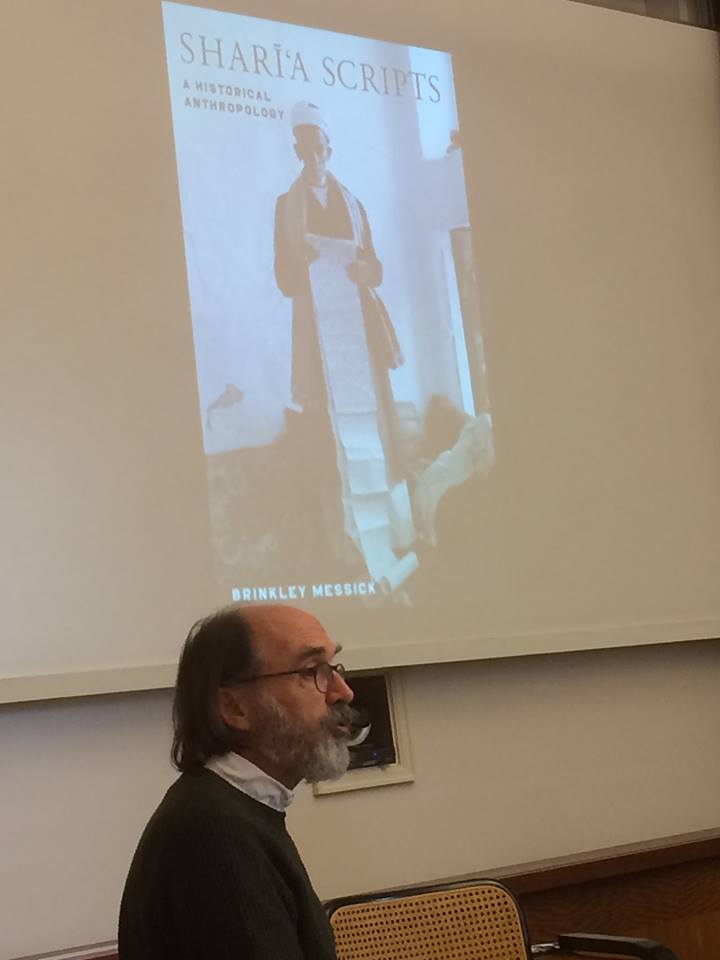
 Prof. Brinkley Messick talking about his new book Shari'a Scripts
I also study Arabic not only for knowledge purposes but also to switch gears from reading scholarly papers and thinking immensely large sociopolitical questions. I also have to remind myself that I am learning for myself, rather than to prove to someone else that I am a hardcore language-learner or Arabophile. I will still take it next semester with Ustaadha Batool, if other conditions allow.

Lastly, I wanted to share that I had the chance to listen to a lot of great scholars of Islam last weekend at the Shi'i studies conference at the Institute of Advanced Studies in Princeton, NJ. It was very exciting to see Arabic skills used for reading primary historical sources.


I might write more about my experience after my exam on Monday. "Allah maaek" to myself lol!