الاثنين، 28 أغسطس 2017

On the shores of Beirut

I was not ready for summer in Lebanon. I did not check the weather or climate prior to my arrival. I just knew I had to go. The best thing in preparation for summer was the sun block I bought reluctantly at the convenient store Rossman. The second best thing was that my apartment had an air conditioner, which I did not expect.
When I traveled to the region, I was surprised first by the heat in the Istanbul airport. Then in Beirut, I realized quickly I would have to change clothes more frequently due to the sweat and dust. I dutifully applied sunscreen everyday. My flatmate Ian also reminded me some time later with the pithy observation that Beirut is kind of like the California of the Middle East in terms of the culture and glossy beach-looks on the street.

The taxi driver who drove me to my apartment on the first day of my arrival invited me to see some sights in Beirut. The next day, he drove by with another car and showed me the prehistoric Pigeons' Rock at Raouché. Later, he also invited me to an outdoor cafe for shisha. He was fine with just coffee. It was interesting how he considered coffee to be in the same category as other "intoxicants" and vices. The cool breeze blew around us and everything felt calm. Families also relaxed with one another, and I was genuinely moved by the abundance and sociality. I had heard about the pollution issues, so I did not expect the sea to be as beautiful as it was. More importantly, the nightlife felt vivacious, warm and welcoming. One of the customers' brought their lovely toddler daughter and the waiter would greet and hug the kid like she was his neighbor. I cherish that scene to this day.

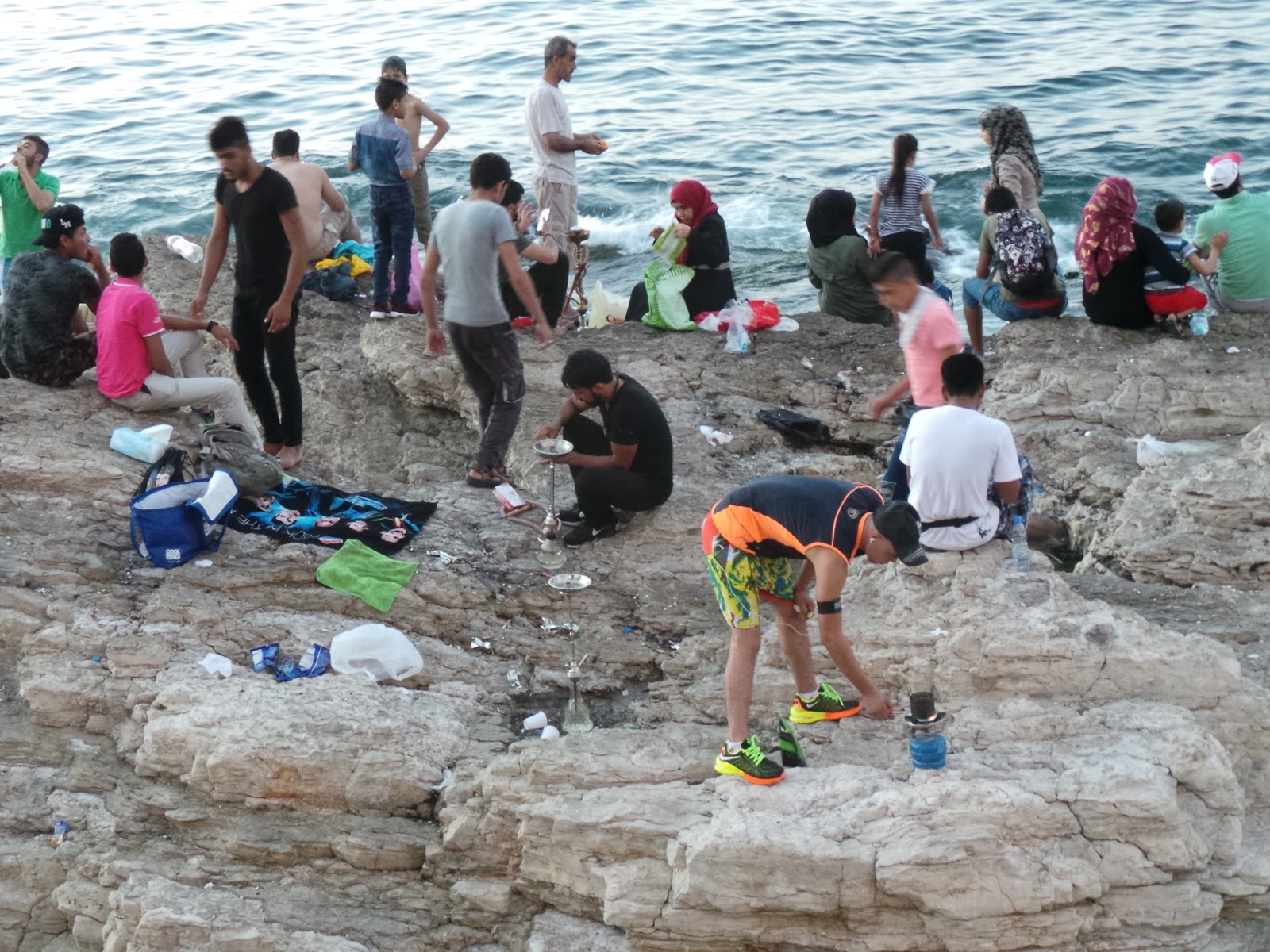
After a few days, I realized that I actually lived quite close to the sea and I did not need a car to get there. I realized that when walking from my class back to Hamra and searching for the beach route. Unfortunately the sun was very bright and uncomfortable. But I got a lot of nice pictures that would have otherwise been different at night. During the day there are mostly swimmers and men who are fishing.


A boy says hello to me while floating in the ocean

A fisherman at work.
Dan and I even saw turtles. One turtle was caught on a hook. The fisherman pulled quite a few times but could not get it either up or off. Many people watched and some even told the fisherman to let it go by cutting the string. ("It's inhumane.") Eventually the turtle was let go of. Humanity insaaniyat won!

Some military men finish their run alongside the promenade.


People can also smoke shisha on the rocks. 


A boat in the middle of a beautiful sunset. Some are for hire. Closer to the camera, there are people standing on rocks, waiting to leave or to enter the sea again.


 Another shot of the same beautiful sunset, marking the start of another active night in Beirut.

I also took my friend Morgana there during one Saturday night. She was also surprised by the amount of people and liked the general balmy and raucous atmosphere. We walked back and forth a couple of times. She has the same habit like me: we would like to take more pictures of people whom we find interesting, but we are also afraid of offending them with our camera.


At night, more people come out and the atmosphere is more electrified and mysterious. Linda said that this is a place where supposedly a lot of life changing events happen, such as proposals or romantic chance meetings. I revisited this place many more times to escape the second hand smoke in my apartment.

I noticed how it was different to walk with a man, with a woman, or by oneself in these open spaces. People have different reactions to you. I also noticed that others behaved differently depending on their company. For example, it was more likely that I would be teased for my presence by a group of people rather than an individual. Sometimes men would say hello to me in a friendly way. Once I smiled back and the man was utterly confused because he probably didn't expect me to smile back.

Morgana and I went to sit on the rocks below the walkway. I stole a shot of a pensive young man who was sitting on the rails. Many people sit like this for the sole purpose of people watching.

A man showing off his skills and standing on a moving bicycle

On the right side is another photo of the same man on the bicycle. Sometimes people also dance in this area, or it could be run over with children and their toys as well. It just depends on the day of the week. Once Ian met a child who was from Syria. The child was asking for money. Ian asked him a few questions which the child could barely answer. He lived with his mother but she was also begging somewhere else. So Ian decided to buy him some water and an ice cream from Mcdonalds. Dan and I waited here for him to complete his mission. He felt a bit better after he bought it, even though we knew that the poverty of refugees is much more rampant than we will ever be able to experience on a first-person basis.


On July 12, a family (specifically the two daughters and one mother) asked me in hesitant English what beauty products I use for my skin, since (in their opinion) my face was so smooth and nice... I said Vichy and they immediately knew it. Oh Beirut... The level of sophistication and consumption of western products in this part of the world surprised me at first, and continued to surprise me...

Many men take chances in the supposedly polluted sea. It is also really easy to get hurt from the rocks since the waves are quite unpredictable.

Sunset


Many young men like to walk and show off their dogs on this long beach walkway. Hasan was one of them. I observed that they all know each other and there seems to be a kind of health competition among them. They love their dogs, but in a different way than what I experienced in the U.S. The dogs are more markers of status in Beirut and mostly men walk the dogs in this area. In the east side of Beirut, I see more nannies walking the dogs for the owners. 

Hasan and his dog "Killer". Killer is often a dog who inspires fear. Parents often do not allow their kids to touch him. At one point a random man on the street even said to Hasan, "I hope your dog eats you!" Hasan is proud that Killer knows his owner's mind even before he communicates with him.


I take this path when I want to go to the sea. It is kind of steep but also very quiet and reflective. Often there are couples sitting on the steps talking with one another.

Hands down, this was my favorite places in Beirut and I really appreciate that it hasn't become a commercial port and it hasn't privatized yet. Hopefully it will become cleaner and more habitable for animals in the future.

الأحد، 27 أغسطس 2017

"Remembrance is a form of meeting"

Title is, again, from the poem Sand and Foam

"My friend, thou art not my friend, but how shall I make thee understand? My path is not thy path, yet together we walk, hand in hand." - Khalil Gibran, My Friend

This is an account of the second day Morgana and spent in Bcharre. See this link for the first day.
We woke up and left the hostel around 10am and asked about the best way from other  hostel folks. Then we ventured towards the city center to find transportation in the direction of the Cedar tree national park. I also made sure about the last bus going from Bcharre back to Beirut.

Left is a photo of the classic fountain at city center. I drank some of that water and it didn't suit me well.


We ordered breakfast at the local bakery. The baker was a woman with a cute daughter. 

Our breakfast: a kind of baked egg bread that was very tasty and warm

After we finished breakfast, the Church's mass also ended. We joked that all the drivers would have also just finished mass. We found a man with a car who was willing to drive us there for 6 dollars.

When we arrived, we were greeted by a street full of tourist trinkets. We later learned that this street has been there for hundreds of years.


We donated 5000LL to enter in the beautiful park. In the park, we also saw many Ethiopian ladies on a day out, dressed up in their traditional dresses. Many either work here or have married into a Lebanese family.


"Since ancient times [the cedars'] shadows have fallen on the profusion of cultures that have enriched Lebanon. The hardy trees were used by the pharaohs of ancient Egypt to furnish their tombs, by King Solomon in the building of his great temple in Jerusalem, and by the Phoenicians in the building of their mighty boats which brought such gifts as the phonetic alphabet to the world. For thousands of years they had inspired the mystics and poets of Assyria, Chaldea, Greece, and Rome. All around the young Gibran the cedars stood in silent majesty, echoing his own words: 'The cedars upon thy breast are a mark of nobleness, and the towers about thee chant thy might and valour, my love.'" - Man and Poet: A New Biography, Suheil Bushrui and Joe Jenkins


A unique outdoor church on top of the trail


A perfect altar for the sermon

Inside the church which had no bathroom

A unique sculpture of faces made by a French artist. Different angles show different objects. From the angle of my photo, you can barely see the sculpted parts.

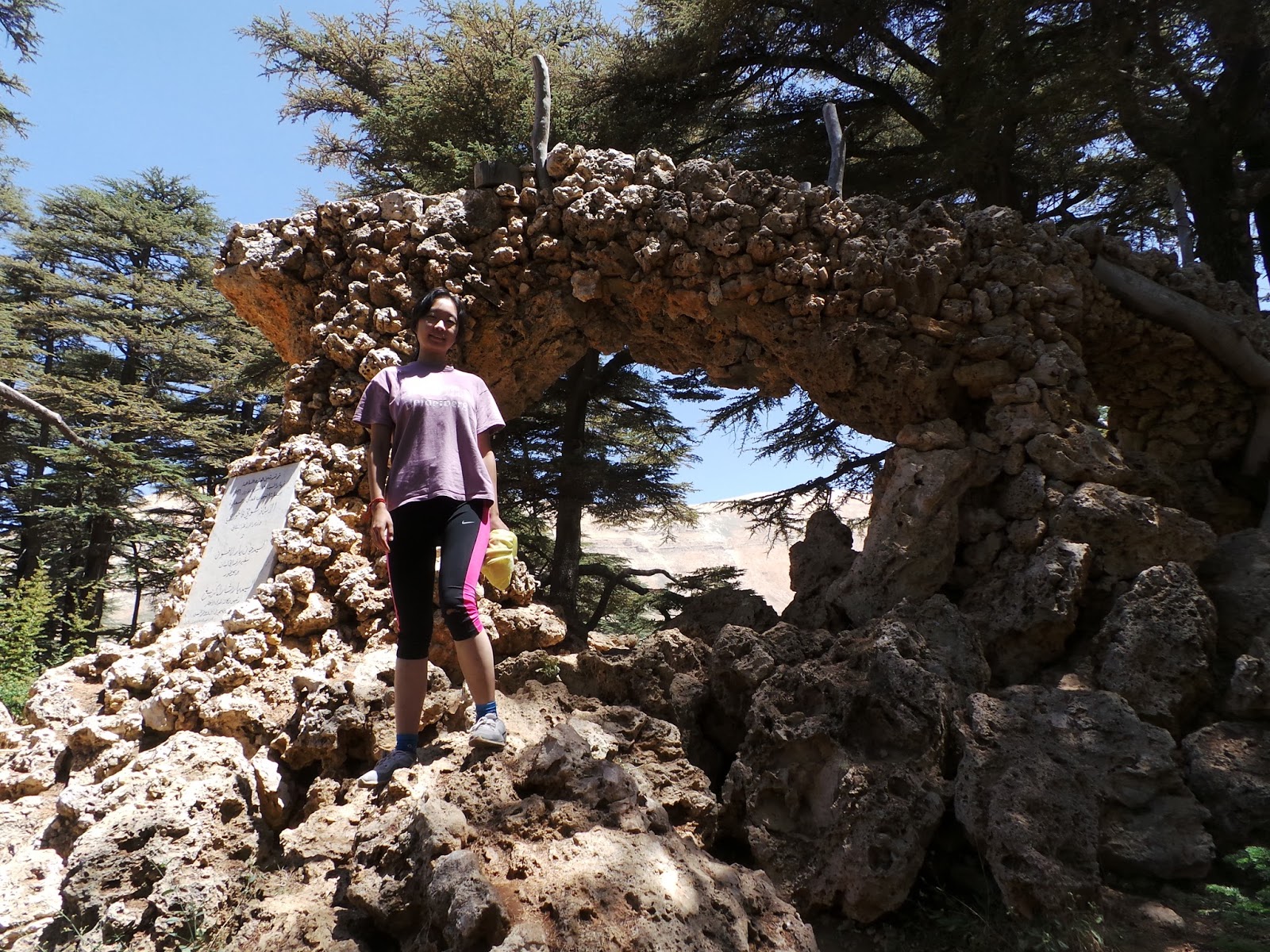
An odd structure where everyone went to pose for a picture, including me.
Many families were there as well and the mothers were particularly ferocious in scolding their kids. But after the scolding, the kids would comfort each other in the cutest way.


"The lengthy branches of the trees spread to encompass within their shade Wadi Qadisha, the sacred valley, with its groves of oak, willow, poplar, and walnut. Every springtime the sacred valley would welcome Tammuz (Adonais), a Phoenician god of death and resurrection, and young girls would wander among the flowers that carpet the valley floors, looking for the handsome young god. " -- Man and Poet: A New Biography, Suheil Bushrui and Joe Jenkins


An up close look of the cedar pine cones.

After we left the cedar park, Morgana and I went to a cafe; she had a glass of orange juice and charged her phone, which we relied on for directions. 

I was very stubborn not to take a car back even though the same driver was there waiting to take us back. So we walked for some time and discussed about the Syrian war and predicament that is Israel's belligerent foreign policy... We walked downhill for at least 30 minutes.


Many cars passed us by. Then one car stopped and two men were sitting in the front. David, who was the driver, asked if we wanted a ride. His companion was Micho, who looked a bit younger. I asked Morgana if she was ok, and she said yes. So I said sure, we will join you. David spoke the most because his English was better. David said he and Micho come to Bcharre once every couple of weeks because he likes the town a lot. David works as an engineer for surveillance cameras and Micho is a drummer. Micho showed us pictures of him at the drum set, which were quite nice. 
Then David invited us for lunch as well. Surprisingly, we went all the way back to where we began our walk down: at one of the cafes across from the cedar park. David said he knew the owner very well. Morgana and I were surprised. Still, we enjoyed the lovely lunch together, where a Lebanese singer even was singing live for us. The atmosphere was very festive and people enjoyed their food even more. Other families even started dancing; David and Morgana briefly joined them while Micho and I watched. David packed some of the leftover for cats. He has a passion for animals, even though he does not have a pet.

David offered to drive us all the way back to Beirut as well. We were happy to accept his offer. He said in order to beat the traffic, we should be on our way soon. I requested that we see one last thing, which was the grotto behind the Gibran museum. David also taught us some Arabic on the way there. he was very glad to meet people from a different cultures, although I am not sure how much experience he had in the past. We went inside the grotto and took pictures together. David said he had never been here before and thanked us for showing him it.

  
Inside the grotto; a very quiet and peaceful place

Behind the grotto there was also another site to see: a Phonecian tomb. I was the only one who climbed up.


It was a very difficult climb. There were no other tourists. The last leg of the trip had no protective barriers. But I still made it pretty far. Under the tomb, it was all gravel and a particularly steep climb. I did not approach it as close as I would have liked, since I was afraid I might slip, but I still saluted it from a near distance.

The obelisk that marks the tomb is thought to be dated back to 750 BCE! Not as remarkable if you don't know the history. 

On the way back to Beirut, David drove all the way. We all briefly fell asleep from time to time, and I was a bit guilty for not engaging in conversation with him even though I was sitting next to him. He had a Wael Kfoury CD which he played from time to time. He stopped by an ice cream shop and Micho treated us to ice cream as well. 


Trilingual Ice cream sign: Armenian, Arabic, and English.

I also learned at this point that David and Micho are Armenian Christians, one of the first Christians in history. I later asked them if they attended a service, since it was Sunday. David said yes, they went to a neighboring town of Bcharre, which he also recommended us to check out if we had a chance. I asked if the priest gave a sermon. He said no. From what I heard, it sounded quite short and ritual centered.


Left: Ice cream guy scooping from the fruit section. Right: Micho enjoying his ice cream. I was a bit confused with the ice cream types, since some didn't have milk in it. But it was still quite a unique experience.

After ice cream, we were dropped home and said good bye to these two new friends. Summer in Lebanon! What an adventurous day. I was so lucky that Morgana was willing to indulge on these unconventional detours.

الأربعاء، 23 أغسطس 2017

"Trees are poems that the earth writes upon the sky"

(Title is quoted from Khalil Gibran's poem Sand and Foam.)


A reproduction of "The Divine World" alongside the roads of Bcharre, "one of the Gibranean visions (1908-1914)"


The second to last adventures Morgana and I made was to Bcharre in the Qadisha valleys. Although I have not read the Bible in a long time, the reputation of the cedar trees seems to precede even the country's capital. (In Boston, I see Lebanese products that use the cedar symbol as well.) So that was my main interest in visiting the place. Morgana was also read The Prophet, so the birthplace of Khalil Gibran also interested her.


“Let there be spaces in your togetherness, And let the winds of the heavens dance between you. Love one another but make not a bond of love: Let it rather be a moving sea between the shores of your souls. Fill each other's cup but drink not from one cup. Give one another of your bread but eat not from the same loaf. Sing and dance together and be joyous, but let each one of you be alone, Even as the strings of a lute are alone though they quiver with the same music. Give your hearts, but not into each other's keeping. For only the hand of Life can contain your hearts. And stand together, yet not too near together: For the pillars of the temple stand apart, And the oak tree and the cypress grow not in each other's shadow.” 


July 22nd
We scheduled to meet each other in the Armenian neighborhood of Beirut to take the long distance bus. I didn't have a phone or internet access and the area had no clear meeting point. Neither of us had been here before. I was a bit agitated since we might not be in the same place and there would be no way of contacting the other. I asked a taxi driver and a policeman where the bus would be. They both pointed in the same direction. While I was walking in a different direction than what they said, just to make sure that it wasn't the right direction (gotta test things out!), Morgana called my name and I saw her. We greeted each other with much excitement. The policeman also corrected us in regards to the actual bus loading site and we went towards that way. While getting in the bus, I was a bit surprised we didn't have to buy tickets beforehand. The journey lasted for three hours. The driver played some music by Fairuz played in between. Many people came and left the bus. We ate Manaooshes I bought from the Hamra bakery (furon). The road was very dangerous and windy. The architecture was exclusively Christian. It is so hard to believe that this area is closer to Tripoli geographically than it is to Beirut. I became concerned as we pass through the fog and small towns since this was not my familiar terrain. Luckily Morgana knew; she was more worried about the driving since she survived an accident ion a similar windy mountain road. I was a bit dizzy when we left the bus but I didn't know it would get worse later on.


I bought some yogurt once we arrived in Bcharre. The store owner, a woman with glasses, who looked around 38 years old, was discussing about a piece of paper. It took her some time to come attend to us. Later she said apologetically she had just got married. I realized the paper was probably the marriage certificate and I congratulated her. "Mubarak." (Not sure if it was the right Arabic  word) There was another wedding ceremony going on in the village as well, with much loud and joyous music. We were even eager to join the party but the specific location was less public than the music. We walked uphill to find our hostel where we made a reservation for the night. Morgana wisely took more breaks than I did. In the mean time we also stopped at a beautiful cathedral to take photos. I finished some salad given to me by Bayt Haleb when I bought Knafeh.

The hostel check in experience was quite odd. The female head of the household was not sure which reservation we had and later asked for our passports and information in quite a brusque manner. We were more than happy to leave the place to explore.

After we dropped our stuff at the hostel, Morgana and I went to a cute cafe: Morgana wanted eat some proper food. (In this area and perhaps beyond people served almonds and a special kind of nuts as appetizers). I was not hungry and just had cappuccino.


There were also some tourists from Beijing at the cafe. It was the one and only time I heard Chinese people speak in Chinese during my one month in Lebanon. But since it was customary to ignore one another, we did not greet. The view was amazing and we took turns taking photos. I exclaimed that I never have been to a mountainous area that had such wealth. It doesn't seem that the young people leave for the cities either. There's a lot of social activity and they are caught up with the, latest trends. Morgana also said that the stones used here are quite expensive.


We rushed to the Gibran museum because we were worried it might close. We were so surprised that it was high up in the mountains. I double checked with a man who was sitting at the gas station whether it was uphill or not. He seemed quite entertained that these two foreigners were going to go all the way up.


We had one hour and successfully toured the museum in due time.  Most of the rooms displayed Gibran's paintings that engaged with deep and heavy themes. Both Morgana and I loved the paintings, which  we did not know about before hand. He also drew portraits of his friends and acquaintances, which included Tagore and Carl Jung. I could see a lot of connections with psychoanalysis in his paintings. I would never have thought he would be from such a quaint and simple town given his engagement with rather dark and moody themes. The guide of the museum said it much better than I did: some men were born in caves but have minds of castles. It is quite interesting to think about how he bolsters or prevents the construction of a uniform Lebanese identity.
Gibran never lived at the site of the museum but he was buried here. His family members fulfilled his wishes despite initial difficulties from the religious order that owned the property. We spent some contemplative time in the thoughtful grave room that almost resembles a religious site for communion. Gibran's quote was also written in prominence in Arabic, French and English. Other Lebanese visitors were less inclined to be close to the dead.

Just before we left the museum, it dawned on me that I was suffering from high altitude sickness. I was nauseous and couldn't walk fast. I regretted drinking coffee. I sat for some time and ate almonds offered to me by one lady who socialized in the museum. Morgana, who has lived in the highest city in the world (El Pasco) and thus had no problems at 1500 meters, took care of me for the rest of the day. We walked arm in arm to a nice restaurant by the waterfall and ate some mezzes (snack dishes) for dinner. We discussed some of the friend group competition we experience as ambitious young people.


While walking back to the hotel, we passed through a lot of people who were also having dinner. It was so odd to be so close to people's houses. One young man even said hello from the inside of his house.


Some kind of Christian votive shrine


When we got back to the town center, were lucky enough to see the wedding fireworks shoot up in the sky amidst the old towny buildings. I made a nice video unexpectedly. While we were in awe of the fireworks, someone drove past us and shouted: "Bcharre! You welcome!" It took me a minute to realize he was saying you are welcome to Bcharre. It was a nice sentiment with some surprise. Looking back, we probably would have missed it if I wasn't slowed down by the high altitude sickness.

here are two short videos I made of the fireworks


We memorized some Arabic verbs and went to sleep. Luckily we were the only two in the room. Unluckily, in between 3am and 8am, the insomniac who also stayed at the hostel went in and out of our rooms just to talk a walk. The female householder  also chain smoked throughout the night. But our spirits were still high when we set out for the cedars the next day.

To be continued...


الثلاثاء، 8 أغسطس 2017

Encountering Followers of Jesus in Beirut

One day, my roommate Dan and I were touring around American University of Beirut as well as the sea front. When we ventured on the way back to our airbnb house, we passed by a bookstore that had an English sign board. I wanted to visit it earlier but always passed it during night time after it closed. This time it was open, so we entered. The decor was very nice and cozy, with a full cafe. Trendy English Christian music played in the background. All the books were related to Christianity. The store also sold decorations as well as stationary imported from China. A math student named Hasan welcomed us and offered us juice with biscuits from a famous western brand. We were a bit hesitant until he said it was his offer. We have clearly underestimated Lebanese hospitality!


Later we met Hiam, who was the person in charge of the place. She had a bespectacled, learned look and a motherly demeanor. Her English accent was quite versatile. When she knew that we were tourists, she warmly recommended some spots for us to tour. Then we moved to a sitting spot to sit down and chat. We learned through her that it was more of a fellowship for followers of Jesus Christ rather than a for-profit bookstore. They had Bible study meetings thrice a week. They also offered us cake from the famous chain Roadster Diner, which was also sent to them for free by some mysterious person. That person sent the desserts in a very passive aggressive way, as a form of apology for some small misunderstanding. Hiam said, "If you are sending the desserts because you think you made us mad, we are really not mad!" But the person still sent the desserts anyways.

Hiam first asked about our story. She asked how we came to decide to come here, since zlebanon was quite "dangerous." I told her I was interested in understanding the society after hearing about the cartoon incident.  She was especially intrigued by Dan, who was half-Syrian and half-British and could speak phrases in Arabic. He was also studying French and Deutsch, so they conversed in French as well. She praised that some people just have a knack for languages, such as her nephew who learned Mandarin, Turkish and Russian in addition to the regular three. She requested to see a picture of Dan's Syrian mother. But he said his mother didn't have a picture. Hiam exclaimed that his mother is quite extreme on the religious front. Hiam mixed some Arabic phrases in her speech and had a very chic dressing style. She is teaches Arabic as a private teacher for foreigners who live in Beirut.  I learned that she has no kids. I said that it is quite fortunate since she would have fewer problems. She said that problems do not come from children or marriage. Happy people find happiness with or without marriage. But she also frowned down upon divorce when she heard that Dan's parents divorced; she did not cite theological reasons. Rather, she finds that two people who have lived together for a long time would find it very difficult to separate and the general outcome is not a good. Her way of talking about the faith reminded me a lot of the people I had met in the US. 


Other tha Hasan, there were many others also helping around the store. One woman, who I will call Jane, shared with us her conversion story. It seemed that she was already from a Christian family from her name, but Jesus Christ did not have the same role in her life until she was healed from a jaw-lock in the recent years. All her close relatives had died from various reasons and she was the only one. Hiam said that she walked through many dark phases in her life. Hiam said that the beggars who usually said "Bless your parents" or "uncle" in idiomatic Arabic did not have anyone to bless when they encountered Jane. One beggar even offered to give her money instead when they heard about her story. Jane was painting a very nice painting with a cross on it. She later played the piano very well and also played crazy, improvised tunes for the fun of it. Her entire demeanor was very jolly, so it was even more intense when she did not smile and looked intently at Dan throughout the story of meeting Jesus Christ, as if that could push him towards conversion in some way. Jane and Hiam had a very casual and close relationship. Hiam used the phrase "Ma too zghale" to ask Jane for a favor and explained to me that it means "Don't be made small".


Hiam also shared the story of a Lebanese man with a Shi'a name in the store, whom I will call D. D was homeless when an Ethiopian maid found him. He was considering suicide. But the maid told him about Jesus's love and introduced him to Hiam's brother-in-law. Her brother-in-law met up with him every day to study and talk about things unrelated to "the street." Hiam said that his mother tried to kill him, which was the main reason for his mental instability and homelessness. She emphasized how unusual it was in Lebanese society to be homeless, since family ties are really strong. (I was a bit skeptical about this claim but had no way to figure out the truth of it.) Both Dan and I listened but later we both found it odd that she was sharing this story with us without D's consent or involvement. He wore casual western clothes, looked around 26 years old and shyly hung around without doing much work related to the store. According to the story, Hiam considered to take him in, since there was room in her place. But she was a single person living with her mother at the time, and she said that the neighbors would talk if they took in a single male. She said that as a follower of Jesus Christ, she could not let people of Beirut think about her religion in the wrong way: "I can't talk about Jesus and do something against our Culture. people don't think nicely." Since he has found a place, he has been coming to the book shop for the past 6 months.

They closed the shop around 8:30. After unexpectedly spending around two hours there, Dan and I left with the others. Hiam said that we should come by again to volunteer or study, and we said sure. I later visited again to introduce my friend Morgana to the project. They didn't seem like they needed extra hands, so I didn't go as a volunteer. Dan brought his brother the next time he went and they also just talked about Jesus. Still, it was quite eye opening to see how some Christians with the evangelical streak are similar in this vastly different part the world. 

الاثنين، 7 أغسطس 2017

A Visit to the Hizbollah Museum

 I first heard of this museum from a former airbnb roommate. Our host jibed at him for paying 4000LL as well as some souvenir money to Hizbollah, which he despised. The roommate also noted how the guide he met there personally hated Israel, which surprised him a lot. Our host said they are the worst neighbors. The conversation piqued my interest as well. 

My friend Morgana and I met at the Saifi Institute's Arabic class. She is from Peru and studies a degree related to law and humanitarianism. She is researching on Syrian refugees in Lebanon and was also interested in checking out the place. On July 29th, which was my last Saturday in Lebanon, we decided to visit the South, namely Saida and the town that hosts the famous Hizbollah museum.

We met up at 10AM, close to our institute, and we took a cab from downtown to the main long-distance bus station for South Lebanon. We only knew the name of where we were supposed to stop, namely a bridge, and relied on the other passengers to notify the moment we should descend.

We were extremely under-prepared and mostly relied on the local people to guide us to the museum. I did little research about the place. We learned mostly on the way, about the surroundings and the relation between the museum and the environs. It is known by many names: The Museum of Resistance, the Mleeta Tourist Landmark, but mostly we used the term "Hizbollah Museum" when asking for directions.

Why did we need to ask for so many directions? It was because the cab driver tried to charge us a lot for the cab fare. He said 2000 LL when in reality he meant 20,000. But by that time we were already 1/3 through the journey. He was praising Peru and China for having very good people and telling us his life story about his years in Australia and divorcing a Turkish wife back there. Then he asked if he wanted him to wait for us to drive us on the way back down. Morgana said that she would probably need 90 minutes in the museum. The driver said that 1 hour is sufficient. Then he said it would cost 40,000 LL both ways. We were shocked and decided to give him 8000 and leave the cab on the road. 
After leaving the cab, we asked a truck driver Hassan how to get up to the Hizbollah museum. He chuckled and wrote down the town name for us on the Manaoosh (Lebanese pizza) paper wrap, in case we had to ask someone else. Then he said with good humor that it would take us 1 hour to reach there by walking. We said thanks and kept on walking. A few minutes later, he drove to us with his truck and his assistant hanging on the back of the truck, telling us to get on and offering to take us to the next bus stop. We caught up on a bus and we were tailing it. Hassan tried to stop it from his position by honking.  It took the bus around 5 minutes to stop and we finally got the bus driver's attention. We took a bus up a few more steps, but then it dropped us off and took another turn to some other town. The driver was considerate enough not to charge us the fare, since we did not reach our destination. The bus route reflects that the people in the area do not visit this museum. After the bus dropped us off, I took a small detour to check out the scenic town. It reminded us of Bcharre, which was north of Beirut and the hometown of writer Khalil Gibran. We bought water there and washed some peaches. Someone offered us drinks inside but we decided to press on.


We stubbornly walked the last 4 km uphill... We later learned that it's far up because the Hizbollah fighters were fighting for it against the Israelis who occupied it during the war. 

The upside was that we had a full view of the scene as well as unique positions for the cool stuff on the way, such as these flags being placed side by side. But I definitely would not do it again. Morgana was also exclaiming: No wonder the driver wanted to charge 20,000LL!


Seeing the museum from afar


"Who comes to this museum?? Definitely only people with cars!" I complained...


We saw something protruding from the museum area for quite a while, and it was our point of reference for hiking upwards. It looked like a tank, but we found out later that it wasn't--it was a lookout point that was never detected by the Israelis during the late 1980s until Hizbollah decided to unveil it. Sometimes it was no longer in sight. When we finally made it up there, we were exhausted. We paid for our tickets at the door. The person said we should find someone with the museum logo on his shirt for an explanation of the museum layout. We found one who was tall, in his middle-age years and wore a cap and shades. He introduced the place with great confidence and experience. He said we can come back to him for any further questions. 

I did not have very high expectations even though we traversed a long distance to reach the place. I was expecting a dingy dark building, like the Stasi museum in Leipzig. But fhe museum was very informative and well-researched.


What surprised me most was that the design of the metaphors was very well thought out. The Israelis are represented by the deserted objects. "Attractive landscaping surrounds 'The Abyss,' full of booty apparently left behind in southern Lebanon after Israel's withdrawal in 2000, and after the 33-day July War in 2006." In addition to the political context, the scenery was also very nice. It seemed that many Lebanese tourists come for the view as well as for the educational value. I also was really surprised when we toured the well-equipped, "180-m tunnel leading to an operations bunker." A soldier was standing on guard at the entrance. But I later read that their presence in the museum had lessened since it first opened.

First time seeing spy equipment


Here is a description of the history reproduced by The Velvet Rocket post about the museum:
On April 3rd, 1985, the Israeli army retreated from Mount Lebanon and the villages and cities of the southern coast to an area that extends from Haasbayah and Mount Sheikh in the east, to Naqoura coastal town in the west, planting hilltops and mountaintops with dozens of fortified outposts and barracks. Soon afterwards, the resistance militants followed the enemy to its bases, to initiate the “war of bases”. From 1985 and over a period of 15 years, the resistance took Mleeta and other mountains and valleys as their strongholds, in defiance of the enemy.
So in that sense, Hizbollah is truly modern: it engaged in a war or multiple wars, in which many pauses and confusion happened in between. The result is that the history is difficult to write. 


These objects from Israeli soldiers containing Hebrew text remind me of how disconnected the two countries Lebanon and Israel are even though they are right next door. Many ancient Mediterranean trade connections were severed since the rise of the nation state.


Morgana reminisced about the time when she and her classmates were trained to be "kidnapped" in Poland for the purpose of becoming bona fide humanitarian workers. I was shocked that they had to go through that process. Later we discussed the Syrian War when we finished touring the bunker. She had the opinion that peace should be achieved in an ideal situation and only then can the Syrian society start to rebuild. I said that even in times of so-called peace, there is hegemony and oppression. I gave her the example of Gandhi and the Congress movement: even though it achieved independence for India through a peaceful movement, it also allowed for upper castes to maintain hegemony for decades. I also said that party politics happens even during times of war, i.e. how Mao built the Chinese Communist Party even when it was engaged in civil war with the Kuomintang. Similarly, FARC was trying to do that in Columbia, although with less success. Although we could have had this discussion elsewhere, we were rather exhausted to keep moving.

Later we had a very interesting political discussion with the tour guide who initially introduced us to the place. He knew about our Arabic program and said many other students from the program have visited before. Morgana asked him about the relationship between Lebanon and Palestine. He gave us a concise history: The Arab league funded the Palestine Liberation Organization (PLO) to fight Israel. Israel did not like it and bombed Lebanon; it reached Beirut in 6 days. Then all sides fought. The PLO left Lebanon and went to Iraq and other Arab countries. But the Palestinian refugees stayed. But Israel continued to use Palestine as a reason for interfering in Lebanon. The Israelis still influenced Lebanese politics through the Phalangist party. They manipulated the politics which resulted in the election of a PM who was from that party. Speaking of the present, he said, "Some Palestinians are involved with ISIS. This is no secret." Then Morgana asked him about Syrian refugees. He said without blinking an eye, "We don't have anything to do with Syrian refugees. We are just observing them for any activity. Any conflict is between the state and the refugees." I was surprised by the shrewd reaction from him. During that week, Hizbollah was conducting military campaign against ISIS in the Lebanese town Arsal that borders Syria. They claimed that there are many ISIS militants hiding in the refugee camps. At the same time, Hizbollah also burned down areas of the camps illegally and Syrian men have died in military custody. (See this article for more details about the anti-refugee violence in Arsal.) He later was pretty nervous and decidedly changed the topic to our background and the usual meet-a-tourist talk (e.g. how China is a great country).

Morgana and I didn't really have a way to go back down. We asked a bus driver Moustafa up in the parking lot on the mountains if we could take a lift down to a town. Even though he was on duty waiting for other people, he still took us down to an intersection. On the way down he asked in Arabic about our situation and our future plans. We communicated haltingly. He chided us that we have been here for a month while learning Arabic and we still only know "shway shway!" (Meaning: a little bit) In my defense we were living in Beirut, where people spoke English very well. He left us his number in case we had any problems. Then we waited on the road for a while, until a service taxi took us to the point where we could get another service taxi. We then proceeded to tour the ancient port city Saida, which deserves another post. 

Overall, although the museum is a semblance of violence, it is not entirely a celebration of it. It shows the labor and the efforts of war in a sobering manner. There is room for reflection and contemplation for the visitors. Scholars Mona Harb and Lara Deeb have noted in their book (p63) that Hizbollah has transformed from militaristic tones to humanistic ones after some time. This plays into their plan to broaden their post- 2000 electoral base. The museum is also a form of leisure, which is a strategic area where Hizbollah can generate jobs and garner more youth support. Indeed, we met a couple on a date in the museum park area. One can disagree with Hizbollah's party politics, such as its slow disarmament process and condemn its support of the Syrian Assad regime, but at the same time it is also important to value the cultural memory of the resistance in terms of actual people with families and ties to the area. Politics often hides more violence, while this museum looks at violence and death as a necessity for survival, however grim that survival is.

For more information about this controversial museum, this is a good article: 

Hezbollah museum: Shrine to resistance or a dying image?