الثلاثاء، 7 مايو 2019

Ramadan 2019: Day 2

Today I finished my paper and read some the interesting ethnography on Cambodian American communities. I had visited Cambodia and I had heard about the community nearby in Lowell, MA, yet I know nothing of these fellow "Asian Americans." I have a new understanding of the importance of writing on second-generation and third-generation immigrant experiences. Perhaps due to the fact that many people view my identity through a cookie-cutter lens, I used to view generational differences in much starker terms.


Ramy's show Ramy is also part of this process: although generations view their lives, pleasures and difficulties through different lenses, one can still synthesize the two "worlds" with an open heart and imagination. Like Ramy, I have also found it challenging in social situations and rarely said outright that I did not drink, even though I had already stopped.

Still from Ramy, with his parents
I also really appreciated the differently abled role of Steve and how he interacted with knowing passive aggressiveness, which reminded me of how some of my Asian American guy friends talk with me as well. Some people seem to have had problems with how much the females in the show are interacting with their sexual identities; for me, it is relatable to see people to explore their desires, even if most people viewed them as "undersexed." (Steve included.)

It also takes a lot of courage to commit to creative work, such as ethnography or a show like Ramy. Walid said before, in an endearing way: I like saying that you are Chinese, because anyone can become "American," but not everyone can be "Chinese."
Between writing my paper, I also heard some of the good news from Liverpool. I did not expect that my team would win, let alone by such a huge margin. I joked later that Mohamed Salah did not even have to appear on the field for Liverpool to win.

Walid told me that Salah wore a T-shirt that said "Never Give Up." I had already given up!

The clouds gathered as I waited for the bus; I gave up and walked instead. The rain started just before my Zumba class.
Our instructor Karen told us about her upcoming marriage and possible change in schedules. I felt surprised and happy for her. Today's class was longer and we were all sweaty by the end. She told us that to feel certain songs, which is totally different with how I approached most media as a historian. Towards the end, I really felt one of the beats and pulled it off.

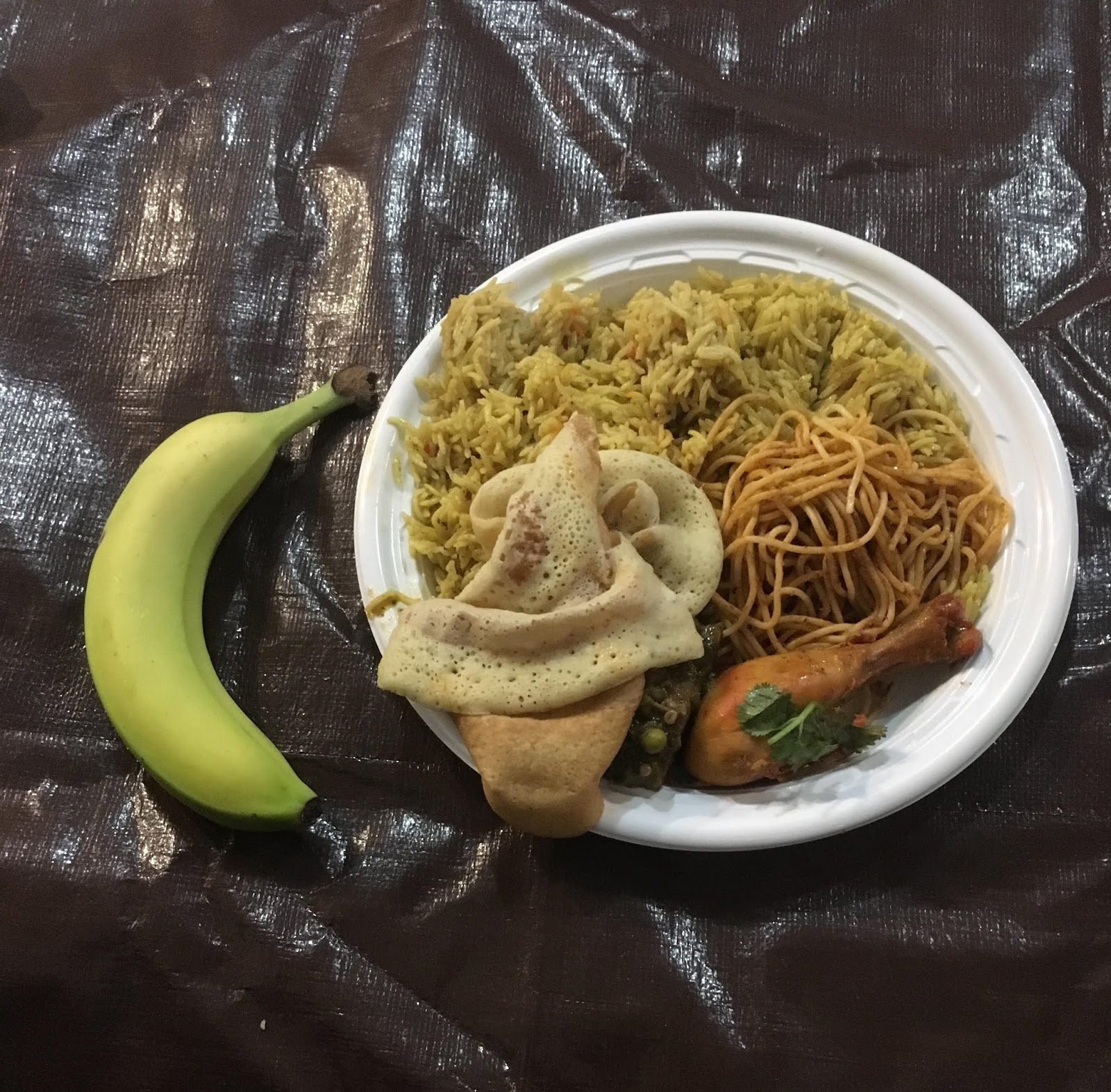
Walid and I met at 9pm, Downtown Crossing, while I was reading about Donald Glover's baby momma and how it created some controversy. Walid and I embraced very longingly. When I complained that I was thirsty, he showed the banana he brought me and told me about his Somali iftar at his new neighborhood mosque.

Walid's dinner
He was served by other men and had eaten everything with his hands like a good sport. Prior to dinner, he compared the prices of food at the neighborhood supermarkets and found them to be not much cheaper than prices in New York. I also complained that at least NY places give one a sense that they are family businesses, whereas the chain stores of Boston do not bring down the prices as much as one would expect.

While we were waiting for the T, a queerly dressed man, cowboy hat in tow, started passing comments to everyone he saw. He said to us, "You two should get married!" We replied as he walked by, "we're already married!" which made him feel slightly sheepish. Walid was very happy that even strangers could see how much in love we were.

Walid also called many of his relatives today. He passed on the greetings of his cousin, who studied as a pharmacist and said "say hello to your beautiful wife." <3 We returned home and watched the lo-fi version of Patriot Act on the mattress "scam" and discussed which mattress we should buy next.

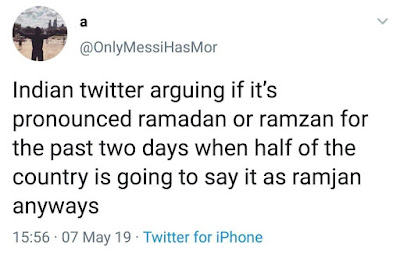
Finally, a funny desi joke my friend Aaron sent to me!

الاثنين، 6 مايو 2019

Ramadan 2019: Day 1


              On Sunday, we ate our "last" lunch together for the next few weeks. Walid made scrambled eggs with dates he bought from the Palestinian shop, whose owner probably overcharged us. But we forgave him anyways. I texted our friend Abdul Latif from Louisville about some news from an archive opportunity. He replied to the news and asked if Ramadan was officially on Monday. I was confused because I thought everyone could check online. Walid was quite expectant of such a question, since he was "in the loop." Upon my request, he typed an affirmative reply to Abdul Latif on my phone. We wanted to play chess but my eyes were sore so we played the Arabic alphabet game (in which we name six categories with any given Arabic alphabet) and slept early around 11pm. We woke up at to Walid’s alarm in the middle of the night. Rather than stuffing himself, Walid was content after drinking some water and went back to sleep afterwards.


The next day, we showered and he prayed. I made some breakfast for myself and was careful so that he did not unintentionally catch the wafts of the aromatic food. He also helped me install my thangka painting into the new frame I bought, which had laid idle in its scroll for months.

I wrote my paper on various communities and their burial grounds in North America. Walid called his brother and some friends to wish each other well. He left to move his things and met up with me again at 4:30pm at Downtown Crossing. It felt like we had parted for a long time and we hugged. Many people headed in the same direction as us. He noted that it was the first Monday for him in Boston. He often left for New York on Monday mornings.

My classmate had asked Walid and I to watch Avengers: the Endgame with him in the theaters, but we were not in the mood. In response, Walid played the “Ramadan” card and said he would be resting at home for the next few weeks. But he joked that he still moved some of his belongings from my place to his new place, and even chaperoned me to my 5:30pm Zumba class. The weather was beautiful and he bought some coffee for me, just to smell and anticipate the taste.
Today's Zumba coordination was quite difficult, and I had not practiced for months. A girl danced in front of me and even thought Walid was looking at her. Walid diverted his attention to his phone instead. By the time I finished, we were both dehydrated and hungry. We passed by a Firestone chain store and I asked Walid if he knew about the Liberian dictator involved in the resource scandal. We arrived at the T station and waited for the subway while a man in a red-checkered turban bounced his rubber ball against the wall. We thought about eating at a Jordanian restaurant, but they did not have main pescatarian dishes. We might visit on a Saturday for their buffet instead.

On the Orange Line, we saw the beautiful sun and Walid joked that it would be nice if someone could push down the sun. Luckily we made it to the Chinese restaurant right around Iftar (7:40) and ate to our hearts content. He said a friend in the Gulf sent him a picture of his sumptuous iftar, and he thought about sending ours to his friend as well. Both of our phone batteries ran out so I drew a picture of our iftar dinner when we returned home. It also occurred to me that this month would be great for some low-key blogging. 


We listened to Sura Isra' together and watched a bit of The Prince of Egypt. Walid noted the animated picture's similarities with the Holy Quran's narration of the events. Then he left for his new place. I helped him pack some of his things and we parted reluctantly.

الخميس، 18 أبريل 2019

Misogyny from men in closed quarters

I have been interacting with non-hetero men for many years and this week is the first time I am suffering from intense misogyny from a non-hetero man -- Ernesto Gonzalez.  He has been my partner's roommate for the past couple of years. My partner and I have yet to move in together. For these reasons, I have been interacting with him on an personal level (in closed quarters). I am documenting these events for personal as well as public purposes, which shall be clear below.

So what happened in the past week? Here is my version:
Both Ernesto and Walid are currently in the process of moving away from their shared apartment. Ernesto continuously throws away Walid's things, assuming that those things are his (including food items). These actions are inconsiderate and selfish at the least.
In addition to this ongoing problem, another fiasco happened: Ernesto decided that he would visit his partner this past week. I purposefully scheduled my visit so that Ernesto would be away from the apartment. Due to miscommunication, he did not leave during my originally planned stay. On April 15th, he notified my partner Walid around 9pm that Walid can no longer stay as promised till the first week of May. This was another inconsiderate act from him because it is basic courtesy to notify anyone earlier of these changes in lease contracts. Walid acquiesed. I was extremely upset; I cried, protested and fought with Walid over this matter. Ernesto did not mention any of these issues the following day.
On April 17th, Ernesto sent a message to Walid asking him to keep things quiet. He was clearly referring to our sounds of intimacies. Perhaps due to his particular religious upbringing, Ernesto found these sounds more disturbing than my voices of protest and fight on the 15th.
I am particularly upset because my personal privacy has become a "man's matter" rather than something one should discuss directly with me. Ernesto is using his male privilege to suppress my freedom.
Furthermore, Ernesto messaged Walid, saying that he will bring his partner with him on Sunday (April 21st). This arrangement further conflicted with my plans, which was to spend the weekend with Walid, without someone eavesdropping and reporting our acts of intimacy. I booked the trip on April 15th, two days before Ernesto declared his one-sided plans. I decided to cancel my plans and thus wasted a bus ticket I ordered.
Another reason for my shock at Ernesto's behavior is because he continuously complains about his work issues with Walid, expecting Walid to be his dutiful listener, while he disrespects the objects owned by Walid (thus affecting my living standards) as well as Walid's time.
I explained my side of the events to Walid yesterday, and I am writing about it again because solidarity among marginalized people is often at risk due to certain people's selfish and misogynistic behaviors. While I have aspired to create friendships and solidarity across all genders, it is easier said than done. I am still hurt over the events that happened this past week. It is additionally desparing for me as a marginalized person: due to the rising cost of private space, there is no easy solution outside of property ownership that would prevent these events from happening.

الثلاثاء، 9 أبريل 2019

Differently Abled Iraqis in America: On the 16th Anniversary

Sixteen years have passed since America (along with other countries) decided to topple Saddam Hussein and institute their own sectarian-colored government in Iraq. The U.S. move to disband the Iraqi military has also been the primary reason for the rise of armed sectarian conflict in Iraq. This post is a commemoration and acknowledgment of U.S. culpability. It hopes to center the lives of Iraqi people who still bear witness to the evolving events of militarism and imperialism. 

-------

Today while I was on the 101 bus venturing from Malden to Medford, I saw three Latino men discussing the motherland (pais) fervently in Spanish.  All wore fashionable hats as well as similar clothes. When two of them left the bus at one point, the remaining one joined the male bus driver and switched to converse in English. He remembered his homeland nostalgically as a place where he did not need to pay for juice or fruit. He also recounted how his hard-earned money in the U.S. could enable him to own property in the motherland. They both lamented the disappearance of a nearby Papa Gino's Pizza. The man bragged about his work and salary to the bus driver and wondered "how can someone earn without working?" He soon left after this statement and the driver wished him a good day.

First, I was struck by the capitalist contradiction in which his labor and remittances will contribute to the capitalization of his motherland, which I guess would also wipe out the practice of receiving free juice. Second, I was annoyed by his ableist understanding of survival, which is prevalent among Chinese immigrants as well. The second part took a while for me to digest and verbalize.

Today was also another class with Prof. Kamran Rastegar where we discussed the connections between colonialism and trauma. While the latter's definition has been criticized by some as Eurocentric, I found trauma as a useful concept to understand my own circumstances as well as the Iraqi friends I made in Louisville. One important intervention made by people caught in political events is that trauma is often ongoing. For my experience, the ideal "safe space" for processing trauma is often (sadly) only found in America or Western Europe, since lives of those in such places are placed at a higher value. Many places in Iraq continue to suffer under conflict and private security companies profit from the current scenario.

For many Iraqis, even after they enter the U.S., their trauma often cannot be addressed due to their racialized subaltern statuses. One of the Iraqi friends I met in Louisville, "A," struggles with the ongoing effects of trauma and the same ableist situations as told by the man I heard on the bus today. "A" believed that only work could secure himself a respectable livelihood in America. On the other hand, he also witnessed the demise of Iraqi men who do not become a middle-class family man, either due to their class position (lack of resources for marrying and/or supporting a partner) or due to their estrangement from American society. One of his former friends resisted wage labor and continued to live as a homeless person in Louisville. This former friend's existence calls to question the possibility of rehabilitating people traumatized by American imperialism. Similar to the man on the bus, "A" also acknowledges that "nothing is free in America," yet he also has a certain pride in his ability to work.


22 hour

Y, a former mercernary and non-Arab Iraqi, found me as an ideal person to discuss his encounters with the American military-industrial complex. He acknowledged his privilege associated with his contribution to the (ever-changing) objectives of American presence in Iraq and how that helped him disabuse any Islamophobic biases from white people in America. He also demonstrated some conflicted feelings over his acts of killing, whether for political or economic gains. His trauma affected him in a negative way. Yet his trauma was not as obviously manifested as trauma of other Iraqis, or me, for that matter.

Others who did not contribute to America's military project had more ambivalent feelings toward their "new" life in America. Many did not relate to their opportunities in America in the same functionalist way as Y did. M, another non-Arab Iraqi, for example, did not adhere to masculine norms of either American or Iraqi standards and did not have the same impetus to integrate into American society as Y. M, as a receiver of unemployment benefits, was seen as less masculine in both Iraqi and American contexts than Y. Thus while America and its capitalism economy is structurally ableist and prefers immigrants with ableist bodies, the need to appear as ableist and available for work also depends on the subjectivity and masculine ideals of each person. Rutgers scholar Dr. Amir Moosavi has also argued that ideals of martyrdom (Shaheed) can be found in literary expressions as well as experiences of Iraqi and Iranian people during and after the Iran-Iraq war. These differences are important for people who wish to decenter white masculinity.

Another case that prompted my thoughts on this subject was the 《和陌生人说话》 interview with former mercenary Bai Xiaobao. One can watch the interview here on Youtube. Originally from a formerly semi-rural background, he achieved middle class status by risking his life in post-2003 Iraq. He leveraged the idea of necropolitics and capitalism to his advantage by serving four years (2012-2016) as a mercenary.

("Necropolitics is the use of social and political power to dictate how some people may live and how some must die.")

Mr. Bai lived precariously along with other non-white mercernaries and prepared for his likely death: he wrote his mother's name as the recipient of the 4,000,000RMB life insurance. bought property near his hometown in China. He reflected how his worldview expanded after his encounter with Beijing and the internet where men discussed mercernary opportunities. Yet my question prompted by experiences of migration and globalization is that Bai Xiaobao's radical reassassessment of his life being more "valuable" in monetary terms in Iraq than in China. While he harmonizes his life choices by promoting China's society as stable and safe in comparison to Iraq, his acts of migration and re-telling can be subversive to China's state project.

Y similarly considered the idea of returning as a mercenary to earn money rather than play it safe with wage labor in the U.S. While ableism allows for some forms of labor, mercenary labor in Iraq has a logic that rejects the state's power of determining life and death. The Chinese and American government continue to profit from migrants in various forms, the former mostly of domestic migrants and the later being mostly migrants of color. Yet the biopolitics of ableism also relies on the idea that one necessarily appreciates one's body beyond all renumeration. If the concern of migrants are predominantly "who will take care of me when I am old," the mercenary (from subaltern backgrounds) has resolved this "money" problem with their own body.

Many of others follow the state logic that they will either die of natural death or state punishment and/or fail the stringent requirements for serving on mercenary forces. The bodies of these people often have to perform labor in order for their survival in America, despite that many aspects of their homeland had been destroyed by war and imperialism. Others, such as South Asian laborers, are exploited as well in Iraq. See: Documents Reveal Details of Labor Trafficking by #KBR Subcontractor in #Iraq.

Due to this reality of the people I know, I am very despondent. There should be more ways in the U.S. that addresse trauma without predicating on the assumption that the person will recover, since recovery is often centered around labor productivity. Centering the trauma of Iraqis should not require more labor from Iraqis, since it is the U.S. that created the dislocation in the first place. Yet there are also other participants in the post-2003 conflict, such as Bai Xiaobao, which complicate the politics of trauma and imperialism.


Further reading:

Achille Mbembe. 2003. Necropolitics.

Antonella Ceccagno. 2017. City making and global labor regimes : Chinese immigrants and Italy's fast fashion industry

Amir Moosavi. 2015. “How to Write Death: Disenchanting Martyrdom in two Novels of the Iran-Iraq War.” Alif: Journal of Comparative Poetics, No. 35.

David Isenberg. 2009. Shadow force : private security contractors in Iraq. 

Gracia Liu-Farrer. 2011. Labor migration from China to Japan : international students, transnational migrants. 

Scott Fitzsimmons. 2017. Private Security Companies during the Iraq War: Military performance and the use of deadly force 

Ulrich Petersohn. 2013. The Effectiveness of Contracted Coalitions: Private Security Contractors in Iraq. 

Yun Gao. 2010. Concealed chains : labour exploitation and Chinese migrants in Europe.  

الأحد، 24 فبراير 2019

Towards a definition of Black Islam in America


In order to have any productive discussion on this matter, one has to define who are Black Muslims. This question is fraught with tension, but it holds promises for solidarity as well. Both talks at college campuses I attended on this theme neatly skirt clear of calling out the Nation of Islam as non-Muslims, although in doing so, both speakers inadvertently highlight the higher authority of Sunni Islam in the contemporary U.S. discourse around Islam. Politcal scientist Fanar Haddad (2014) has linked critical race theory's notion that people with privileged skin color adopt stances of "color-blindness," while Sunnis have a similar "sect-blindness." Sunni Muslims often subsitute their experience as the universal experience, with claims such as "We are all Muslims." Shi'as and other "sects" are much more aware of their Otherness. Br. Sharif Nasir honored his family's roots in Nation of Islam, but also stressed that it was necessary for his eventual road to Sunni Islam. After Br. Sharif Nasir's talk, I found myself asking, while Islam may benefit from rehabilitating the legacy of Malcolm X, how does Nation of Islam (NOI) figure into our understanding of the black radical tradition? Are we doing justice to the latter in our attempts to narrate a teleogy from NOI to (Sunni) Islam? 


My facebook post on Sharif Nasir at Harvard University
The anthropologist of the two speakers, Dr. Donna Auston, did give credit for NOI for having contributed to the BLM movement in cities such as Baltimore, yet how can one even speak of Black Islam if there is no clear definition? The khutba (sermon) at Islamic Society of Boston Cultural Center (ISBCC) did not evade this question, since their religious authority is in direct competition with NOI in America. (A presumably NOI brother was yelling at people who were on their to the mosque last Friday, asking why they wore western clothes to worship and why they did not bond together as a "nation.")

The imam of the sermon commemorated Malcolm X’s decision to convert at the risk of ostracization. In calling out “Christian-supremacy” (words of Dr. Auston) in the US, there are also forms of hegemony and hierarchy that we must be wary of. Dr. Auston's work does explore the complexities of living as black and Muslim in America, such as being both impoverished but also under the radar in terms of discussion. Yet her framework is largely a liberal one, in which the assumption is that media exposure would lead to the betterment of events. If poverty and lack of food is at the center of the Black Islamic experience, as she emphasized throughout the talk, then a more leftist and socialist orientation should be adopted in the research methods. Black Lives Matter has addressed the issue of capital and exploitation since the years of its movement aftermath. I think the same can be adopted in critiquing the predicament of Islamophobia, which Dr. Auston rightly pointed out to be an "industry" rather than just an opinion. 

In terms of who is an American Muslim, I personally am in favore of a more fluid definition, rather than a Sunni-centric one. This is a work in progess, and I do not have all the answers. At the same time, there are so many historical events that need to be unpacked for building true and long-lasting solidarity. I look forward to such efforts made by Sharif Nasir, whose well-researched documentary on the assassination of Malcolm X is due to come out this year. 

الأحد، 28 أكتوبر 2018

How to Love an Arab in 2018

"Here is the medicine: That though the heart is breaking, happiness can exist in a moment, also."
- Alice Walker, in the Foreword to Zora Neale Hurston’s Baracoon

Before Jamal Khashoggi's death, before Saudi's involvement with Lebanon's politics and Nasrallah's threat of retaliation, before the surge of #MeToo news alerts, I was in love with an Arab student from Jizan. It happened during one of my first weeks in New England. I already felt like I didn't belong here. His attention and love was one comforting aspect of my otherwise dreary life. We had a brief moment of political solidarity when we drove to his apartment one night. He said that Saudi students rarely used their opportunity in the US to make money on the side, even though there are plenty of other students on F1 visas who work within the gray area. He said that this was also common among Chinese students he knew, and he surmised that it was probably because both governments were very strict and created law-abiding cultures in China and Saudi Arabia. I was envigorated by this observation of love and appreciated this rather somber connection with him.

Soon our differences emerged, particularly on the question of Saudi's involvement with Lebanon's politics, Saudi's disproportionate war with Yemen, as well as our interpretations of Islamic culture. I wrote about this in another earlier post titled Solidarity, Dissimulation, and Making Space. He did not wish to continue to talk with me after a fallout in regards to our differences. Sometimes I would still check his social media. He was home for the summer and once visited the tomb of one former caliph in the desert. It was quite an interesting homecoming for a diasporic Muslim whose identity shifted through time and space.

In wake of Khashoggi's death, I am sure he and I would have differences in our political analysis of the events. But making sense of events "abroad" and away from "home" is always a complicated affair. Especially when the English news media often promotes certain kinds of narratives over others. I was especially moved by the detail that Khashoggi was living in Turkey, which is often viewed by minorities in certain parts of the Arab world as a relatively neutral ground vis-a-vis the "West." Given the Turkish state's incompetency in stopping the Saudi bodyguard from moving Khashoggi's body onto a private plane in Istanbul, the tragedy made me think more about my understandings of Turkey, much more so than Saudi Arabia. I am affected by this tragedy in the way that I also believe in similar values as Jamal Khashoggi and I too wish a better future for Saudi Arabi and the Gulf. While I never knew about his work prior to his gruesome death, I am further connected on a second level to this story--I started as a journalist from the non-West, and often have to struggle against totalizing narratives of the lack of free speech in China. The more I reflect on the matters of the world, the more complex "free speech" becomes. Yet those who do not recognize the complexity often reduce the subjectivities of non-Westerners to either a pro-liberal or anti-liberal. I recognize the humanity of Saudis as well as anyone residing in the Gulf. They inhabit a fertile ground for creativity, and will continue to connect with one another and re-imagine a future beyond what the powerful have dictated for them. I believe in them as I believe in my own potential.

Here are some insighful thoughts on the Khashoggi tragedy I read from Twitter--


My thoughts are with the millions of young Saudis for whom Jamal Khashoggi wished a better future and who may be wondering what lies in store for their country, my thoughts are with the millions of Iranians, Syrians, Egyptians... all the people of this region. We deserve better.

The Khashgoggi story has a human element that is disturbing and macabre. However it points and illustrates a wider point about Saudi society and culture. I've lived in the Kingdom for many years - not that makes me an authority by any stretch of the imagination》》1:41 AM - 22 Oct 2018
Saudi society and culture in Riyadh is deeply toxic. Anecdotally people will say that the people of the Eastern province and Jeddah are hospitable kind and more open but Riyadh is a different story altogether. Going beyond the govt. Saudi society is hopelessly dysfunctional
More... To throw the Salafi school under the bus for the hopeless state of Saudi society is unfair. The problem is inextricably linked to wealth and the corrosive effects of it on a society that merely a few decades ago was a Bedouin backwater
Muslims in the West have known this for many years. There are bigger, wiser and better people who can point to the mortal danger the Saudis and their allies pose. Our options are simple but difficult to implement - we require financial independence and autonomy

-----------------------------------------------


Source: https://www.thevintagearab.com/post/179330775839


During this year I have also reflected on previous notions of feminine identity. I have had tense relations with many female relatives in my earlier life. I have gradually learned to stop fighting and love women in a different way. While following various people from the Gulf on social media, I realized that when men are the public faces of a community, one learns to see and feel attached to their female relatives regardless of whether or not meeting their relatives in person. Because kinship does not necessarily entail social contact. There are many ways to express and receive love beyond becoming in contact. Affection and care received by men--the public face--can be connected and transferred to the womenfolk through ways other than language or images. Even though it is assumed that everyone who can access internet would create a social media account, these gendered silences are also important for me personally as I grow into my public persona of an academic.

Being part of the diaspora in the U.S., one gains a certain distance from the usual sectarian logics. There can be space for dialogue if one can see how justice is impossible without love. While there is disproportionate amount of violence in the news, I hope for the possibility for reconciliation. Within this context, I also want to share the news with my readers that I am engaged to my future husband, Walid Anbar. We both believe in the values of interfaith dialogue, love, and understanding. Insha'allah we will be part of this ongoing process of creating such spaces in the U.S.

الأربعاء، 25 يوليو 2018

Is the concept of the military institution a Eurocentric one?

The modern-liberal paradigm assumes that the people who serve in any military is or should be divorced from politics. One should not have a particular allegiance, charismatic or otherwise, with their bosses or leaders. Within histories that have been written in a similar vein, the military in any non-European country is merely one of the many institutions playing catch-up with Eurocentric models of sovereignty. 

However, if we observe the history of Middle Eastern society without assuming a teleological narrative that culminates in the modern nation state, then we would possibly see that the military institution similarly did not have a smooth path toward the current model. The following sections will shift focus to scholarship of the Middle East. 

Shah Ismail I, Sheikh of the Safavi tariqa, founder of the Safavid dynasty, commander-in-chief of the Kizilbash Armies

Scholars of modernity and Islam have noted how colonialism and other factors have influenced histories of social organizations such as the ulama. There is a common method that looks for knowledge within the ulama, and historians are possibly biased in this respect, since the ulama is the institution that most resembles the current-day university. However, if one does not presume that soldiers are without a culture, then the rich history of Kurdish Alevis, Albanian Betakshis as well as Arab Shi'i tribes would be of great use for writing an alternative history of knowledge. A new method of history must review the bifurcation of "the people who fight" and "the people who study" as interlinked and criss-crossing, rather than atemporally distinct. Studies of Sufism such as the Naqshbandis have made very important contributions in this regard (see a quote on the similarities of ideas in Sufism and Shi'ism in footnote 1).


Worshippers circle the shrine of El-Sayed El-Badawi; this mawlid is considered Egypt's most famous. Tanta, Egypt, Oct 16, 2014. Mosa'ab Elshamy

The transmission of Shi'ism and affective ideas of Shi'ism in regions such as Turkey, Iran, Iraq and the Gulf cannot be told separate of its military aspect. There are serious lack of comparisons in knowledge and ideas in this respect. Current scholarship generally assumes that the ulama has a greater say in matters of Islamic theology and doctrine. The divorce of certain Islamic practices from textual knowledge has been rightly pinned on colonial intervention and the rise of the nation-state. But what role has historians played in this process of privileging the ulama as an institution of knowledge? Paradoxically, the military as a modern phenomenon has also been studied as an important site of reform. Many military personnel from the Ottoman Empire accepted European training and played a decisive role in introducing new ideas that still reverberate in modern politics. Interested readers might look into the episodes of Ottoman History Podcast that devote to this particular subject, such as Military Education and the Last Ottoman Generation and Jafar al-Askari: Modernization, Martial Discipline and Post-Ottoman Iraq. Yet "military" and "education" in some histories have taken on a modernizing narrative trend, in which there could not have been educated military personnel before the advent of European knowledge. This neglects the alternative modes of education prior to European influence and/or colonization. Modernity in some aspects were imported, but cultural memory remained attached to alternative notions of justice and war, such as jihad. In this aspect, one could delve into earlier times, or review the interwar period with an even more skeptical view of modernity.

To recover jihad from a colonial and stereotypical view of jihadis or fanatics, one must recuperate military traditions within the context of Islamic history as well. Shiism is particularly an interesting facet to look at these issues, since they have provided significant alternative concepts of jihad. Recovering different modes of military knowledge can also help us revisit the erroneous assumptions that the Middle East was hegemonically dominated by one form of Islam.  

Footnote:
1. Quote from How to Conceptualize Ottoman Sunnitization by Derin Terzioğlu